

This chemistry question involves key chemical concepts and calculations. The detailed solution below walks through each step, from identifying the reaction type to computing the final answer.
ScanSolve AI Answer
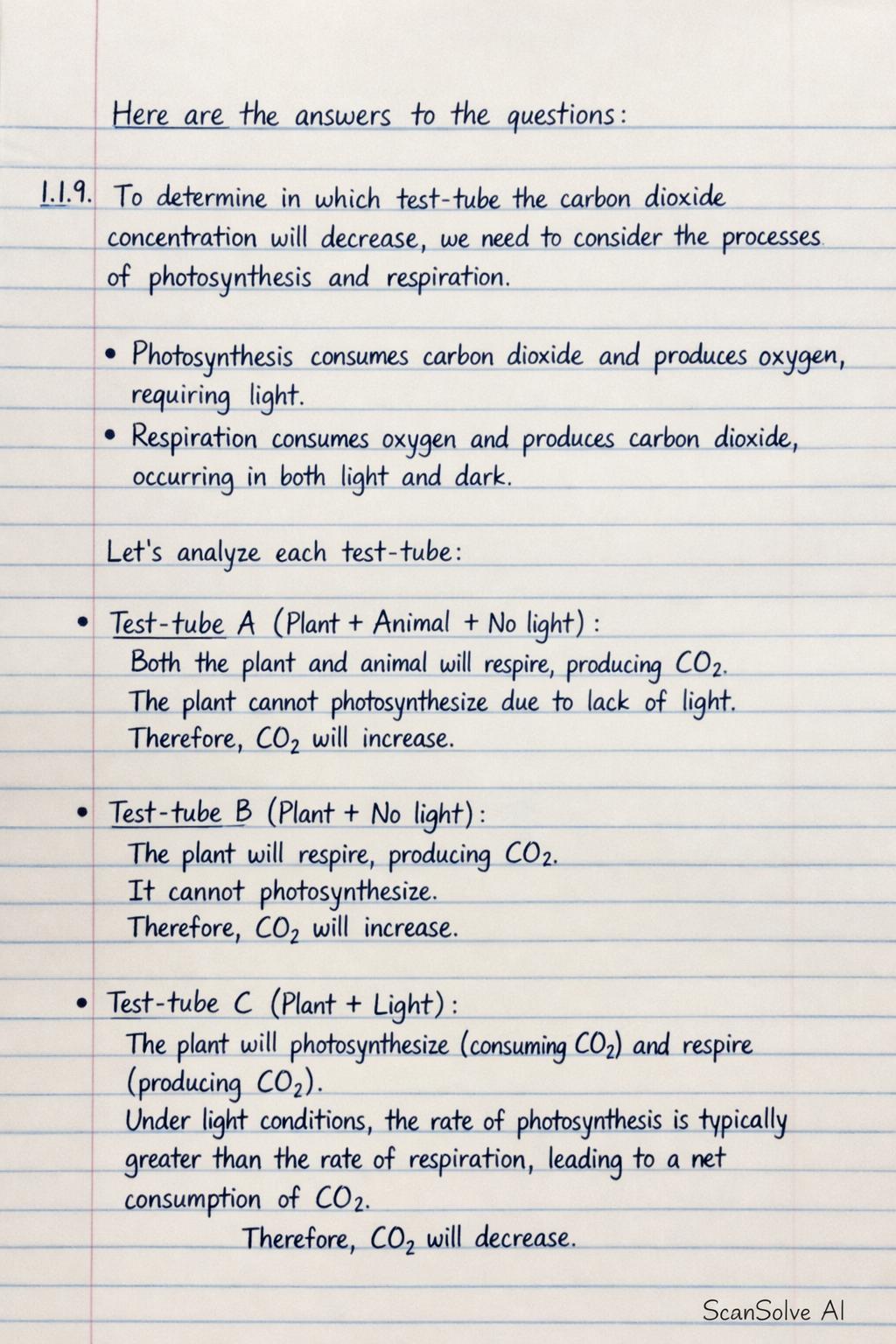
Here are the answers to the questions: 1.1.9. To determine in which test-tube the carbon dioxide concentration will decrease, we need to consider the processes of photosynthesis and respiration. Photosynthesis consumes carbon dioxide and produces oxygen, requiring light. Respiration consumes oxygen and produces carbon dioxide, occurring in both light and dark. Let's analyze each test-tube: Test-tube A (Plant + Animal + No light): Both the plant and animal will respire, producing CO_2. The plant cannot photosynthesize due to lack of light. Therefore, CO_2 will increase. Test-tube B (Plant + No light): The plant will respire, producing CO_2. It cannot photosynthesize. Therefore, CO_2 will increase. Test-tube C (Plant + Light): The plant will photosynthesize (consuming CO_2) and respire (producing CO_2). Under light conditions, the rate of photosynthesis is typically greater than the rate of respiration, leading to a net consumption of CO_2. Therefore, CO_2 will decrease. Test-tube D (Animal + Light): The animal will respire, producing CO_2. There is no plant to consume CO_2. Therefore, CO_2 will increase. Thus, the carbon dioxide concentration will decrease in test-tube C. C 1.2. 1.2.1. A plant body with no true roots, stem and leaves: Thallus 1.2.2. A symbiotic relationship where both organisms benefit: Mutualism 1.2.3. Reproduction which uses non-reproductive parts of a plant to produce new plants: Vegetative propagation 1.2.4. The collective name for a filament and an anther: Stamen 1.2.5. Organic component of soil, formed by the decomposition of leaves and other plant material by soil microorganisms: Humus 1.2.6. The type of animal that does not have a backbone: Invertebrate 1.2.7. Tissue that transports water in plants: Xylem 1.2.8. An underground stem in ferns: Rhizome 1.2.9. The incorporation of absorbed nutrients into the cells of the body: Assimilation 1.2.10. The process of producing ATP without oxygen: Anaerobic respiration Last free one today — make it count tomorrow, or type /upgrade for unlimited.