
We read your photo as:
Describe the test for carbon dioxide gas, including procedure, observations, and conclusion. Also, identify hazard symbols and associated chemicals.
ScanSolve AI Answer
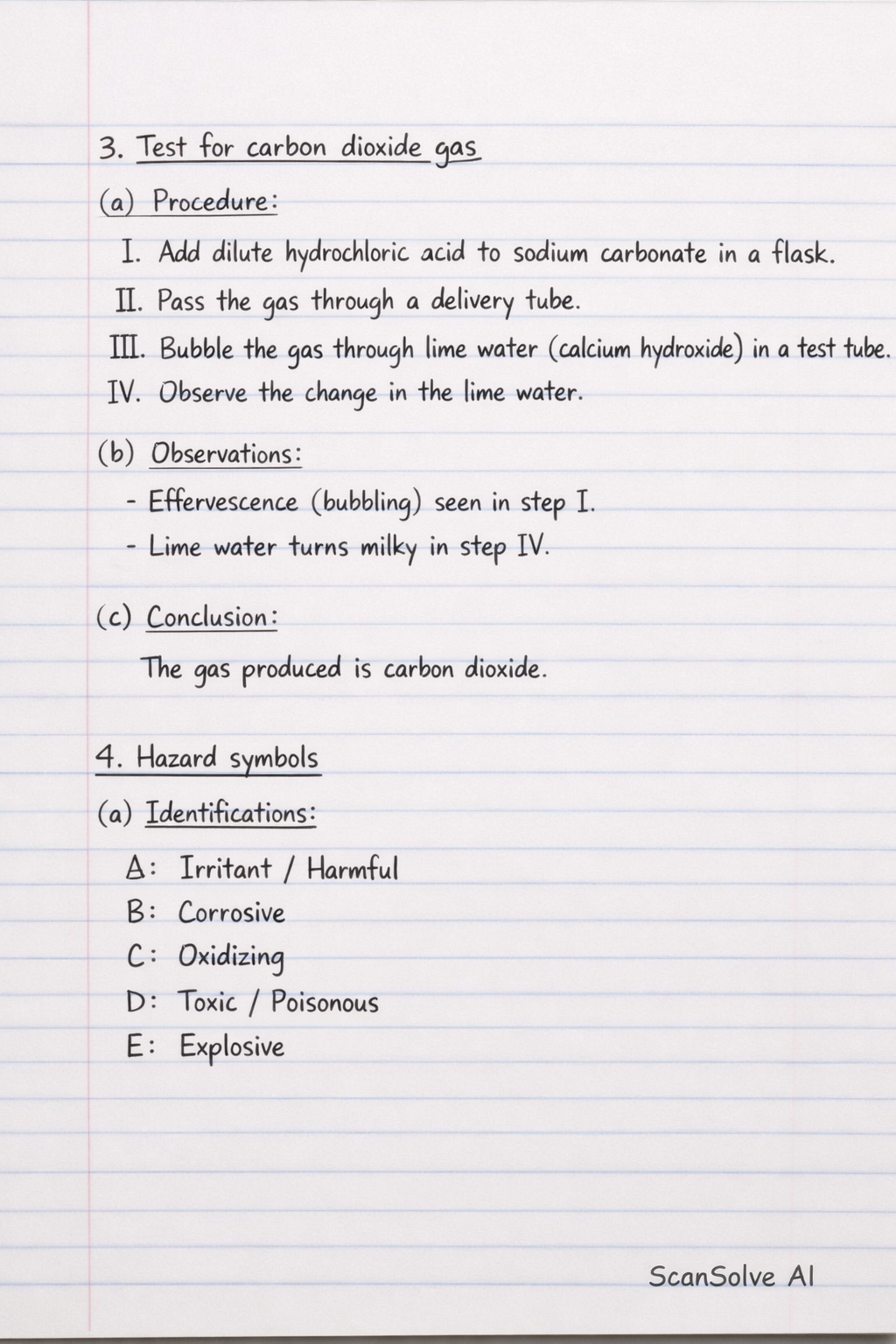
Here are the procedures, observations, and conclusions for question 3, and the hazard symbol identifications and associated chemicals for question 4.
3. Test for carbon dioxide gas
a) Write out the procedure used by the student in each of the steps:
- I. Add dilute hydrochloric acid to sodium carbonate in a flask.
- II. Pass the gas produced through a delivery tube.
- III. Bubble the gas through lime water (calcium hydroxide solution) in a test tube.
- IV. Observe the change in the lime water.
b) Give two (2) observations made in the test:
- • Effervescence (fizzing/gas bubbles) is observed in step I.
- • The lime water turns milky/cloudy in step IV.
c) Write the conclusion drawn from the test:
The gas produced is carbon dioxide.
4. Hazard symbols
a) Identify each of the symbols labelled A, B, C, D and E:
- A: Irritant / Harmful
- B: Corrosive
- C: Oxidizing
- D: Toxic / Poisonous
- E: Explosive
b) Name two (2) chemicals which can be associated with each symbol A, B, C, D and E:
- A (Irritant/Harmful): Ethanol, Acetone
- B (Corrosive): Concentrated hydrochloric acid, Sodium hydroxide
- C (Oxidizing): Hydrogen peroxide, Potassium permanganate
- D (Toxic/Poisonous): Potassium cyanide, Methanol
- E (Explosive): Nitroglycerin, TNT
c) State two (2) safety precautions that should be taken when handling chemicals with symbol C:
- • Keep away from flammable materials and heat sources.
- • Store in a cool, well-ventilated area, and wear appropriate personal protective equipment (PPE) such as gloves and eye protection.
Still stuck on this one?
Ask a follow-up, and the answer starts from this question.
More Chemistry Questions
Handwritten Step-by-Step Solution
Get this as a handwritten image on WhatsApp — like a tutor wrote it for you.
Try on WhatsApp