
We read your photo as:
Describe the chemical tests to identify carbon dioxide, ammonia, and hydrogen sulfide.
Chemistry
ScanSolve AI Answer
Step-by-step solution
6 stepshere are the chemical tests to identify the given gases:
1) Identification of Carbon Dioxide ()
Pass the gas through limewater (calcium hydroxide solution).
Observe the change.
Carbon dioxide turns limewater milky due to the formation of insoluble calcium carbonate.
2) Identification of Ammonia ()
Bring a glass rod dipped in concentrated hydrochloric acid () near the gas.
Observe the change.
Ammonia reacts with hydrogen chloride gas (from the concentrated ) to form dense white fumes of ammonium chloride.
3) Identification of Hydrogen Sulfide ()
Pass the gas through lead(II) acetate paper (or solution).
Observe the change.
Hydrogen sulfide turns lead(II) acetate paper black due to the formation of lead(II) sulfide.
Was this helpful?
Still stuck on this one?
Ask a follow-up, and the answer starts from this question.
Got a different question?Ask your own question
More Chemistry Questions
QDescribe the test for carbon dioxide gas, including procedure, observations, and conclusion. Also…QIdentify the metal sulphide used to prepare hydrogen sulphide gas, write the equation for its…QPlease provide the procedure, observations, and conclusion for a test identifying carbon dioxide…QHow can you test for the presence of sulfite and carbonate radicals in a sample?QThe problem describes a series of chemical tests performed on a mixture C, which contains an…
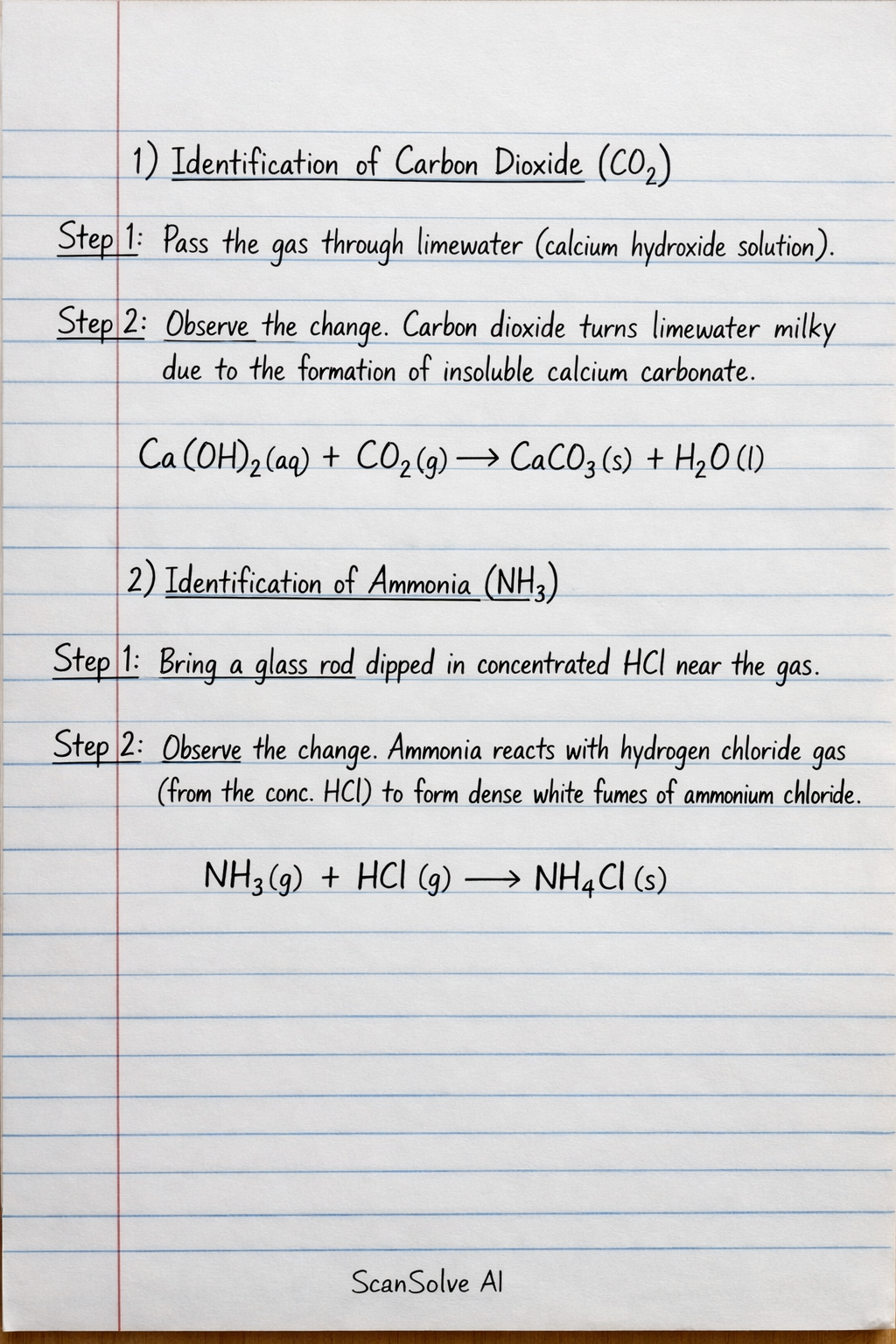
Handwritten Step-by-Step Solution
Get this as a handwritten image on WhatsApp — like a tutor wrote it for you.
Try on WhatsApp