

This chemistry question involves key chemical concepts and calculations. The detailed solution below walks through each step, from identifying the reaction type to computing the final answer.
ScanSolve AI Answer
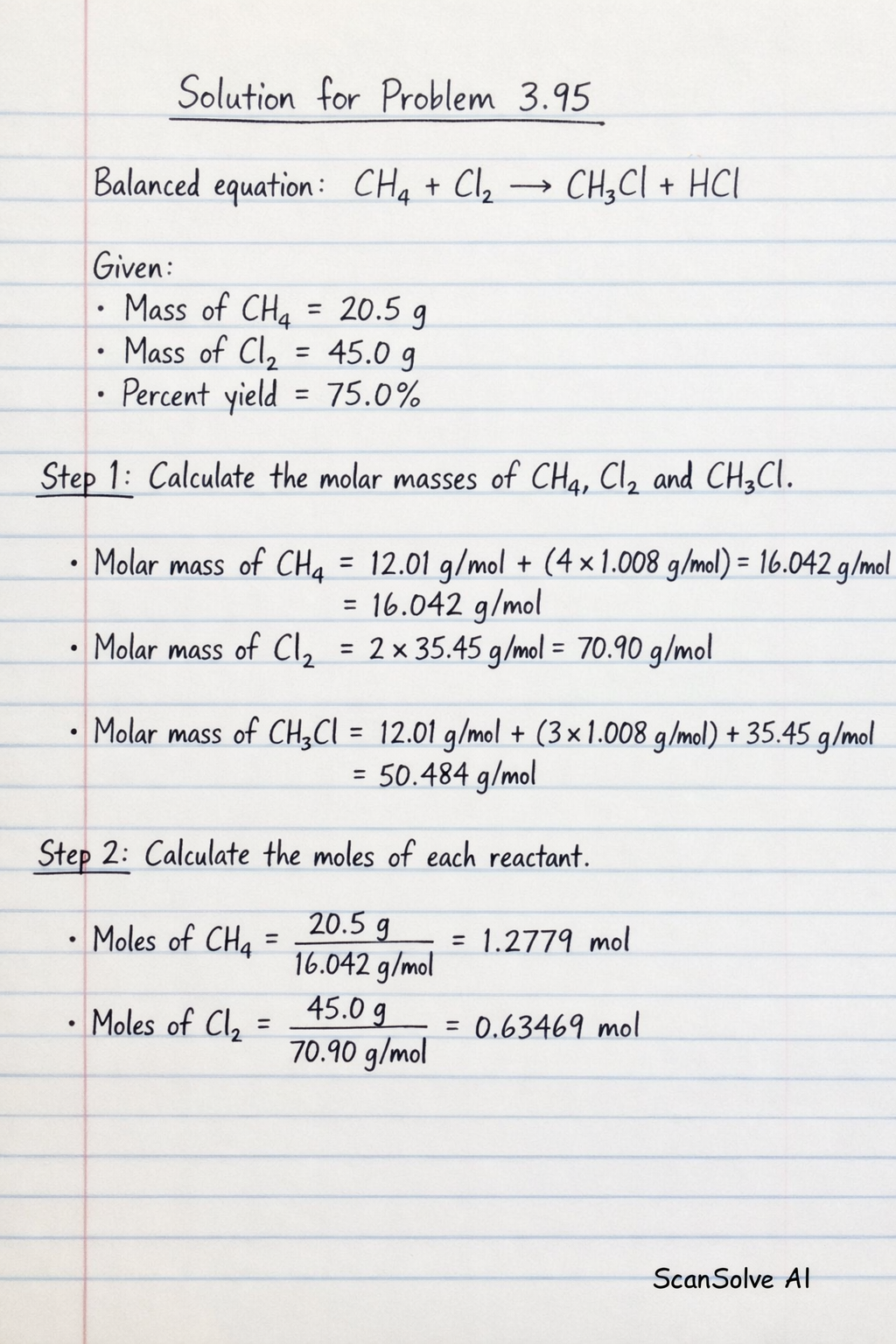
Here's the solution for problem 3.95. Problem 3.95: Mass of Chloromethane Produced The balanced chemical equation for the reaction is: CH_4(g) + Cl_2(g) CH_3Cl(g) + HCl(g) Given: Mass of CH_4 = 20.5 g Mass of Cl_2 = 45.0 g Percent yield = 75.0\% Step 1: Calculate the molar masses of CH_4, Cl_2, and CH_3Cl. Molar mass of CH_4 = 12.01 g/mol (C) + (4 × 1.008 g/mol (H)) = 16.042 g/mol Molar mass of Cl_2 = 2 × 35.45 g/mol (Cl) = 70.90 g/mol Molar mass of CH_3Cl = 12.01 g/mol (C) + (3 × 1.008 g/mol (H)) + 35.45 g/mol (Cl) = 50.484 g/mol Step 2: Calculate the moles of each reactant. moles of CH_4 = 20.5 g16.042 g/mol = 1.2779 mol moles of Cl_2 = 45.0 g70.90 g/mol = 0.63469 mol Step 3: Determine the limiting reactant. From the balanced equation, 1 mol of CH_4 reacts with 1 mol of Cl_2. To react all 1.2779 mol of CH_4, we would need 1.2779 mol of Cl_2. Since we only have 0.63469 mol of Cl_2, chlorine (Cl_2) is the limiting reactant. Step 4: Calculate the theoretical moles of CH_3Cl produced from the limiting reactant. From the balanced equation, 1 mol of Cl_2 produces 1 mol of CH_3Cl. theoretical moles of CH_3Cl = 0.63469 mol Cl_2 × 1 mol CH_3Cl1 mol Cl_2 = 0.63469 mol CH_3Cl Step 5: Calculate the theoretical mass (yield) of CH_3Cl. theoretical mass of CH_3Cl = 0.63469 mol × 50.484 g/mol = 32.049 g Step 6: Calculate the actual mass of CH_3Cl using the given percent yield. Actual Yield = Theoretical Yield × Percent Yield100\% Actual Yield = 32.049 g × (75.0\%)/(100\%) = 32.049 g × 0.750 = 24.03675 g Rounding to three significant figures: 24.0 g 3 done, 2 left today. You're making progress.