
We read your photo as:
The most common enzyme deficiency in congenital adrenal hyperplasia
ScanSolve AI Answer
Answer
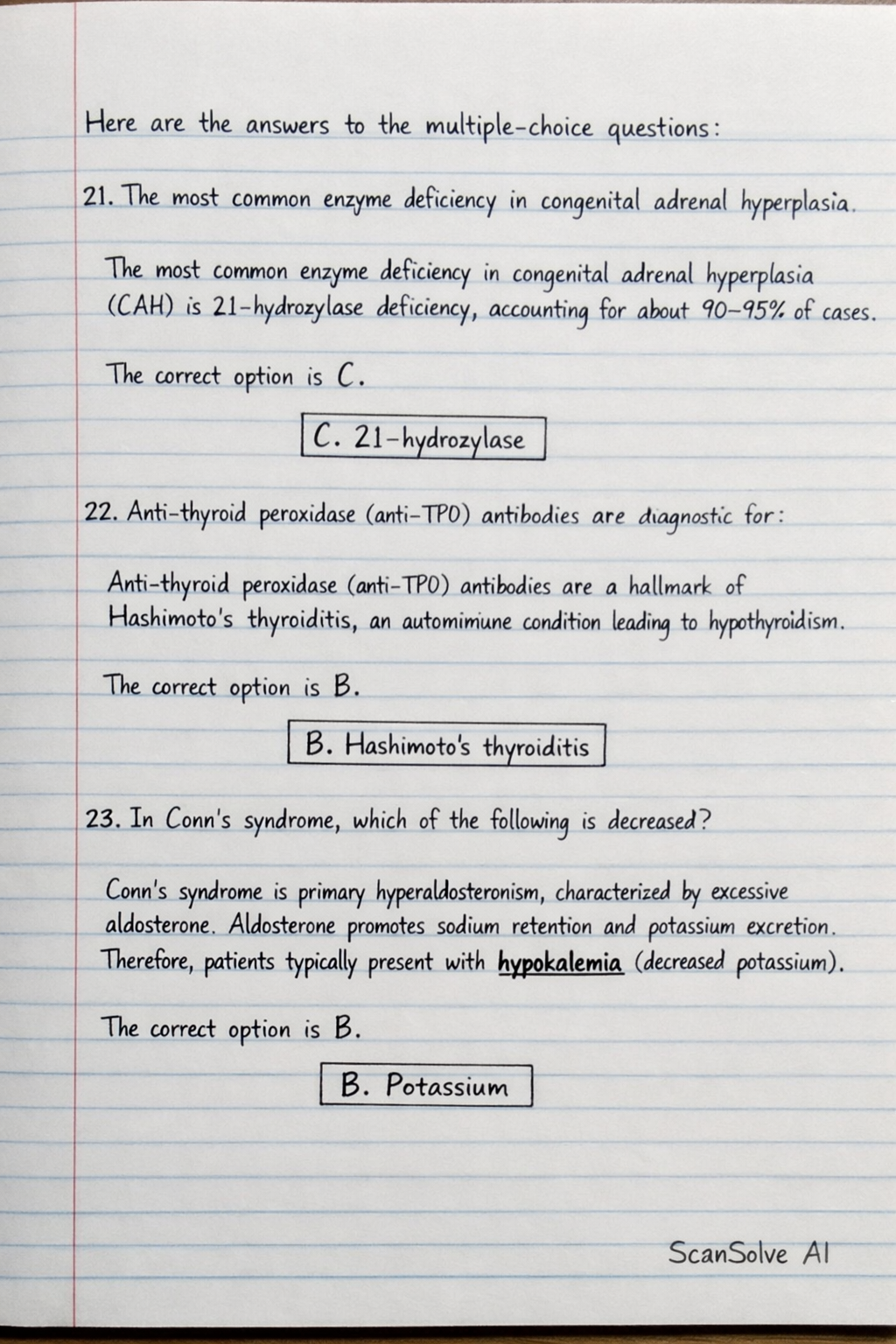
Here are the answers to the multiple-choice questions:
21. The most common enzyme deficiency in congenital adrenal hyperplasia
The most common enzyme deficiency in congenital adrenal hyperplasia (CAH) is 21-hydroxylase deficiency, accounting for about of cases.
The correct option is C.
22. Anti-thyroid peroxidase (anti-TPO) antibodies are diagnostic for:
Anti-thyroid peroxidase (anti-TPO) antibodies are a hallmark of Hashimoto's thyroiditis, an autoimmune condition leading to hypothyroidism.
The correct option is B.
23. In Conn's syndrome, which of the following is decreased?
Conn's syndrome is primary hyperaldosteronism, characterized by excessive aldosterone. Aldosterone promotes sodium retention and potassium excretion. Therefore, patients typically present with hypokalemia (decreased potassium).
The correct option is B.
24. A patient with Addison's disease is likely to show:
Addison's disease is primary adrenal insufficiency, leading to decreased cortisol and aldosterone. Decreased cortisol causes hypoglycemia. Decreased aldosterone causes sodium loss (hyponatremia) and potassium retention (hyperkalemia).
The correct option is A.
25. Damage to the pituitary stalk leads to increased:
The pituitary stalk contains blood vessels and nerve fibers connecting the hypothalamus to the pituitary. Dopamine, an inhibitory hormone for prolactin, is transported via this stalk. Damage to the stalk interrupts this inhibitory pathway, leading to a loss of tonic inhibition on prolactin secretion, thus causing increased prolactin levels.
The correct option is C.
Try one yourself
A new problem that tests the same skill.
Still stuck on this one?
Ask a follow-up, and the answer starts from this question.
More Chemistry Questions
Handwritten Step-by-Step Solution
Get this as a handwritten image on WhatsApp — like a tutor wrote it for you.
Try on WhatsApp