

This chemistry question involves key chemical concepts and calculations. The detailed solution below walks through each step, from identifying the reaction type to computing the final answer.
ScanSolve AI Answer
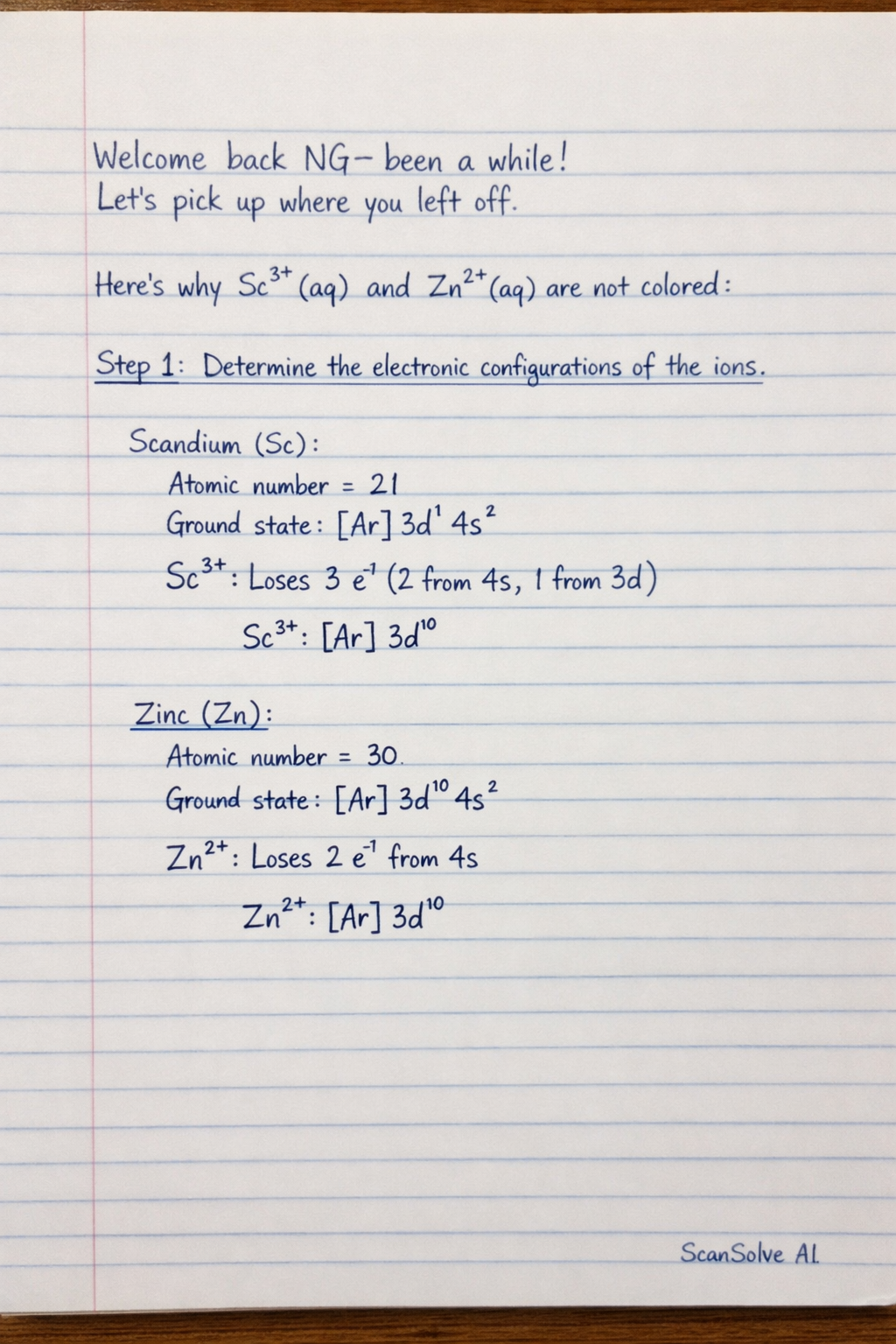
Here's why Sc^3+(aq) and Zn^2+(aq) are not colored: Step 1: Determine the electronic configurations of the ions. Scandium (Sc) has an atomic number of 21. Its ground state electronic configuration is [Ar] 3d^1 4s^2. When Sc forms Sc^3+, it loses all three valence electrons (two from 4s and one from 3d). Sc^3+: [Ar] 3d^0 Zinc (Zn) has an atomic number of 30. Its ground state electronic configuration is [Ar] 3d^10 4s^2. When Zn forms Zn^2+, it loses its two 4s valence electrons. Zn^2+: [Ar] 3d^10 Step 2: Explain the condition for color in transition metal ions. Transition metal ions are colored when they have partially filled d-orbitals, allowing for d-d electronic transitions. In these transitions, electrons absorb specific wavelengths of visible light to jump from a lower energy d-orbital to a higher energy d-orbital. The remaining unabsorbed light is transmitted, giving the ion its observed color. Step 3: Apply the condition to Sc^3+ and Zn^2+. Sc^3+ has a d^0 configuration, meaning it has no d-electrons* to undergo d-d transitions. Zn^2+ has a d^10 configuration, meaning its d-orbitals are completely filled*. There are no vacant higher-energy d-orbitals for electrons to jump into, so d-d transitions cannot occur. Step 4: Conclude why they are colorless. Since neither Sc^3+ nor Zn^2+ can undergo d-d electronic transitions, they do not absorb visible light and therefore appear colorless. The final answer is Sc^3+ has a d^0 configuration and Zn^2+ has a d^10 configuration. Neither can undergo d-d electronic transitions, so they are colorless.. Send me the next one 📸