This chemistry question involves key chemical concepts and calculations. The detailed solution below walks through each step, from identifying the reaction type to computing the final answer.
ScanSolve AI Answer
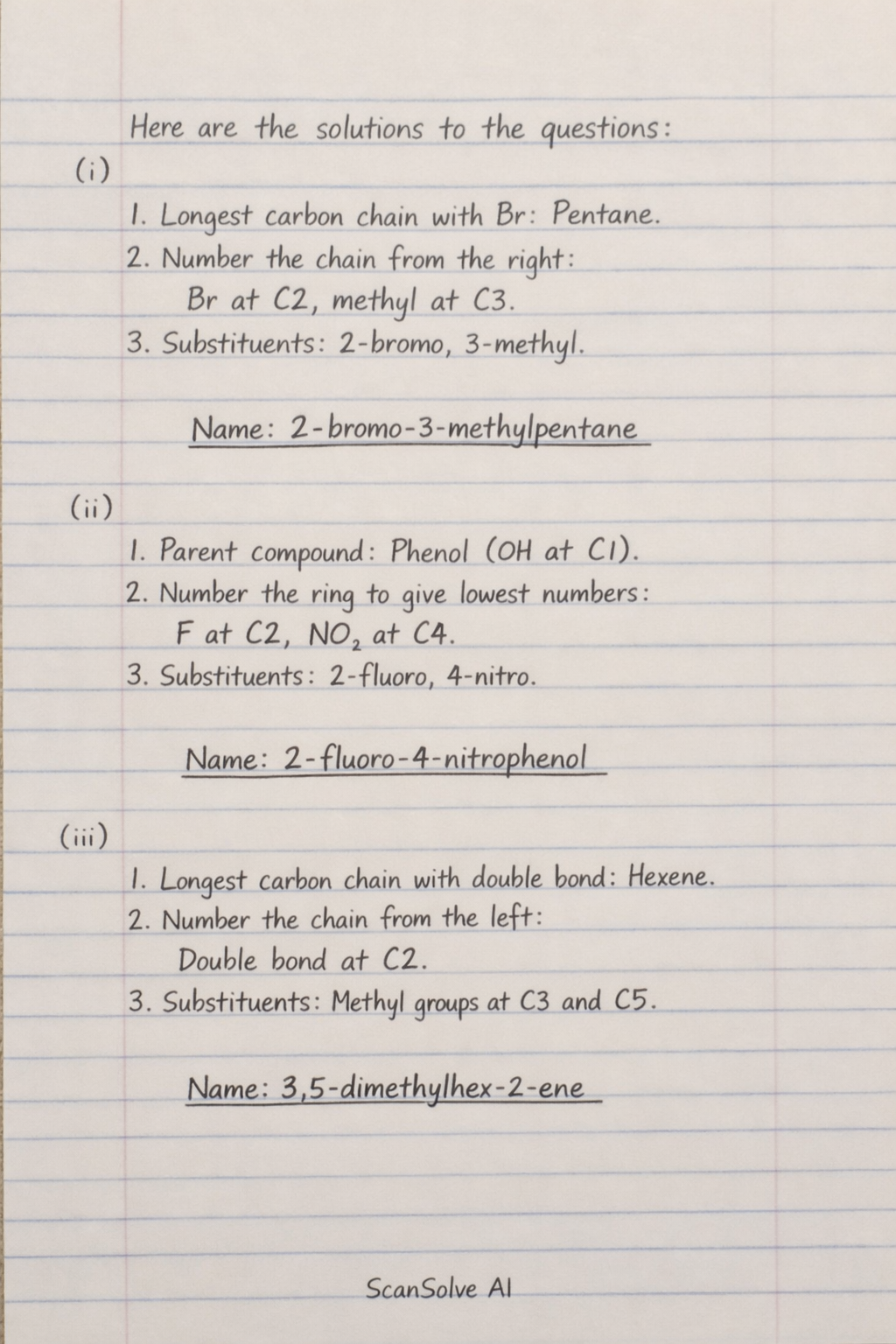
Here are the solutions to the questions:
3. Give the IUPAC name to the following compound (3 marks)
(i)
1. Identify the longest carbon chain containing the bromine atom: Pentane.
2. Number the chain to give the bromine the lowest possible number. Numbering from the right gives bromine at C2 and methyl at C3.
3. Substituents: 2-bromo, 3-methyl.
Name: 2-bromo-3-methylpentane*
(ii)
1. Identify the parent compound: Phenol (due to the -OH group, which is at C1).
2. Number the ring to give the other substituents the lowest possible numbers. Clockwise numbering from -OH gives F at C2 and NO2 at C4.
3. Substituents: 2-fluoro, 4-nitro.
Name: 2-fluoro-4-nitrophenol*
(iii)
1. Identify the longest carbon chain containing the double bond: Hexene.
2. Number the chain to give the double bond the lowest possible number. Numbering from the left gives the double bond at C2.
3. Substituents: Methyl groups at C3 and C5.
Name: 3,5-dimethylhex-2-ene*
4. Why are alkenes called olefins? (1 mark)
Alkenes are called olefins because early members of the series, such as ethene (ethylene), reacted with halogens to form oily products (e.g., ethylene dichloride). The term "olefin" comes from the Latin words "oleum" (oil) and "faciens" (making).
5. Which of the following compounds can exist as cis-trans (geometric) isomers? Draw them. (2 marks)
Cis-trans isomerism occurs in alkenes when each carbon of the double bond is attached to two different groups.
i. CH2=CBrCH3
The carbon on the left of the double bond (CH2) has two identical hydrogen atoms. Therefore, this compound cannot exhibit cis-trans isomerism.
ii. CHCl=CHBr
The carbon on the left (CHCl) has a hydrogen and a chlorine atom (different groups). The carbon on the right (CHBr) has a hydrogen and a bromine atom (different groups). Therefore, this compound can exist as cis-trans isomers.
Cis-isomer:
$$
\begin{array}{c}
\text{H} \\
\text{/ } \\
\text{C=C} \\
\text{\textbackslash } \\
\text{Cl}
\end{array}
\begin{array}{c}
\text{H} \\
\text{/ } \\
\text{ } \\
\text{\textbackslash } \\
\text{Br}
\end{array}
$$
cis-1-bromo-2-chloroethene
Trans-isomer:
$$
\begin{array}{c}
\text{H} \\
\text{/ } \\
\text{C=C} \\
\text{\textbackslash } \\
\text{Cl}
\end{array}
\begin{array}{c}
\text{Br} \\
\text{/ } \\
\text{ } \\
\text{\textbackslash } \\
\text{H}
\end{array}
$$
trans-1-bromo-2-chloroethene
6. What is the name of an ester prepared from butyl alcohol and propanoic acid? (1 mark)
The ester formed from butyl alcohol and propanoic acid is named by taking the alkyl group from the alcohol and the carboxylate name from the acid.
Butyl alcohol $\rightarrow$ butyl
Propanoic acid $\rightarrow$ propanoate
Name: Butyl propanoate*
7. How can you distinguish between the following (only by one chemical test)? (4 marks)
i. Acetone and acetaldehyde
Test: Tollens' test* (ammoniacal silver nitrate solution).
Observation:
Acetaldehyde* (an aldehyde) will give a positive result, forming a silver mirror on the inner surface of the test tube.
Acetone* (a ketone) will give a negative result, with no visible change.
ii. Primary, secondary and tertiary alcohols
Test: Lucas test* (a solution of concentrated HCl and anhydrous ZnCl2).
Observation:
Tertiary alcohols* react immediately, forming a cloudy solution (turbidity) due to the formation of an insoluble alkyl chloride.
Secondary alcohols* react more slowly, producing turbidity within 5-10 minutes.
Primary alcohols* do not react at room temperature, and the solution remains clear.
8. Why do carboxylic acids have higher boiling point than alcohols? (1 mark)
Carboxylic acids have higher boiling points than alcohols of comparable molecular weight because they can form dimers through two strong hydrogen bonds between two carboxylic acid molecules. This effectively doubles their molecular weight and requires significantly more energy to overcome these stronger intermolecular forces compared to the single hydrogen bonds typically formed between alcohol molecules.
9. Explain why ketones are considered less reactive than aldehydes (2 marks)
Ketones are less reactive than aldehydes towards nucleophilic addition reactions due to two main reasons:
Steric Hindrance: Ketones have two alkyl groups attached to the carbonyl carbon, while aldehydes have at least one smaller hydrogen atom. The bulkier alkyl groups in ketones create more steric hindrance, making it more difficult for nucleophiles to approach and attack the electrophilic carbonyl carbon.
Electronic Effects (Inductive Effect): Alkyl groups are electron-donating. In ketones, two electron-donating alkyl groups push electron density towards the carbonyl carbon, reducing its partial positive charge. This makes the carbonyl carbon less electrophilic and thus less attractive to nucleophiles compared to aldehydes, which have only one electron-donating alkyl group (or none in formaldehyde).
10. Give the products of the following reaction: (2 marks)
The reaction shown is the dehydration of ethanol using concentrated sulfuric acid at 180°C. This is an elimination reaction where water is removed from the alcohol to form an alkene.
$$
\text{CH}_3\text{CH}_2\text{OH} \xrightarrow{\text{conc. H}_2\text{SO}_4, 180^\circ\text{C}} \text{CH}_2=\text{CH}_2 + \text{H}_2\text{O}
$$
Product: Ethene
3. Give the IUPAC name to the following compound (3 marks)
|Chemistry
3. Give the IUPAC name to the following compound (3 marks)
ScanSolve AI Answer
Here are the solutions to the questions:
3. Give the IUPAC name to the following compound (3 marks)
(i)
Identify the longest carbon chain containing the bromine atom: Pentane.
Number the chain to give the bromine the lowest possible number. Numbering from the right gives bromine at C2 and methyl at C3.
Substituents: 2-bromo, 3-methyl.
Name: 2-bromo-3-methylpentane
(ii)
Identify the parent compound: Phenol (due to the -OH group, which is at C1).
Number the ring to give the other substituents the lowest possible numbers. Clockwise numbering from -OH gives F at C2 and NO2 at C4.
Substituents: 2-fluoro, 4-nitro.
Name: 2-fluoro-4-nitrophenol
(iii)
Identify the longest carbon chain containing the double bond: Hexene.
Number the chain to give the double bond the lowest possible number. Numbering from the left gives the double bond at C2.
Substituents: Methyl groups at C3 and C5.
Name: 3,5-dimethylhex-2-ene
4. Why are alkenes called olefins? (1 mark)
Alkenes are called olefins because early members of the series, such as ethene (ethylene), reacted with halogens to form oily products (e.g., ethylene dichloride). The term "olefin" comes from the Latin words "oleum" (oil) and "faciens" (making).
5. Which of the following compounds can exist as cis-trans (geometric) isomers? Draw them. (2 marks)
Cis-trans isomerism occurs in alkenes when each carbon of the double bond is attached to two different groups.
i. CH2=CBrCH3
The carbon on the left of the double bond (CH2) has two identical hydrogen atoms. Therefore, this compound cannot exhibit cis-trans isomerism.
ii. CHCl=CHBr
The carbon on the left (CHCl) has a hydrogen and a chlorine atom (different groups). The carbon on the right (CHBr) has a hydrogen and a bromine atom (different groups). Therefore, this compound can exist as cis-trans isomers.
Cis-isomer:
H/C=C\textbackslashClH/\textbackslashBr
cis-1-bromo-2-chloroethene
Trans-isomer:
H/C=C\textbackslashClBr/\textbackslashH
trans-1-bromo-2-chloroethene
6. What is the name of an ester prepared from butyl alcohol and propanoic acid? (1 mark)
The ester formed from butyl alcohol and propanoic acid is named by taking the alkyl group from the alcohol and the carboxylate name from the acid.
Butyl alcohol → butyl
Propanoic acid → propanoate
Name: Butyl propanoate
7. How can you distinguish between the following (only by one chemical test)? (4 marks)
i. Acetone and acetaldehyde
Test:Tollens' test (ammoniacal silver nitrate solution).
Observation:
Acetaldehyde (an aldehyde) will give a positive result, forming a silver mirror on the inner surface of the test tube.
Acetone (a ketone) will give a negative result, with no visible change.
ii. Primary, secondary and tertiary alcohols
Test:Lucas test (a solution of concentrated HCl and anhydrous ZnCl2).
Observation:
Tertiary alcohols react immediately, forming a cloudy solution (turbidity) due to the formation of an insoluble alkyl chloride.
Secondary alcohols react more slowly, producing turbidity within 5-10 minutes.
Primary alcohols do not react at room temperature, and the solution remains clear.
8. Why do carboxylic acids have higher boiling point than alcohols? (1 mark)
Carboxylic acids have higher boiling points than alcohols of comparable molecular weight because they can form dimers through two strong hydrogen bonds between two carboxylic acid molecules. This effectively doubles their molecular weight and requires significantly more energy to overcome these stronger intermolecular forces compared to the single hydrogen bonds typically formed between alcohol molecules.
9. Explain why ketones are considered less reactive than aldehydes (2 marks)
Ketones are less reactive than aldehydes towards nucleophilic addition reactions due to two main reasons:
Steric Hindrance: Ketones have two alkyl groups attached to the carbonyl carbon, while aldehydes have at least one smaller hydrogen atom. The bulkier alkyl groups in ketones create more steric hindrance, making it more difficult for nucleophiles to approach and attack the electrophilic carbonyl carbon.
Electronic Effects (Inductive Effect): Alkyl groups are electron-donating. In ketones, two electron-donating alkyl groups push electron density towards the carbonyl carbon, reducing its partial positive charge. This makes the carbonyl carbon less electrophilic and thus less attractive to nucleophiles compared to aldehydes, which have only one electron-donating alkyl group (or none in formaldehyde).
10. Give the products of the following reaction: (2 marks)
The reaction shown is the dehydration of ethanol using concentrated sulfuric acid at 180°C. This is an elimination reaction where water is removed from the alcohol to form an alkene.
CH3CH2OHconc.H2SO4,180\circCCH2=CH2+H2O
Product: Ethene
Need help with your own homework?
Get instant step-by-step solutions to any question. Free to start.