
We read your photo as:
4.7.1. This is a long term equilibrium for the business.
ScanSolve AI Answer
Here are the answers to your questions based on the provided graph:
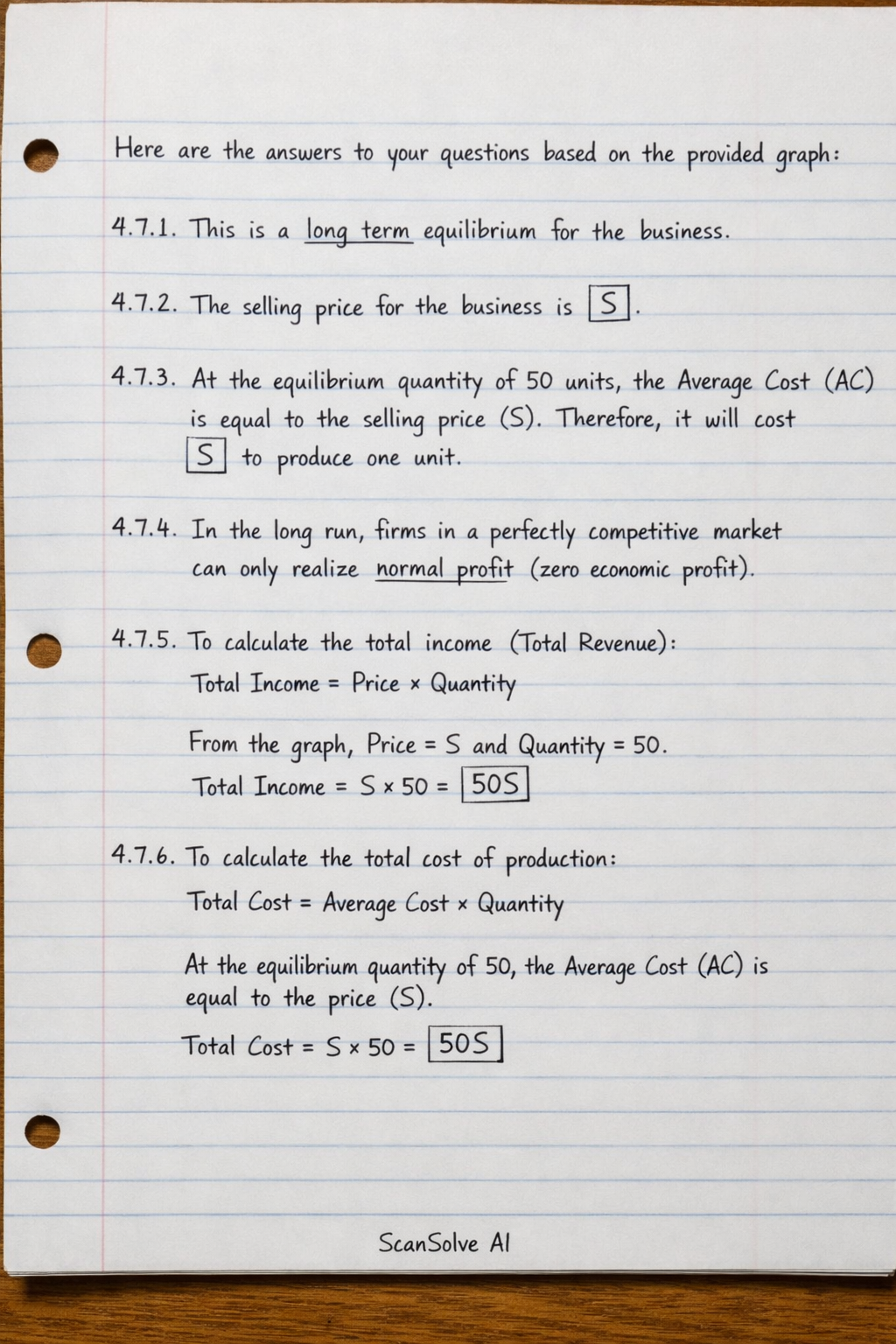
4.7.1. This is a long term equilibrium for the business.
4.7.2. The selling price for the business is .
4.7.3. At the equilibrium quantity of 50 units, the Average Cost (AC) is equal to the selling price (S). Therefore, it will cost to produce one unit.
4.7.4. In the long run, firms in a perfectly competitive market can only realize normal profit (zero economic profit).
4.7.5. To calculate the total income (Total Revenue):
From the graph, Price = S and Quantity = 50.
4.7.6. To calculate the total cost of production:
At the equilibrium quantity of 50, the Average Cost (AC) is equal to the price (S).
4.7.7.
- Short-term: A period in which at least one factor of production (e.g., capital) is fixed, while others (e.g., labor) are variable. Firms can adjust output by changing variable inputs.
- Long-term: A period in which all factors of production are variable. Firms can adjust their scale of operations, and new firms can enter or exit the industry.
4.7.8. Yes, this equilibrium can exist in the short term. In the short run, a firm in perfect competition can earn economic profit, incur economic losses, or earn normal profit. The graph shows a situation where the firm is earning normal profit (Price = Average Cost), which is a possible short-run equilibrium outcome.
4.7.9. In the long run, a business in a perfectly competitive market cannot realize economic profits or losses due to the assumption of free entry and exit of firms.
- If firms are earning economic profits, new firms will be attracted to enter the industry. This increases the overall market supply, which drives down the market price until economic profits are eliminated, and firms earn only normal profit.
- If firms are incurring economic losses, existing firms will exit the industry. This decreases the overall market supply, which drives up the market price until losses are eliminated, and firms again earn normal profit. This dynamic ensures that in the long run, firms in perfect competition will always earn only normal profit.
Still stuck on this one?
Ask a follow-up, and the answer starts from this question.
More Chemistry Questions
Handwritten Step-by-Step Solution
Get this as a handwritten image on WhatsApp — like a tutor wrote it for you.
Try on WhatsApp