
This chemistry question involves key chemical concepts and calculations. The detailed solution below walks through each step, from identifying the reaction type to computing the final answer.
ScanSolve AI Answer
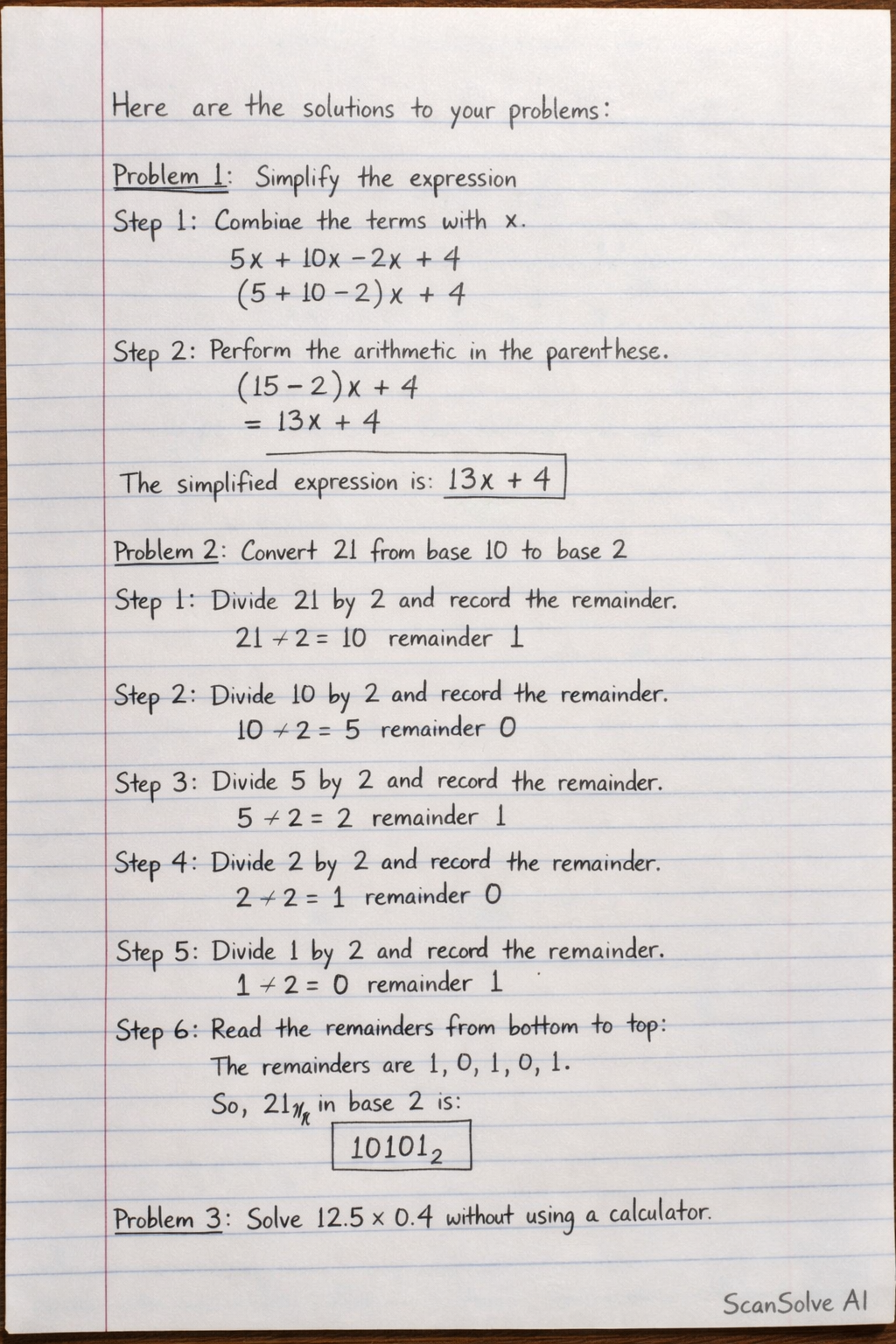
Here are the solutions to your problems: Problem 1: Simplify the expression Step 1: Combine the terms with x. 5x + 10x - 2x + 4 = (5 + 10 - 2)x + 4 Step 2: Perform the arithmetic within the parentheses. (5 + 10 - 2)x + 4 = (15 - 2)x + 4 = 13x + 4 The simplified expression is: 13x + 4 Problem 2: Convert 21 from base 10 to base 2 Step 1: Divide 21 by 2 and record the remainder. 21 ÷ 2 = 10 remainder 1 Step 2: Divide the quotient (10) by 2 and record the remainder. 10 ÷ 2 = 5 remainder 0 Step 3: Divide the quotient (5) by 2 and record the remainder. 5 ÷ 2 = 2 remainder 1 Step 4: Divide the quotient (2) by 2 and record the remainder. 2 ÷ 2 = 1 remainder 0 Step 5: Divide the quotient (1) by 2 and record the remainder. 1 ÷ 2 = 0 remainder 1 Step 6: Read the remainders from bottom to top to get the base 2 number. The remainders are 1, 0, 1, 0, 1. So, 21_10 in base 2 is: 10101_2 Problem 3: Solve 12.5 × 0.4 without using a calculator Step 1: Multiply the numbers as if they were whole numbers, ignoring the decimal points for now. 125 × 4 Step 2: Perform the multiplication. 125 × 4 = 500 Step 3: Count the total number of decimal places in the original numbers. 12.5 has one decimal place. 0.4 has one decimal place. Total decimal places = 1 + 1 = 2. Step 4: Place the decimal point in the product (500) two places from the right. 5.00 5.00 = 5 The product is: 5