
We read your photo as:
A student represented an atom of element J using the diagram below.
ScanSolve AI Answer
Step-by-step solution
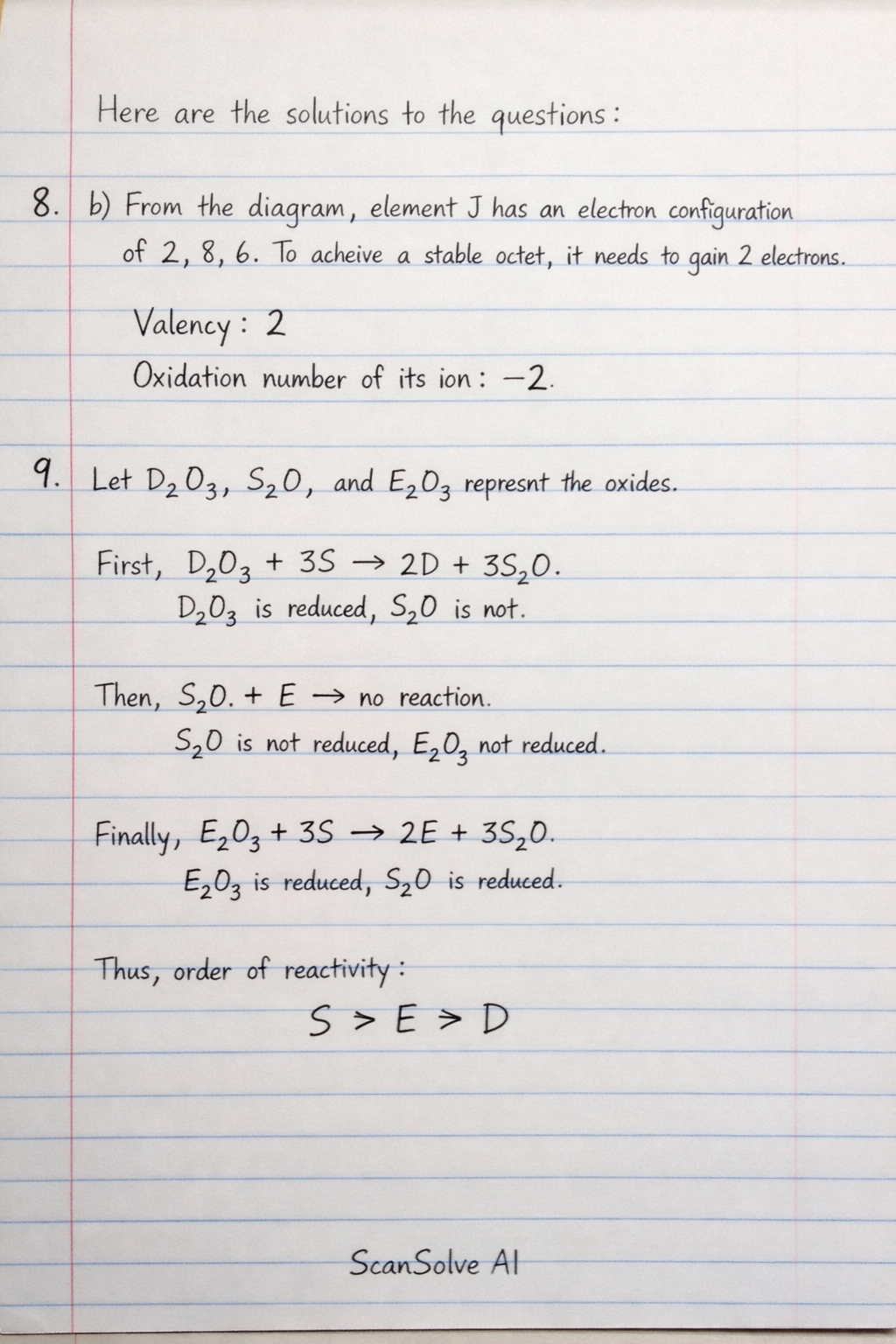
4 stepsHere are the solutions to the questions:
8. A student represented an atom of element J using the diagram below.
b) Write the valency of element J and the oxidation number of its ion.
- From the diagram, element J has an electron configuration of 2, 8, 6. To achieve a stable octet, it needs to gain 2 electrons.
- Valency: 2
- Oxidation number of its ion: -2
9. When the oxide of metal D is heated in the presence of metal S, the oxide is reduced. The oxide of metal S is not reduced when heated together with metal E and with metal D. The oxide of metal E is reduced by metal S and not by metal D. Arrange the three metals horizontally, in their order of decreasing reactivity.
Let's deduce the reactivity order:
- "The oxide of metal D is heated in the presence of metal S, the oxide is reduced." This means metal S is more reactive than metal D. ()
- "The oxide of metal S is not reduced when heated together with metal E and with metal D." This means metal S is more reactive than both metal E and metal D. ( and )
- "The oxide of metal E is reduced by metal S and not by metal D." This confirms . It also means metal D is not reactive enough to reduce the oxide of E, so metal E is more reactive than metal D. ()
Combining these, the order of decreasing reactivity is:
S > E > D
10. Calculate the number of nitrogen atoms that are found in 1.4g of nitrogen gas (N = 14, L = 6.023 x 10^23)
Determine the molar mass of nitrogen gas ().
Nitrogen gas is diatomic, so its formula is .
Molar mass of
Molar mass ofCalculate the number of moles of nitrogen gas.
Calculate the number of nitrogen gas molecules.
Calculate the number of nitrogen atoms.
Each molecule contains 2 nitrogen atoms.
11. Give the name of the processes that occur when the following substances are left in open watch glasses overnight:
a) Concentrated sulphuric (VI) acid
Hygroscopy (or absorption of water vapor)b) Sodium carbohydrate decahydrate
Assuming "Sodium carbohydrate decahydrate" is a typo and refers to Sodium carbonate decahydrate ():
Efflorescence
Still stuck on this one?
Ask a follow-up, and the answer starts from this question.
More Chemistry Questions
Handwritten Step-by-Step Solution
Get this as a handwritten image on WhatsApp — like a tutor wrote it for you.
Try on WhatsApp