
Can you give me a brief understand if the notation of isotope,I don't quite understand
Chemistry
ScanSolve AI Answer
Answer
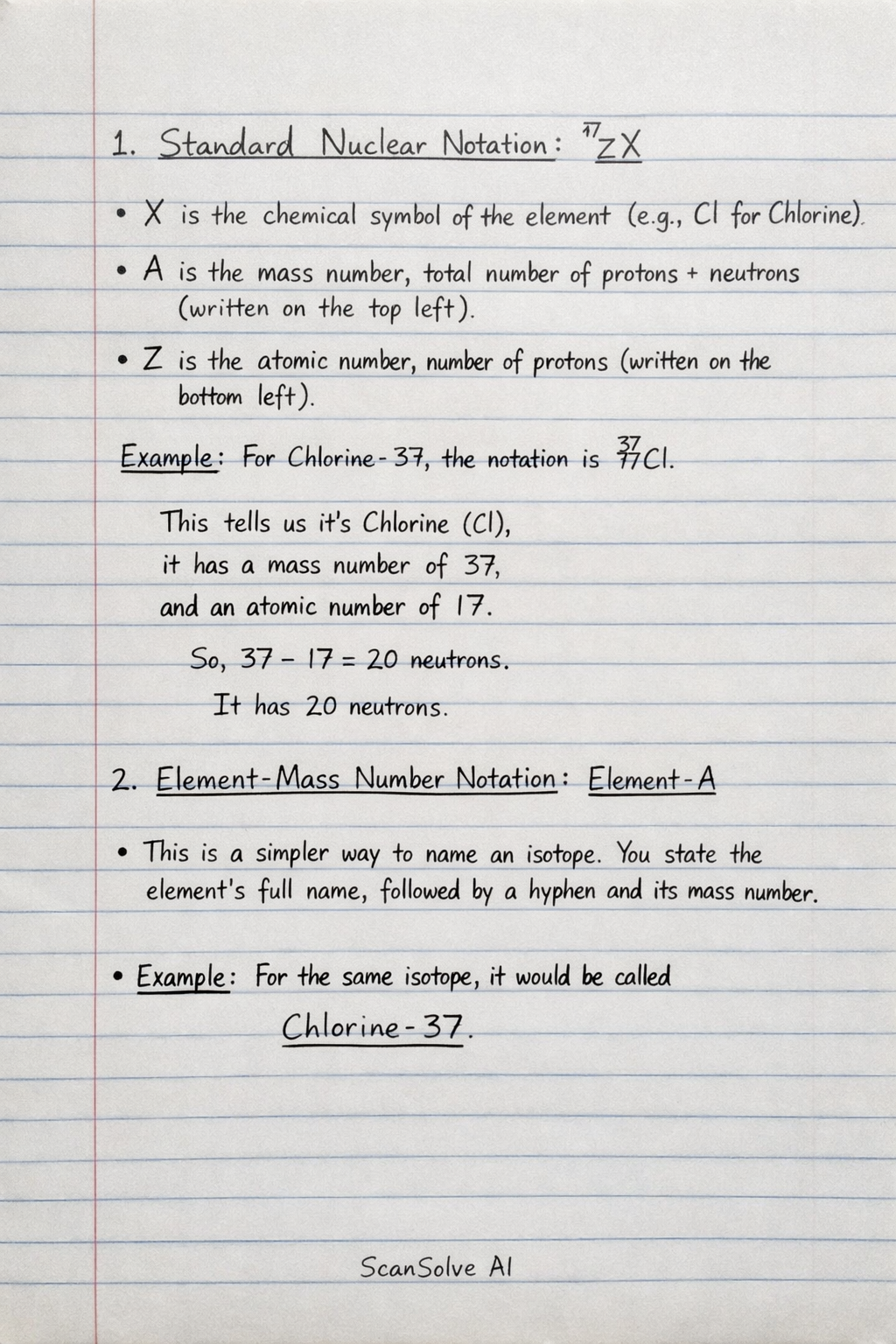
The notation for an isotope is typically written in two main ways:
-
Standard Nuclear Notation:
- is the chemical symbol of the element (e.g., Cl for Chlorine).
- is the mass number, which is the total number of protons and neutrons in the nucleus. It's written as a superscript on the top left.
- is the atomic number, which is the number of protons in the nucleus. It's written as a subscript on the bottom left.
Example: For Chlorine-37, the notation is . This tells us it's Chlorine (Cl), it has a mass number of 37, and an atomic number of 17 (meaning 17 protons). From this, we can deduce it has neutrons.
-
Element-Mass Number Notation:
- This is a simpler way to name an isotope. You state the element's full name, followed by a hyphen and its mass number.
Example: For the same isotope, it would be called Chlorine-37.
Was this helpful?
Try one yourself
A new problem that tests the same skill.
Still stuck on this one?
Ask a follow-up, and the answer starts from this question.
Got a different question?Ask your own question
More Chemistry Questions
Handwritten Step-by-Step Solution
Get this as a handwritten image on WhatsApp — like a tutor wrote it for you.
Try on WhatsApp