We read your photo as:

A) Construct the balanced chemical equation for the reaction.

Chemistry

ScanSolve AI Answer

Step-by-step solution

3 steps

Here's a step-by-step solution to your chemistry problem:

Part a

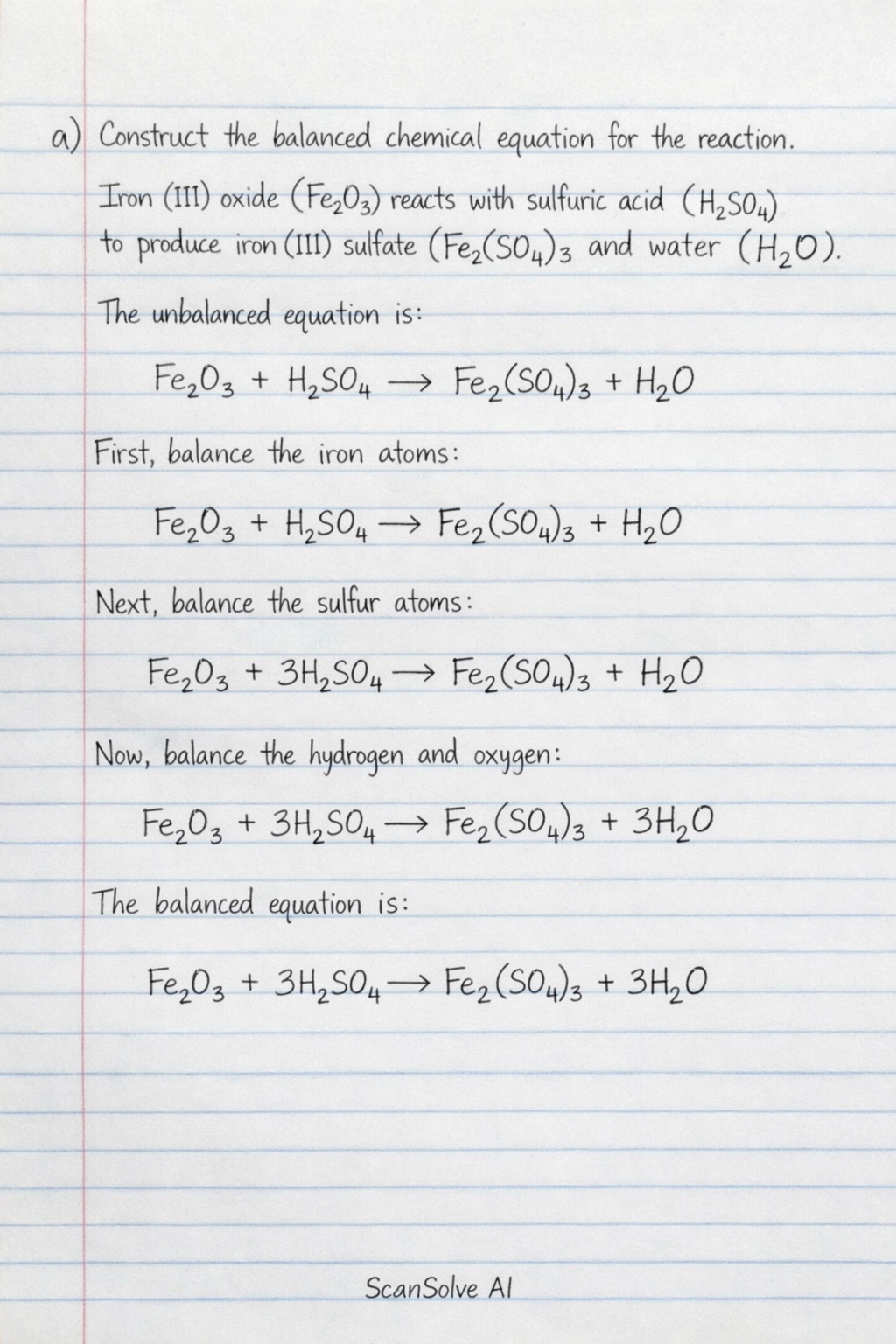
**Construct the balanced chemical equation for the reaction.

Iron (III) oxide (Fe2O3\text{Fe}_2\text{O}_3) reacts with sulfuric acid (H2SO4\text{H}_2\text{SO}_4) to produce iron (III) sulfate (Fe2(SO4)3\text{Fe}_2(\text{SO}_4)_3) and water (H2O\text{H}_2\text{O}).

The unbalanced equation is:
Fe2O3+H2SO4→Fe2(SO4)3+H2O\text{Fe}_2\text{O}_3 + \text{H}_2\text{SO}_4 \rightarrow \text{Fe}_2(\text{SO}_4)_3 + \text{H}_2\text{O}

To balance the equation:

  1. Balance Fe: There are 2 Fe atoms on both sides.
  2. Balance SO4\text{SO}_4 groups: There is 1 SO4\text{SO}_4 group on the left and 3 on the right. Place a coefficient of 3 in front of H2SO4\text{H}_2\text{SO}_4. Fe2O3+3H2SO4→Fe2(SO4)3+H2O\text{Fe}_2\text{O}_3 + 3\text{H}_2\text{SO}_4 \rightarrow \text{Fe}_2(\text{SO}_4)_3 + \text{H}_2\text{O}
  3. Balance H atoms: There are 3×2=63 \times 2 = 6 H atoms on the left. Place a coefficient of 3 in front of H2O\text{H}_2\text{O}. Fe2O3+3H2SO4→Fe2(SO4)3+3H2O\text{Fe}_2\text{O}_3 + 3\text{H}_2\text{SO}_4 \rightarrow \text{Fe}_2(\text{SO}_4)_3 + 3\text{H}_2\text{O}
  4. Check O atoms (excluding those in SO4\text{SO}_4): There are 3 O atoms in Fe2O3\text{Fe}_2\text{O}_3 on the left and 3 O atoms in 3H2O3\text{H}_2\text{O} on the right. The equation is balanced.

The balanced chemical equation is:

Fe2O3+3H2SO4→Fe2(SO4)3+3H2O\boxed{\text{Fe}_2\text{O}_3 + 3\text{H}_2\text{SO}_4 \rightarrow \text{Fe}_2(\text{SO}_4)_3 + 3\text{H}_2\text{O}}

Part b(i)· 3 steps

**Calculate the mass of the pure oxide that reacted with the acid.

  1. Calculate the moles of sulfuric acid reacted.

    Given:
    Volume of H2SO4=600 cm3=0.600 dm3\text{H}_2\text{SO}_4 = 600 \, \text{cm}^3 = 0.600 \, \text{dm}^3
    Concentration of H2SO4=0.100 mol/dm3\text{H}_2\text{SO}_4 = 0.100 \, \text{mol/dm}^3

    Moles of H2SO4=Concentration×Volume\text{Moles of H}_2\text{SO}_4 = \text{Concentration} \times \text{Volume} Moles of H2SO4=0.100 mol/dm3×0.600 dm3=0.0600 mol\text{Moles of H}_2\text{SO}_4 = 0.100 \, \text{mol/dm}^3 \times 0.600 \, \text{dm}^3 = 0.0600 \, \text{mol}
  2. Use stoichiometry to find the moles of pure iron (III) oxide reacted.

    From the balanced equation: 1 mol of Fe2O31 \, \text{mol of Fe}_2\text{O}_3 reacts with 3 mol of H2SO43 \, \text{mol of H}_2\text{SO}_4.
    The mole ratio of Fe2O3:H2SO4\text{Fe}_2\text{O}_3 : \text{H}_2\text{SO}_4 is 1:31:3.

    Moles of Fe2O3=Moles of H2SO4×13\text{Moles of Fe}_2\text{O}_3 = \text{Moles of H}_2\text{SO}_4 \times \frac{1}{3} Moles of Fe2O3=0.0600 mol×13=0.0200 mol\text{Moles of Fe}_2\text{O}_3 = 0.0600 \, \text{mol} \times \frac{1}{3} = 0.0200 \, \text{mol}
  3. Calculate the mass of pure iron (III) oxide.

    Molar mass of Fe2O3\text{Fe}_2\text{O}_3:
    M(Fe2O3)=(2×Ar of Fe)+(3×Ar of O)\text{M}(\text{Fe}_2\text{O}_3) = (2 \times \text{Ar of Fe}) + (3 \times \text{Ar of O})
    M(Fe2O3)=(2×55.8)+(3×16.0)=111.6+48.0=159.6 g/mol\text{M}(\text{Fe}_2\text{O}_3) = (2 \times 55.8) + (3 \times 16.0) = 111.6 + 48.0 = 159.6 \, \text{g/mol}

    Mass of Fe2O3=Moles×Molar Mass\text{Mass of Fe}_2\text{O}_3 = \text{Moles} \times \text{Molar Mass} Mass of Fe2O3=0.0200 mol×159.6 g/mol=3.192 g\text{Mass of Fe}_2\text{O}_3 = 0.0200 \, \text{mol} \times 159.6 \, \text{g/mol} = 3.192 \, \text{g}

    Rounding to 3 significant figures:

    Mass of pure oxide=3.19 g\text{Mass of pure oxide} = \boxed{3.19 \, \text{g}}

Part b(ii)

**Calculate the percentage (%) purity of iron (III) oxide assuming that the impurities did not react with the acid.

Given:
Total mass of impure iron (III) oxide = 4.00 g4.00 \, \text{g}
Mass of pure iron (III) oxide reacted = 3.192 g3.192 \, \text{g} (from part b(i))

Percentage purity=Mass of pure substanceTotal mass of impure substance×100%\text{Percentage purity} = \frac{\text{Mass of pure substance}}{\text{Total mass of impure substance}} \times 100\% Percentage purity=3.192 g4.00 g×100%\text{Percentage purity} = \frac{3.192 \, \text{g}}{4.00 \, \text{g}} \times 100\% Percentage purity=0.798×100%\text{Percentage purity} = 0.798 \times 100\% Percentage purity=79.8%\text{Percentage purity} = 79.8\%

Rounding to 3 significant figures:

Percentage purity=79.8%\text{Percentage purity} = \boxed{79.8\%}
Was this helpful?

Still stuck on this one?

Ask a follow-up, and the answer starts from this question.

Got a different question?Ask your own question
Handwritten step-by-step solution preview

Handwritten Step-by-Step Solution

Get this as a handwritten image on WhatsApp — like a tutor wrote it for you.

Try on WhatsApp