
We read your photo as:
Describe a simple test to distinguish between the two. ii) What is the coordination number and oxidation state of cobalt in each of the isomers above?
ScanSolve AI Answer
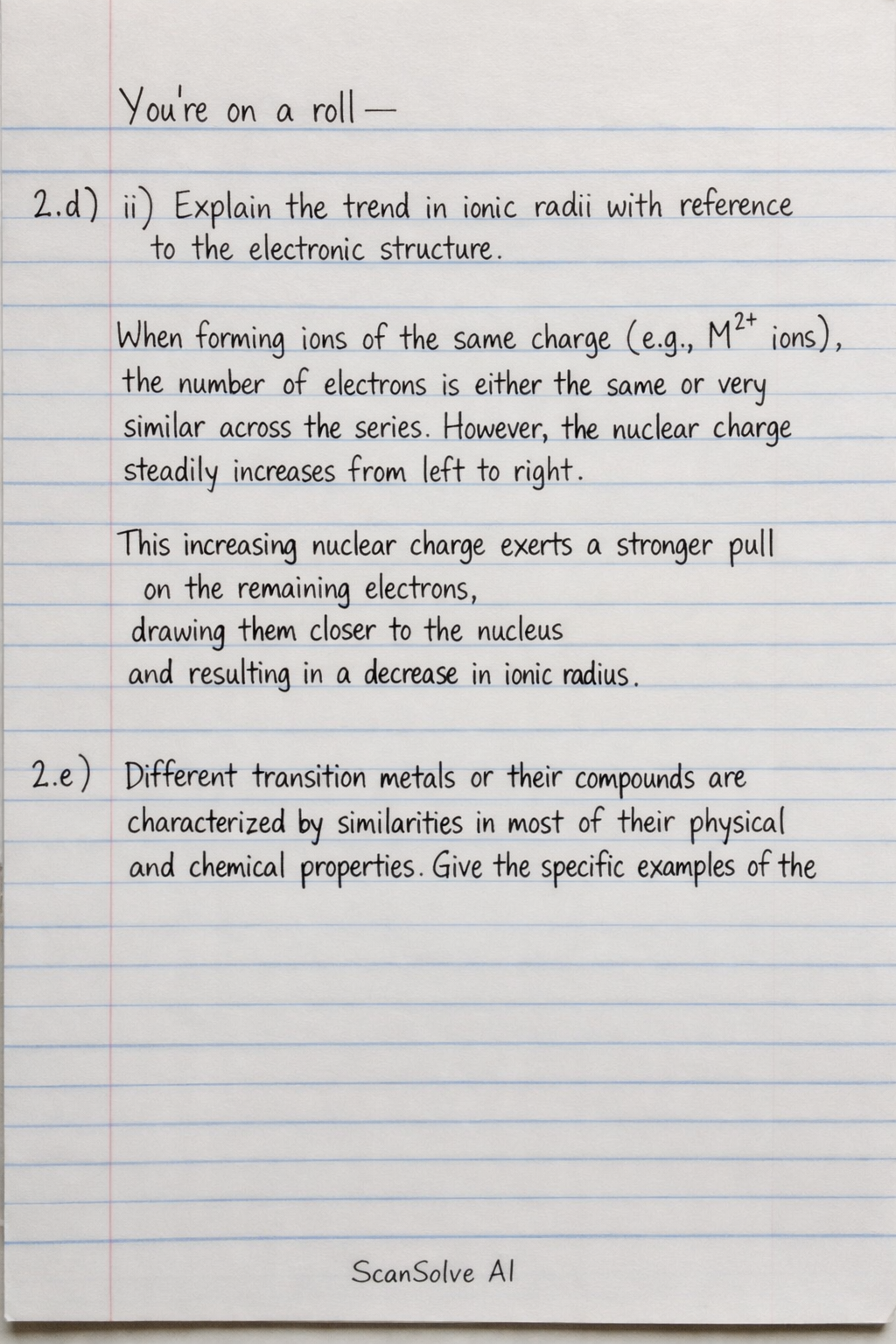
2.d) ii) Explain the trend in ionic radii with reference to the electronic structure.
When forming ions of the same charge (e.g., ions), the number of electrons is either the same or very similar across the series. However, the nuclear charge steadily increases from left to right. This increasing nuclear charge exerts a stronger pull on the remaining electrons, drawing them closer to the nucleus and resulting in a decrease in ionic radius.
2.e) Different transition metals or their compounds are characterized by similarities in most of their physical and chemical properties. Give the specific examples of the
2.e) i) Use of different transition metals colour of each ion.
- ions are typically blue (e.g., in solution).
- ions are typically pale green (e.g., in solution).
- ions are typically yellow/brown (e.g., in solution).
- ions are typically violet or green depending on ligands (e.g., in solution).
- ions are typically pink (e.g., in solution).
2.e) ii) Coloured ions specifying the colour of each ion.
This is similar to the previous point, providing more examples:
- ions are green (e.g., in solution).
- (permanganate) ions are intense purple.
- (dichromate) ions are orange.
- (vanadyl) ions are yellow.
2.e) iii) Compounds of an element with different oxidation states.
- Iron (Fe):
- Iron(II) chloride: (oxidation state +2)
- Iron(III) chloride: (oxidation state +3)
- Manganese (Mn):
- Manganese(IV) oxide: (oxidation state +4)
- Potassium permanganate: (oxidation state +7)
2.f) Transition metals form stable complexes.
2.f) i) Give the structures of three complexes formed when concentration hydrochloric acid is progressively added to aqueous chromium (iii) Chloride.
Starting from the hexaaquachromium(III) ion, chloride ligands progressively replace water ligands.
-
Hexaaquachromium(III) ion:
Systematic name: Hexaaquachromium(III) ion
-
Pentachloroaquachromium(III) ion: (or other intermediate, e.g., tetrachloro)
Systematic name: Pentachloroaquachromate(III) ion
-
Hexachlorochromate(III) ion:
Systematic name: Hexachlorochromate(III) ion
2.f) ii) Describe a simple chemical procedure for quantitatively distinguishing between the complexes in (i).
A simple chemical procedure to quantitatively distinguish between these complexes, which have different charges and colors, is spectrophotometry.
- Each complex, such as (violet), (green), and (yellow), will absorb light at different wavelengths and with different intensities.
- By measuring the absorbance of a solution at specific wavelengths using a spectrophotometer, the concentration of each complex can be determined, as absorbance is directly proportional to concentration (Beer-Lambert Law).
2.d) Describe a simple observable chemical change which shows that iron (iii) is a more stable oxidation state than iron (ii).
- When an aqueous solution of iron(II) ions (, which is pale green) is exposed to air, it will slowly oxidize to iron(III) ions (, which is yellow/brown).
- Observable change: The pale green solution gradually turns yellow or brown as is oxidized to .
- Reaction:
2.d) ii) Why is iron (iii) more stable?
Iron(III) () is more stable than iron(II) () because has an electron configuration of . This half-filled d-subshell configuration confers extra stability due to increased exchange energy and symmetrical distribution of electrons, making it energetically more favorable than the configuration of .
3.a) i) Write the electronic configuration of the following ions using the s,p,d notation: , ,
- : (Scandium's atomic number is 21, so . Losing 3 electrons gives )
- : (Manganese's atomic number is 25, so . Losing 2 electrons from gives )
- : (Zinc's atomic number is 30, so . Losing 2 electrons from gives )
3.a) ii) Which of these ions if any are colourless?
The ions that are colorless are those with either a completely empty d-subshell () or a completely filled d-subshell (), as they cannot undergo d-d electronic transitions.
- has a configuration, so it is colorless.
- has a configuration. While it has d-electrons, d-d transitions are spin-forbidden, making it very pale pink, often considered effectively colorless in dilute solutions.
- has a configuration, so it is colorless.
Therefore, are colorless.
Still stuck on this one?
Ask a follow-up, and the answer starts from this question.
More Chemistry Questions
Handwritten Step-by-Step Solution
Get this as a handwritten image on WhatsApp — like a tutor wrote it for you.
Try on WhatsApp