
We read your photo as:
A) Define atom, element, compound, and molecule. b) Explain the relationship between atom, element, and molecule using an example.
ScanSolve AI Answer
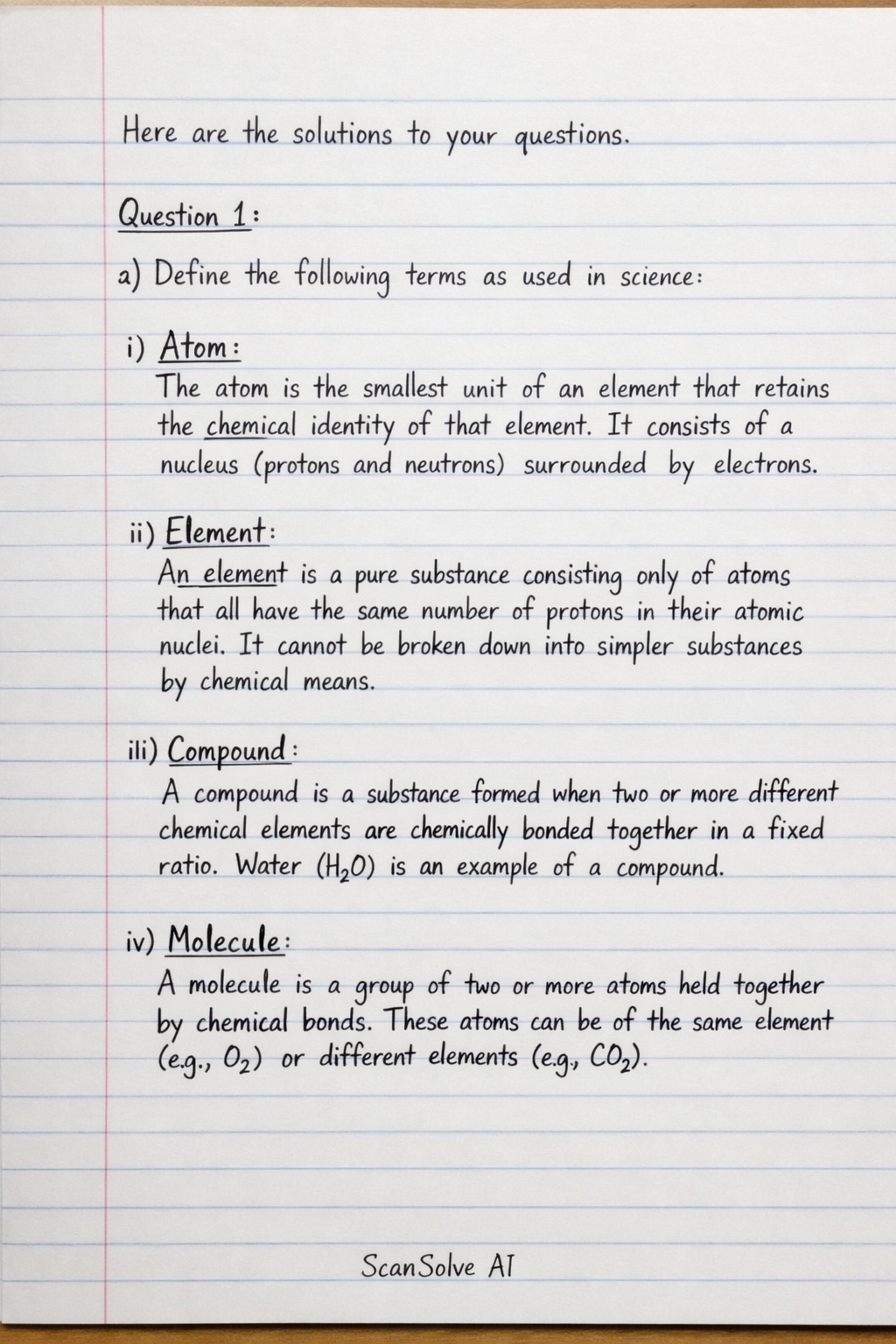
Here are the solutions to your questions.
Question 1:
a) Define the following terms as used in science:
- i) Atom: The atom is the smallest unit of an element that retains the chemical identity of that element. It consists of a nucleus (protons and neutrons) surrounded by electrons.
- ii) Element: An element is a pure substance consisting only of atoms that all have the same number of protons in their atomic nuclei. It cannot be broken down into simpler substances by chemical means.
- iii) Compound: A compound is a substance formed when two or more different chemical elements are chemically bonded together in a fixed ratio. Water () is an example of a compound.
- iv) Molecule: A molecule is a group of two or more atoms held together by chemical bonds. These atoms can be of the same element (e.g., ) or different elements (e.g., ).
b) Explain the relationship between atom, element, molecule using an example.
An atom is the fundamental building block of matter. An element is a pure substance made up of only one type of atom. For example, all atoms in a sample of pure oxygen are oxygen atoms, making oxygen an element. When two or more atoms chemically bond, they form a molecule. If two oxygen atoms bond, they form an oxygen molecule (), which is still considered an element. If two hydrogen atoms bond with one oxygen atom, they form a water molecule (), which is a compound.
Question 2:
Write down the names of the following common elements:
-
- Fe: Iron
-
- Au: Gold
-
- Na: Sodium
-
- O: Oxygen
-
- Cl: Chlorine
-
- K: Potassium
Question 3:
Write a word equation for the formation of water.
Question 4:
State the application of gold, aluminium and oxygen in the society.
- Gold: Used in jewelry, currency, and electronics due to its conductivity and resistance to corrosion.
- Aluminium: Used in aircraft construction, beverage cans, and window frames because it is lightweight, strong, and corrosion-resistant.
- Oxygen: Essential for respiration in living organisms, used in combustion processes, and for medical support in hospitals.
Question 5:
Explain 5 reasons for labelling substances in the society.
- Safety Information: Labels provide crucial warnings about potential hazards (e.g., flammable, corrosive, toxic) to prevent accidents and ensure safe handling.
- Ingredient Disclosure: They list the components of a substance, which is vital for consumers with allergies, dietary restrictions, or those needing to understand product composition.
- Usage Instructions: Labels guide users on how to properly use, store, or dispose of a product, ensuring effectiveness and preventing misuse.
- Identification and Branding: Labels help identify the product, its manufacturer, and brand, distinguishing it from similar items and building consumer trust.
- Legal and Regulatory Compliance: Many substances require specific labeling by law to meet health, safety, and environmental regulations, ensuring accountability and consumer protection.
Still stuck on this one?
Ask a follow-up, and the answer starts from this question.
More Chemistry Questions
Handwritten Step-by-Step Solution
Get this as a handwritten image on WhatsApp — like a tutor wrote it for you.
Try on WhatsApp