
We read your photo as:
A diagram shows a series of reactions involving solids P and T, and gases Q and U, and solutions R and S. Identify the substances and write equations for the reactions.
ScanSolve AI Answer
Here's the solution to the questions based on the provided diagram:
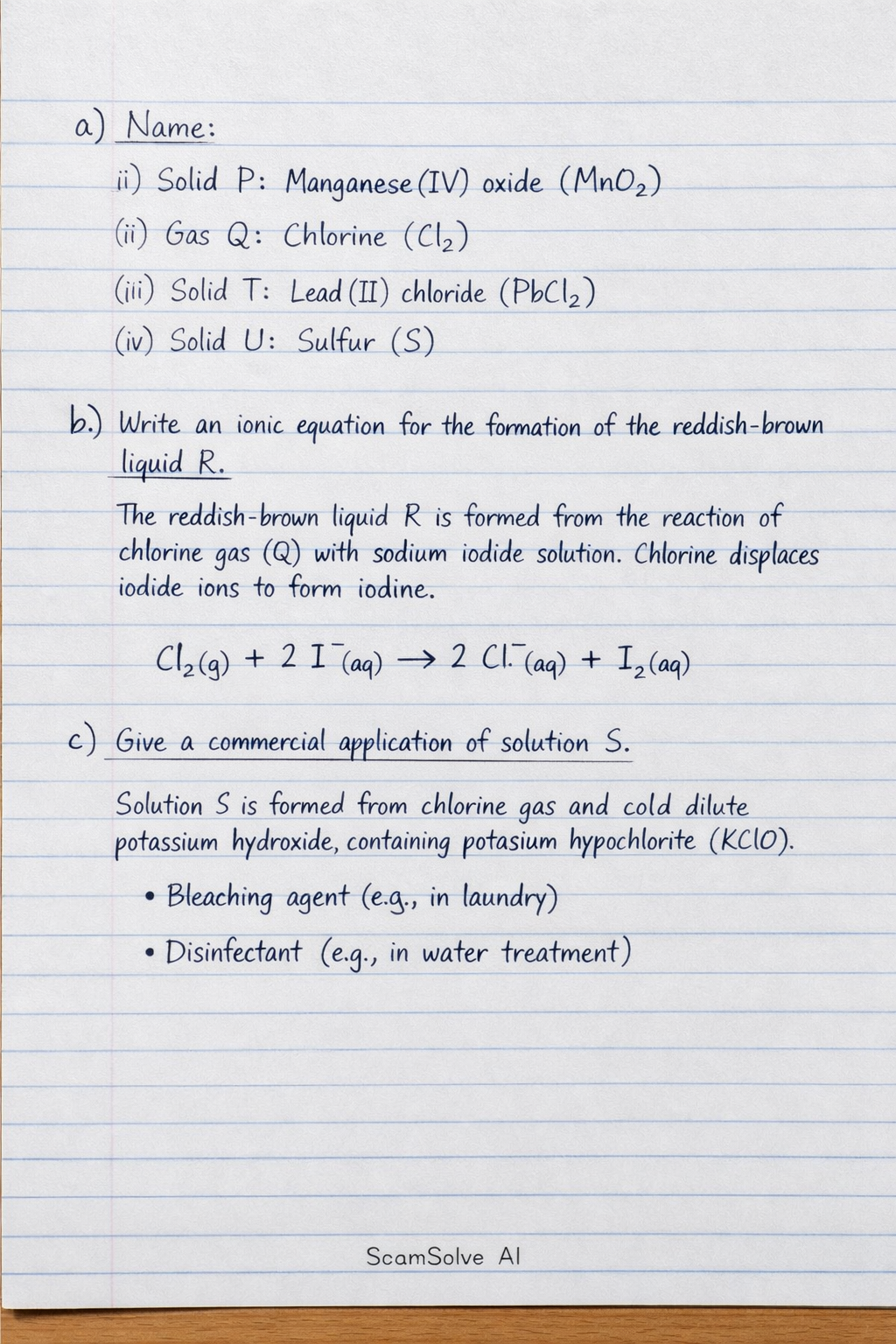
a) Name:
- (i) Solid P: Manganese(IV) oxide ()
- (ii) Gas Q: Chlorine ()
- (iii) Solid T: Lead(II) chloride ()
- (iv) Solid U: Sulfur ()
b) Write an ionic equation for the formation of the reddish-brown liquid R.
The reddish-brown liquid R is formed from the reaction of chlorine gas (Q) with sodium iodide solution. Chlorine displaces iodide ions to form iodine.
c) Give a commercial application of solution S.
Solution S is formed from chlorine gas and cold dilute potassium hydroxide, containing potassium hypochlorite ().
- Bleaching agent (e.g., in laundry) or disinfectant (e.g., in water treatment).
d) State and explain the observation made when a gas jar containing chlorine gas is inverted over a gas jar containing hydrogen sulphide gas.
- Observation: A white or yellowish solid is formed, and the yellow-green colour of chlorine gas disappears.
- Explanation: Chlorine gas () is a strong oxidizing agent that reacts with hydrogen sulfide gas (). Chlorine oxidizes hydrogen sulfide to solid sulfur (), which appears as a white or yellowish solid, and is itself reduced to hydrogen chloride gas ().
4. Give a reason why chlorine is used in the manufacture of pesticides and germicides.
Chlorine is a strong oxidizing agent and is highly reactive. These properties allow it to be incorporated into organic compounds to synthesize various pesticides and germicides, or to act directly as a germicidal agent by disrupting microbial cell structures.
Still stuck on this one?
Ask a follow-up, and the answer starts from this question.
More Chemistry Questions
Handwritten Step-by-Step Solution
Get this as a handwritten image on WhatsApp — like a tutor wrote it for you.
Try on WhatsApp