
We read your photo as:
A. Explain to the pharmacist intern who just joined the team three (3) physicochemical factors of drugs and suppository base affecting rectal absorption of drugs.
ScanSolve AI Answer
Here are the explanations for the suppository formulations:
a. Explain to the pharmacist intern who just joined the team three (3) physicochemical factors of drugs and suppository base affecting rectal absorption of drugs.
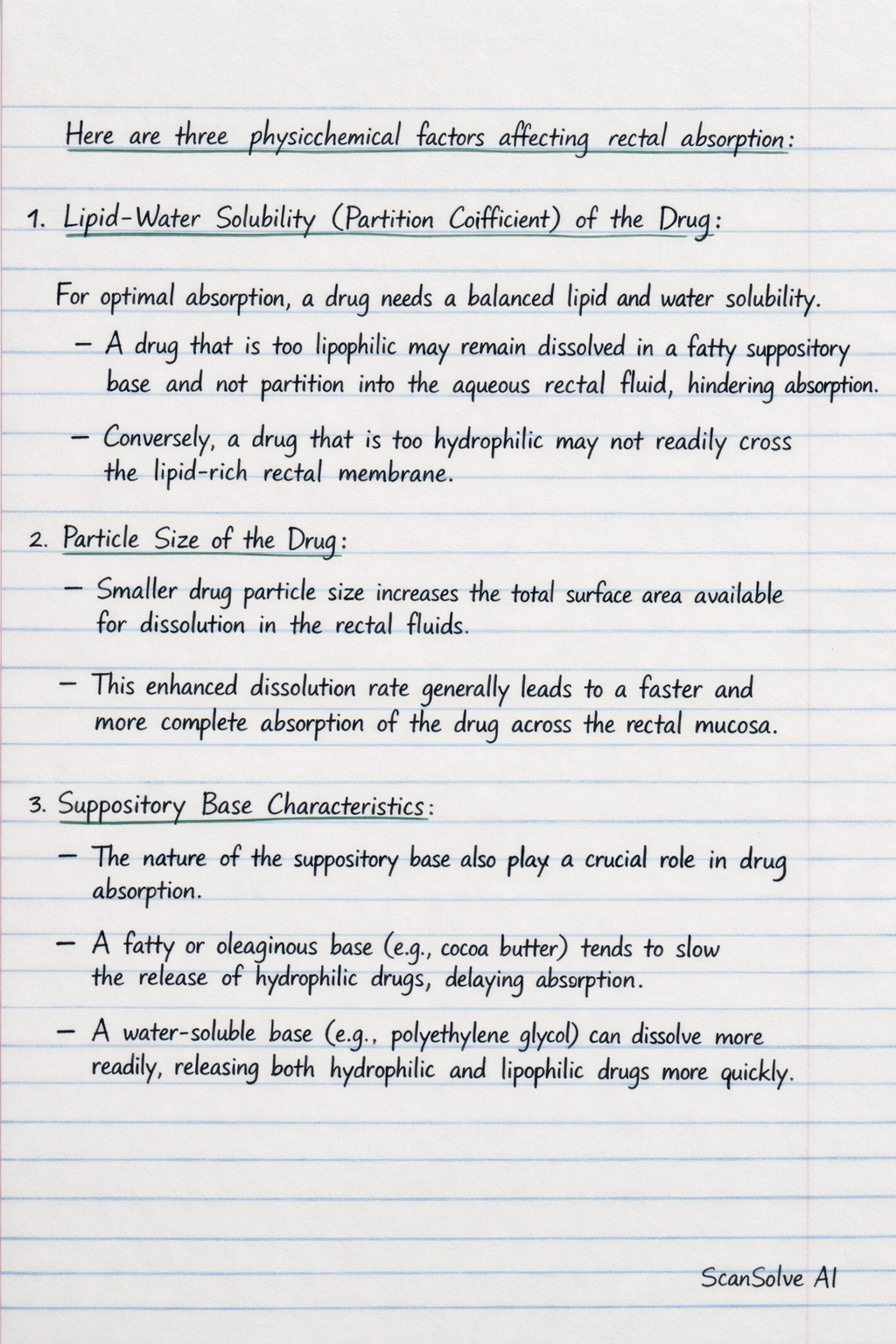
Here are three physicochemical factors affecting rectal absorption:
- Lipid-Water Solubility (Partition Coefficient) of the Drug: For optimal absorption, a drug needs a balanced lipid and water solubility. A drug that is too lipophilic may remain dissolved in a fatty suppository base and not partition into the aqueous rectal fluid, hindering absorption. Conversely, a drug that is too hydrophilic may not readily cross the lipid-rich rectal membrane.
- Particle Size of the Drug: Smaller drug particle size increases the total surface area available for dissolution in the rectal fluids. This enhanced dissolution rate generally leads to a faster and more complete absorption of the drug across the rectal mucosa.
- Melting/Softening Point of the Suppository Base: The suppository base must melt or soften at body temperature () to release the drug. If the melting point is too high, the suppository may not melt completely, leading to poor drug release. If it's too low, the suppository may be difficult to handle or store.
b. A colleague calls and asks for help concerning the preparation of six (6) propofol suppositories (lipophilic drug).
-
Which suppository base are you going to use and why? I would use a hydrophilic base such as Polyethylene Glycols (PEGs).
- Why: Propofol is a lipophilic drug. To ensure good release and absorption of a lipophilic drug, it should be formulated in a hydrophilic base. This creates a greater difference in affinity between the drug and the base, encouraging the drug to partition out of the base and into the aqueous rectal fluids, from where it can be absorbed across the rectal membrane. If a lipophilic drug were in a lipophilic base (like cocoa butter), it would tend to stay dissolved in the base, leading to poor release.
-
Which excipient can be added? A surfactant (e.g., Polysorbate 80) can be added.
- Why: As propofol is a lipophilic drug being incorporated into a hydrophilic PEG base, a surfactant can help improve the dispersion and solubility of the propofol within the base, ensuring a more uniform distribution and efficient release of the drug.
-
Describe the hand molding method of suppository preparation. The hand molding method is suitable for preparing a small number of suppositories, especially when specific shapes or sizes are needed.
- Preparation: The suppository base (e.g., PEGs) is grated or finely powdered, and the active drug (propofol) is also finely powdered.
- Mixing: The powdered drug is thoroughly mixed with the base on an ointment slab or tile until a homogeneous blend is achieved.
- Kneading: A small amount of a suitable liquid (e.g., water or glycerin for PEG bases) may be added to the mixture to form a pliable, plastic mass. This mass is then kneaded by hand (wearing gloves) until it is smooth and uniform.
- Rolling: The plastic mass is rolled into a cylindrical rod of uniform diameter.
- Cutting and Shaping: The rod is then cut into the required number of pieces, each containing the correct dose. Each piece is then manually shaped into the desired suppository form (e.g., torpedo shape) using the fingers.
- Finishing: The finished suppositories are smoothed and polished.
Still stuck on this one?
Ask a follow-up, and the answer starts from this question.
More Chemistry Questions
Handwritten Step-by-Step Solution
Get this as a handwritten image on WhatsApp — like a tutor wrote it for you.
Try on WhatsApp