

This chemistry question involves key chemical concepts and calculations. The detailed solution below walks through each step, from identifying the reaction type to computing the final answer.
ScanSolve AI Answer
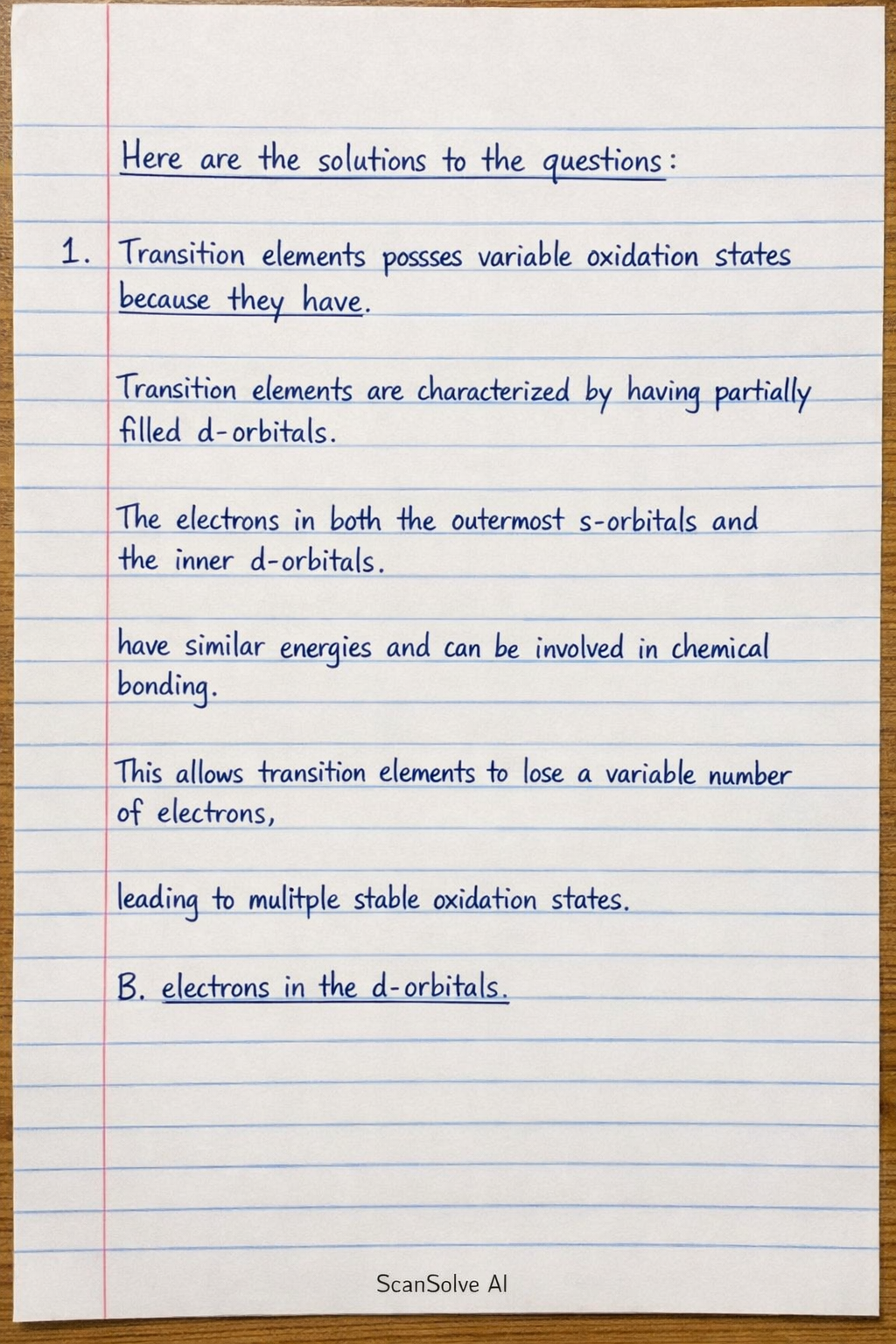
Here are the solutions to the questions: 1. Transition elements possess variable oxidation states because they have Transition elements are characterized by having partially filled d-orbitals. The electrons in both the outermost s-orbitals and the inner d-orbitals have similar energies and can be involved in chemical bonding. This allows transition elements to lose a variable number of electrons, leading to multiple stable oxidation states. B. electrons in the d-orbitals. 2. A hydrocarbon C_3H_y burns in air according to the following equation: C_3H_y(g) + 5O_2(g) → 3CO_2(g) + (y)/(2)H_2O_(g) The value of y is Step 1: Balance the oxygen atoms on both sides of the equation. On the reactant side, there are 5 × 2 = 10 oxygen atoms from 5O_2. On the product side, there are 3 × 2 = 6 oxygen atoms from 3CO_2 and (y)/(2) × 1 = (y)/(2) oxygen atoms from (y)/(2)H_2O. Step 2: Set the total number of oxygen atoms on the reactant side equal to the total on the product side. 10 = 6 + (y)/(2) Step 3: Solve for y. 10 - 6 = (y)/(2) 4 = (y)/(2) y = 4 × 2 y = 8 D. 8. 3. An element X has a valency of +3. The correct formula of its chloride is Step 1: Determine the charge of element X and chlorine. Element X has a valency of +3, meaning it forms an ion with a +3 charge (X^3+). Chlorine (Cl) is a halogen and typically has a valency of -1, forming an ion with a -1 charge (Cl^-). Step 2: Combine the ions to form a neutral compound. To balance the +3 charge of one X^3+ ion, three Cl^- ions are required (3 × (-1) = -3). The charges balance: (+3) + 3(-1) = 0. Step 3: Write the chemical formula. The formula for the chloride of X is XCl_3. B. XCl_3 Last free one today — make it count tomorrow, or type /upgrade for unlimited.