
We read your photo as:
A) iii) To another portion of the filtrate, add 2 drops of barium nitrate followed by 1 cm³ of 2M nitric acid.
Chemistry
ScanSolve AI Answer
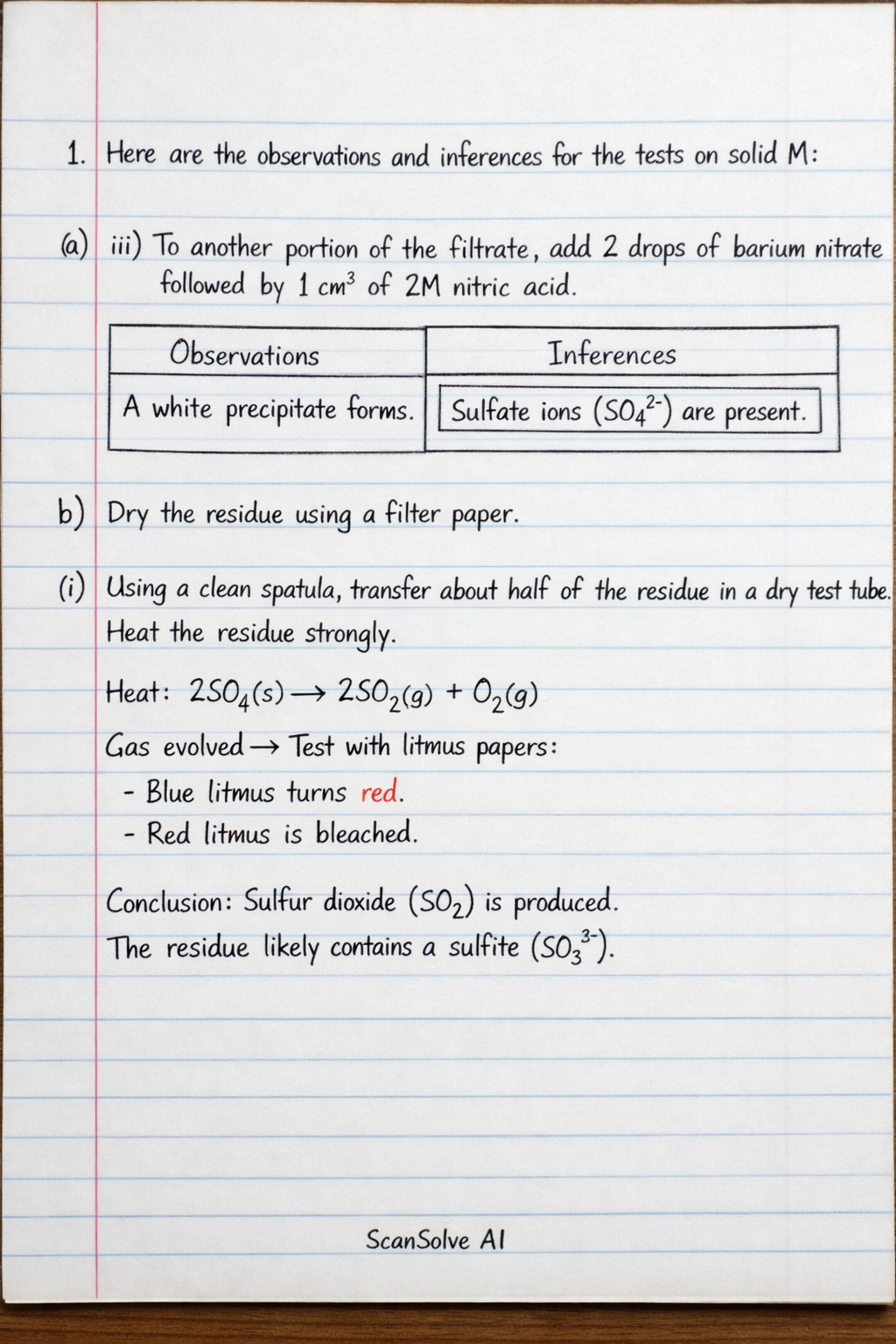
Here are the observations and inferences for the tests on solid M:
a) iii) To another portion of the filtrate, add 2 drops of barium nitrate followed by of 2M nitric acid.
| Observations | Inferences |
|---|---|
| A white precipitate forms. |
b) Dry the residue using a filter paper.
i) Using a clean spatula, transfer about half of the residue in a dry test tube, heat the residue strongly and test the gas produced using moist blue and red litmus papers.
| Observations | Inferences |
|---|---|
| A colorless gas is produced. The gas turns moist blue litmus paper red. Moist red litmus paper remains red. |
ii) Place the remaining residue in a dry test tube. Add 2M nitric acid until all the solid dissolves. Retain the mixture for test (iii) below.
| Observations | Inferences |
|---|---|
| The white residue dissolves with effervescence to form a colorless solution. |
Was this helpful?
Still stuck on this one?
Ask a follow-up, and the answer starts from this question.
Got a different question?Ask your own question
More Chemistry Questions
Qb) ii) Place the remaining residue in a dry test tube. Add 2M nitric acid until all the solid…QI) Add dilute hydrochloric acid to sodium carbonate in a conical flask.QA) Calculate the mass concentration of iron (II). b) Explain why the solution was acidified with…QCalculate the concentration of a nitric (V) acid solution prepared by adding distilled water to 20…QThe reagents for qualitative work include: dilute sodium hydroxide solution, dilute hydrochloric…
Handwritten Step-by-Step Solution
Get this as a handwritten image on WhatsApp — like a tutor wrote it for you.
Try on WhatsApp