
We read your photo as:
A ladder is leaning against a wall. The ladder is 10 metres long, and the base of the ladder is 6 metres away from the wall.
ScanSolve AI Answer
Step-by-step solution
10 stepsHere are the solutions to the problems:
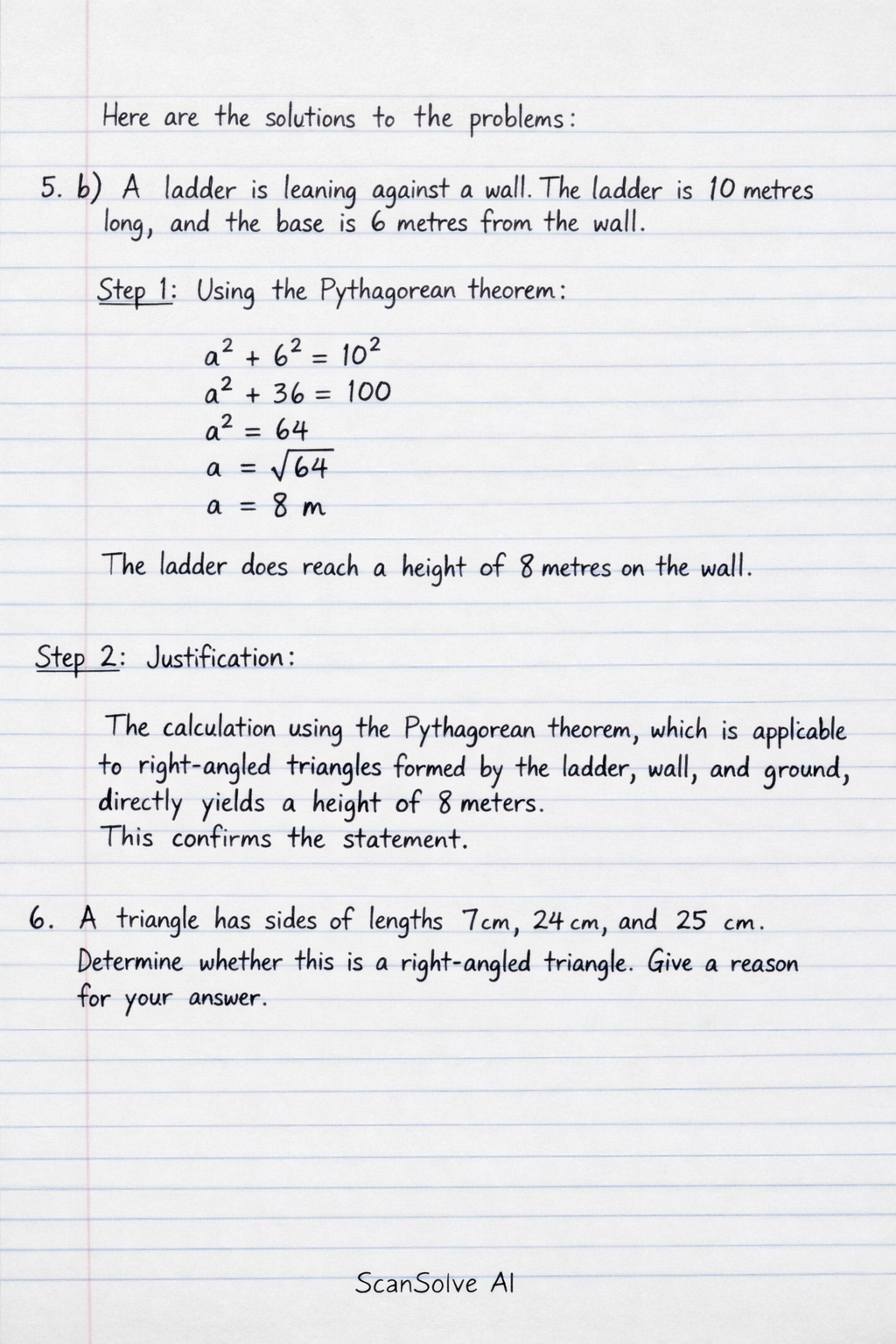
5. A ladder is leaning against a wall. The ladder is 10 metres long, and the base of the ladder is 6 metres away from the wall.
b) Explain whether the ladder reaches a height of 8 metres on the wall. Justify your answer using the Pythagorean theorem.
From part a), we used the Pythagorean theorem where is the ladder length (10 m), is the distance from the wall (6 m), and is the height on the wall.
We found:
The ladder does reach a height of 8 metres on the wall.
Justification
The calculation using the Pythagorean theorem, which is applicable to right-angled triangles formed by the ladder, wall, and ground, directly yields a height of 8 meters. This confirms the statement.
6. A triangle has sides of lengths 7 cm, 24 cm, and 25 cm. Determine whether this is a right-angled triangle. Give a reason for your answer.
To determine if a triangle is right-angled, we use the converse of the Pythagorean theorem.
If the square of the longest side (hypotenuse) is equal to the sum of the squares of the other two sides, then it is a right-angled triangle.
Let cm, cm, and cm (the longest side).
We check if .Calculate the squares of the sides.
Sum the squares of the two shorter sides and compare with the square of the longest side.
Since , the triangle is a right-angled triangle. The reason is that its side lengths satisfy the Pythagorean theorem.
7. A vector u has components (3, 4). Calculate the magnitude (length) of this vector using the formula: Magnitude = .
The components of the vector are and .
Substitute these values into the given formula.
Calculate the squares of the components.
Add the values and find the square root.
The magnitude of vector u is
8. Two vectors are described as follows:
Vector a has a magnitude of 10 and direction from the positive x-axis.
Vector b has a magnitude of 10 and direction from the positive x-axis but is positioned at a different starting point.a) Analyse whether these vectors are equal.
For two vectors to be equal, they must have the same magnitude and the same direction.
Their starting points do not affect their equality.
Compare Vector a and Vector b.
- Both Vector a and Vector b have a magnitude of 10.
- Both Vector a and Vector b have a direction of from the positive x-axis.
- Although Vector b is positioned at a different starting point, this does not change its magnitude or direction.
Conclusion: Yes, these vectors are equal.
b) Explain what makes two vectors equal.
Two vectors are considered equal if they have the same magnitude (length) and the same direction. Their position in space (starting point) does not determine their equality.
c) Provide a real-life example of equal vectors.
If two cars are traveling at 60 km/h due North at the same time, their velocity vectors are equal, even if they are on different roads or started from different locations.
Still stuck on this one?
Ask a follow-up, and the answer starts from this question.
More Chemistry Questions
Handwritten Step-by-Step Solution
Get this as a handwritten image on WhatsApp — like a tutor wrote it for you.
Try on WhatsApp