
We read your photo as:
An experiment was carried out to investigate the reaction between dilute hydrochloric acid and some metals.
ScanSolve AI Answer
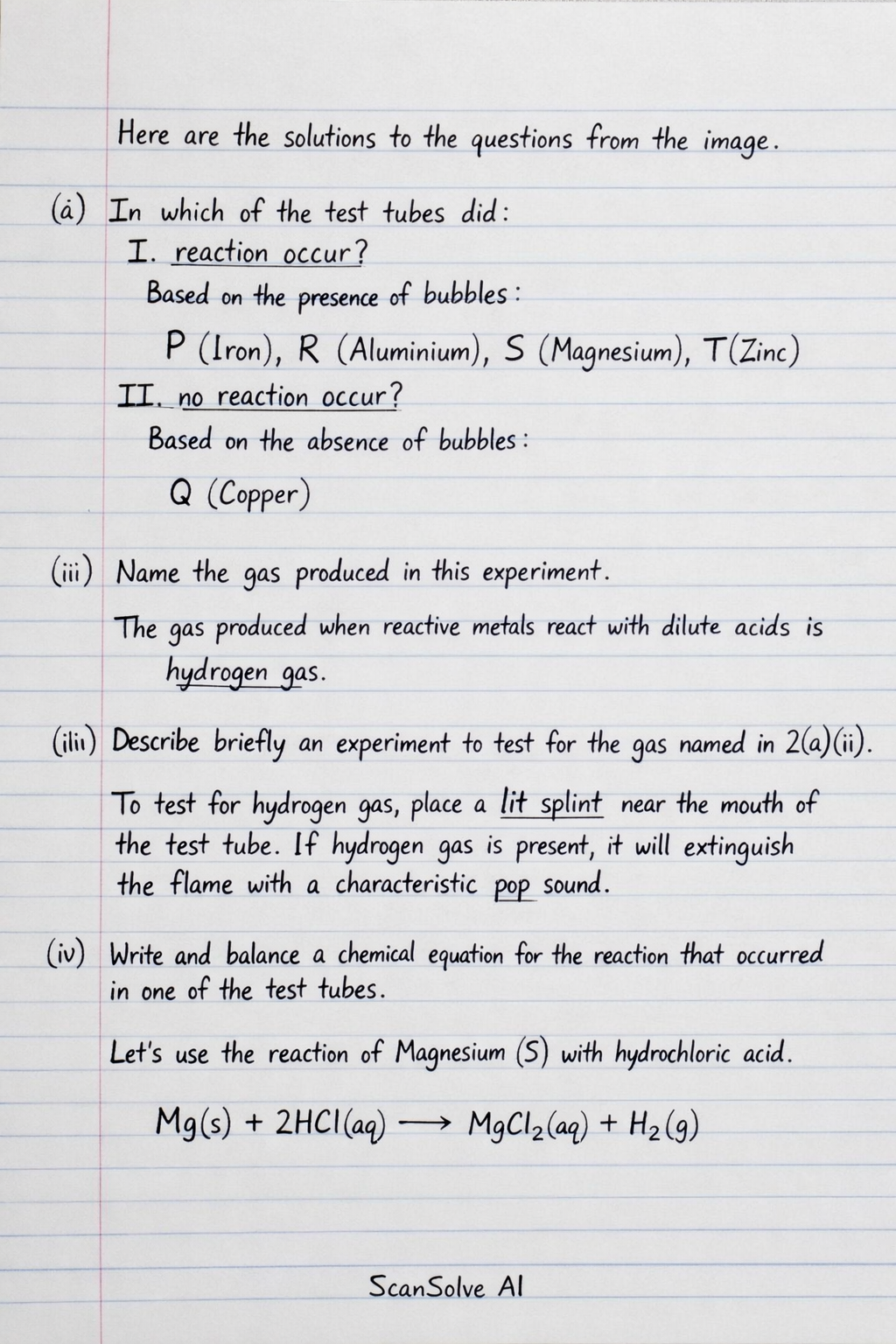
Here are the solutions to the questions from the image.
2. An experiment was carried out to investigate the reaction between dilute hydrochloric acid and some metals.
a)
(i) In which of the test tubes did:
I. reaction occur?
Based on the presence of bubbles:
- P (Iron), R (Aluminium), S (Magnesium), T (Zinc) II. no reaction occur? Based on the absence of bubbles:
- Q (Copper)
(ii) Name the gas produced in this experiment.
The gas produced when reactive metals react with dilute acids is hydrogen gas.
(iii) Describe briefly an experiment to test for the gas named in 2(a)(ii).
To test for hydrogen gas, place a lit splint near the mouth of the test tube. If hydrogen gas is present, it will extinguish the flame with a characteristic pop sound.
(iv) Write and balance a chemical equation for the reaction that occurred in one of the test tubes.
Let's use the reaction of Magnesium (S) with hydrochloric acid.
b) An iron metal was placed in a test tube containing water for two weeks.
(i) State the appearance of the iron after the two weeks.
The iron would appear reddish-brown and flaky due to the formation of rust.
(ii) Name the process responsible for the answer given in 2(b)(i).
The process is rusting (or corrosion).
(iii) State two ways by which the process named in 2(b)(ii) could be prevented.
- Painting or greasing: This creates a barrier that prevents oxygen and water from reaching the iron surface.
- Galvanizing: This involves coating the iron with a layer of zinc, which is more reactive than iron and corrodes preferentially, protecting the iron.
Still stuck on this one?
Ask a follow-up, and the answer starts from this question.
More Chemistry Questions
Handwritten Step-by-Step Solution
Get this as a handwritten image on WhatsApp — like a tutor wrote it for you.
Try on WhatsApp