This chemistry question involves key chemical concepts and calculations. The detailed solution below walks through each step, from identifying the reaction type to computing the final answer.
ScanSolve AI Answer
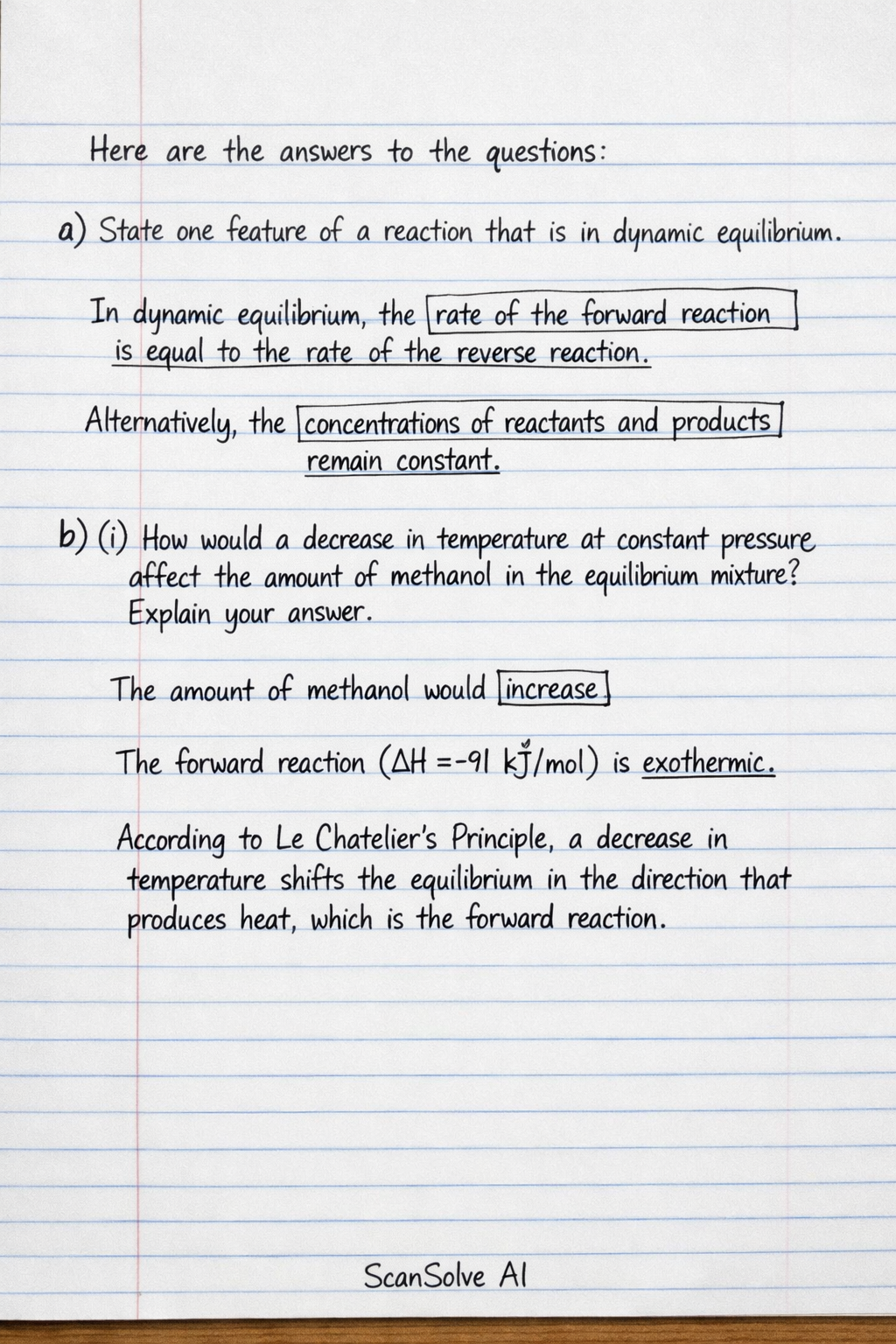
Here are the answers to the questions:
a) State one feature of a reaction that is in dynamic equilibrium.
In dynamic equilibrium, the $\boxed{\text{rate of the forward reaction is equal to the rate of the reverse reaction}}$.
Alternatively, the $\boxed{\text{concentrations of reactants and products remain constant}}$.
b) (i) How would a decrease in temperature at constant pressure affect the amount of methanol in the equilibrium mixture? Explain your answer.
The amount of methanol would $\boxed{\text{increase}}$.
The forward reaction ($\Delta H = -91 \text{ kJ/mol}$) is $\boxed{\text{exothermic}}$. According to Le Chatelier's Principle, a decrease in temperature shifts the equilibrium in the direction that produces heat, which is the forward reaction.
b) (ii) How would an increase in pressure at constant temperature affect the amount of methanol in the equilibrium mixture? Explain your answer.
The amount of methanol would $\boxed{\text{increase}}$.
The reactant side has $1 (\text{CO}) + 2 (\text{H}_2) = 3$ moles of gas, while the product side has $1 (\text{CH}_3\text{OH}) = 1$ mole of gas. According to Le Chatelier's Principle, an increase in pressure shifts the equilibrium to the side with $\boxed{\text{fewer moles of gas}}$, which is the product side.
c) (i) Write a chemical equation for the conversion of methanol into methanal.
$$2\text{CH}_3\text{OH(g)} + \text{O}_2\text{(g)} \xrightarrow{\text{Fe}_2\text{O}_3 \text{ catalyst}} 2\text{H}_2\text{CO(g)} + 2\text{H}_2\text{O(g)}$$
c) (ii) What is meant by the term catalyst?
A catalyst is a substance that $\boxed{\text{increases the rate of a chemical reaction without being chemically changed or consumed}}$.
c) (iii) Explain how a catalyst works.
A catalyst works by $\boxed{\text{providing an alternative reaction pathway with a lower activation energy}}$. This allows a greater proportion of reactant molecules to have sufficient energy to react, thus speeding up the reaction.
a) State one feature of a reaction that is in dynamic equilibrium.
|Chemistry
a) State one feature of a reaction that is in dynamic equilibrium.
ScanSolve AI Answer
Here are the answers to the questions:
a) State one feature of a reaction that is in dynamic equilibrium.
In dynamic equilibrium, the ∗rateoftheforwardreactionisequaltotherateofthereversereaction∗.
Alternatively, the ∗concentrationsofreactantsandproductsremainconstant∗.
b) (i) How would a decrease in temperature at constant pressure affect the amount of methanol in the equilibrium mixture? Explain your answer.
The amount of methanol would ∗increase∗.
The forward reaction (ΔH=−91 kJ/mol) is ∗exothermic∗. According to Le Chatelier's Principle, a decrease in temperature shifts the equilibrium in the direction that produces heat, which is the forward reaction.
b) (ii) How would an increase in pressure at constant temperature affect the amount of methanol in the equilibrium mixture? Explain your answer.
The amount of methanol would ∗increase∗.
The reactant side has 1(CO)+2(H2)=3 moles of gas, while the product side has 1(CH3OH)=1 mole of gas. According to Le Chatelier's Principle, an increase in pressure shifts the equilibrium to the side with ∗fewermolesofgas∗, which is the product side.
c) (i) Write a chemical equation for the conversion of methanol into methanal.2CH3OH(g)+O2(g)Fe2O3catalyst2H2CO(g)+2H2O(g)
c) (ii) What is meant by the term catalyst?
A catalyst is a substance that ∗increasestherateofachemicalreactionwithoutbeingchemicallychangedorconsumed∗.
c) (iii) Explain how a catalyst works.
A catalyst works by ∗providinganalternativereactionpathwaywithaloweractivationenergy∗. This allows a greater proportion of reactant molecules to have sufficient energy to react, thus speeding up the reaction.
Need help with your own homework?
Get instant step-by-step solutions to any question. Free to start.