

This chemistry question involves key chemical concepts and calculations. The detailed solution below walks through each step, from identifying the reaction type to computing the final answer.
ScanSolve AI Answer
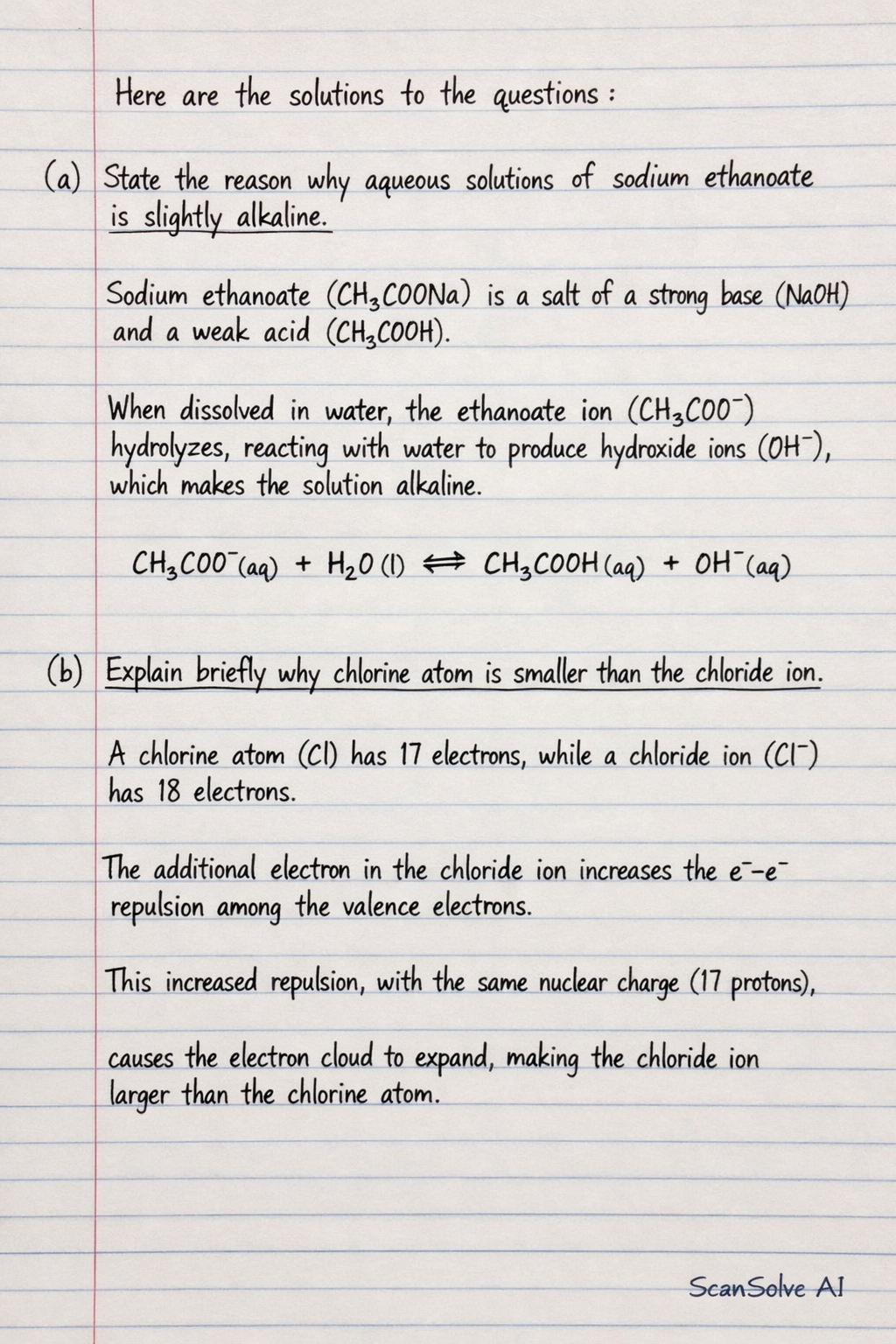
Here are the solutions to the questions: a) State the reason why aqueous solutions of sodium ethanoate is slightly alkaline. Sodium ethanoate (CH_3COONa) is a salt of a strong base (NaOH) and a weak acid (CH_3COOH). When dissolved in water, the ethanoate ion (CH_3COO^-) hydrolyzes, reacting with water to produce hydroxide ions (OH^-), which makes the solution alkaline. CH_3COO^- (aq) + H_2O (l) CH_3COOH (aq) + OH^- (aq) b) Explain briefly why chlorine atom is smaller than the chloride ion. A chlorine atom (Cl) has 17 electrons, while a chloride ion (Cl^-) has 18 electrons. The additional electron in the chloride ion increases the electron-electron repulsion among the valence electrons. This increased repulsion, with the same nuclear charge (17 protons), causes the electron cloud to expand, making the chloride ion larger than the chlorine atom. c) Use the kinetic theory to explain briefly the cooling effect that is produced when a liquid evaporates. According to the kinetic theory, particles in a liquid have a range of kinetic energies. During evaporation, only the most energetic particles at the liquid's surface possess enough energy to overcome intermolecular forces and escape into the gaseous phase. As these high-energy particles leave, the average kinetic energy of the remaining liquid particles decreases. Since temperature is a measure of average kinetic energy, this decrease results in a cooling effect on the remaining liquid. d) Define the term deliquescence. Deliquescence is the phenomenon where a substance absorbs moisture from the atmosphere until it dissolves in the absorbed water, forming a solution. This process typically occurs with highly soluble ionic compounds.