
This chemistry question involves key chemical concepts and calculations. The detailed solution below walks through each step, from identifying the reaction type to computing the final answer.
ScanSolve AI Answer
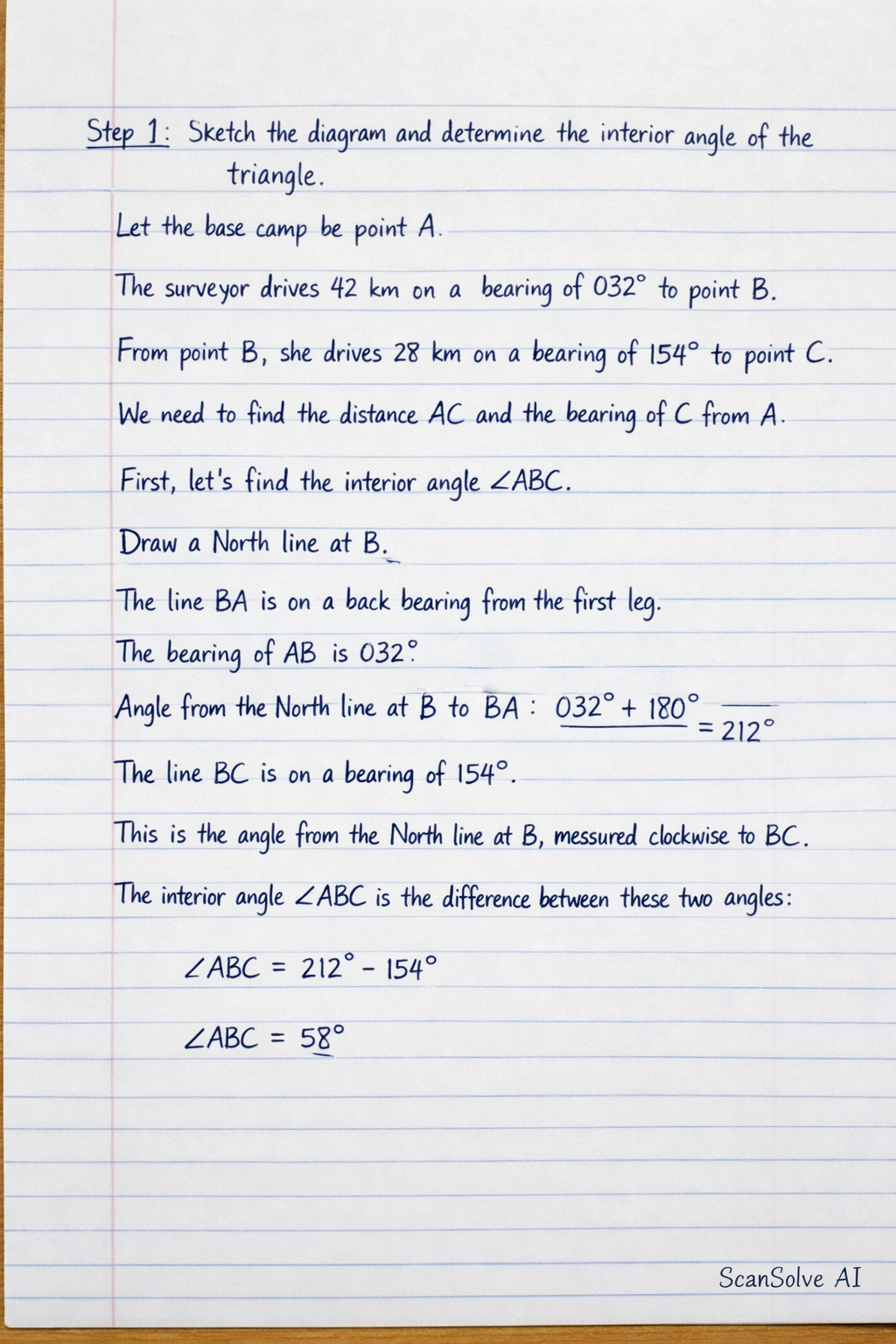
To solve this navigation problem, we will use trigonometry, specifically the Cosine Rule and the Sine Rule, after sketching the path taken by the surveyor. Step 1: Sketch the diagram and determine the interior angle of the triangle. Let the base camp be point A. The surveyor drives 42 km on a bearing of 032^ to point B. From point B, she drives 28 km on a bearing of 154^ to point C. We need to find the distance AC and the bearing of C from A. First, let's find the interior angle ABC. Draw a North line at B. The line BA (from B to A) is on a back bearing from the first leg. The bearing of AB is 032^. The angle from the North line at B, measured clockwise to BA, is 032^ + 180^ = 212^. The line BC (from B to C) is on a bearing of 154^. This is the angle from the North line at B, measured clockwise to BC. The interior angle ABC is the difference between these two angles: ABC = 212^ - 154^ = 58^ Step 2: Calculate the distance from the base camp (AC) using the Cosine Rule. In ABC: AB = 42 km BC = 28 km ABC = 58^ Using the Cosine Rule: AC^2 = AB^2 + BC^2 - 2(AB)(BC) ( ABC) AC^2 = 42^2 + 28^2 - 2(42)(28) (58^) AC^2 = 1764 + 784 - 2352 (58^) AC^2 = 2548 - 2352(0.529919...) AC^2 = 2548 - 1246.307 AC^2 = 1301.693 AC = sqrt(1301.693) AC ≈ 36.079 km Rounding to one decimal place: AC = 36.1 km Step 3: Calculate the bearing from the base camp (bearing of C from A) using the Sine Rule. To find the bearing of C from A, we need to find the angle BAC and add it to the initial bearing of AB (032^). Using the Sine Rule in ABC: (( BAC))/(BC) = (( ABC))/(AC) (( BAC))/(28) = ((58^))/(36.079) ( BAC) = (28 × (58^))/(36.079) ( BAC) = (28 × 0.848048)/(36.079) ( BAC) = (23.745344)/(36.079) ( BAC) ≈ 0.65800 BAC = (0.65800) BAC ≈ 41.15^ The bearing of C from A is the bearing of AB plus BAC: Bearing = 032^ + 41.15^ Bearing = 73.15^ Rounding to the nearest degree and expressing as a three-figure bearing: Bearing = 073^ Last free one today — make it count tomorrow, or type /upgrade for unlimited.