We read your photo as:

Two people, P and Q, start at the same time from a base camp R. P walks on a bearing of 205° at 4 km/h and Q walks on a bearing of 060° at 3 km/h. Calculate the distance between P and Q after 5 hours.

Mathematics

ScanSolve AI Answer

Answers

2 parts
a

33 km\text{33 km}

b

040∘040^\circ

Step-by-step solution

4 steps

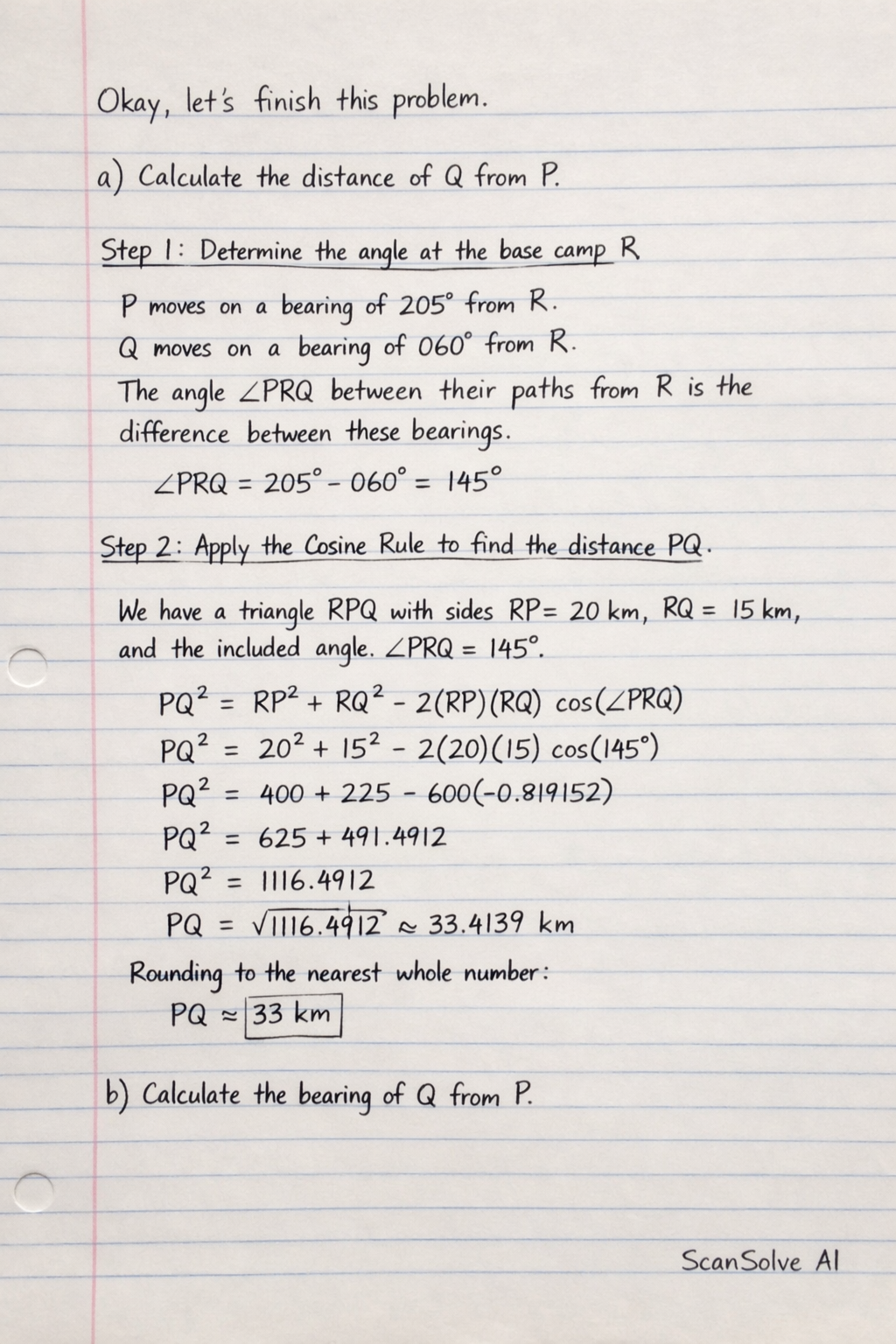
Okay, let's finish this problem.

Part a· 2 steps

Calculate the distance of Q from P.

  1. Determine the angle at the base camp R.

    P moves on a bearing of 205° from R. Q moves on a bearing of 060° from R. The angle ∠PRQ\angle PRQ between their paths from R is the difference between these bearings.

    ∠PRQ=205∘−060∘=145∘\angle PRQ = 205^\circ - 060^\circ = 145^\circ
  2. Apply the Cosine Rule to find the distance PQ.

    We have a triangle RPQ with sides RP=20RP = 20 km, RQ=15RQ = 15 km, and the included angle ∠PRQ=145∘\angle PRQ = 145^\circ.

    PQ2=RP2+RQ2−2(RP)(RQ)cos⁡(∠PRQ)PQ^2 = RP^2 + RQ^2 - 2(RP)(RQ)\cos(\angle PRQ) PQ2=202+152−2(20)(15)cos⁡(145∘)PQ^2 = 20^2 + 15^2 - 2(20)(15)\cos(145^\circ) PQ2=400+225−600(−0.819152)PQ^2 = 400 + 225 - 600(-0.819152) PQ2=625+491.4912PQ^2 = 625 + 491.4912 PQ2=1116.4912PQ^2 = 1116.4912 PQ=1116.4912≈33.4139 kmPQ = \sqrt{1116.4912} \approx 33.4139 \text{ km}

    Rounding to the nearest whole number:

    PQ≈33 kmPQ \approx \boxed{\text{33 km}}

Part b

040∘040^\circ

Calculate the bearing of Q from P.

  1. Use the Sine Rule to find ∠RPQ\angle RPQ.

    To find the bearing of Q from P, we first need to determine an angle within △RPQ\triangle RPQ. Let's find ∠RPQ\angle RPQ.

    RQsin⁡(∠RPQ)=PQsin⁡(∠PRQ)\frac{RQ}{\sin(\angle RPQ)} = \frac{PQ}{\sin(\angle PRQ)} 15sin⁡(∠RPQ)=33.4139sin⁡(145∘)\frac{15}{\sin(\angle RPQ)} = \frac{33.4139}{\sin(145^\circ)} sin⁡(∠RPQ)=15sin⁡(145∘)33.4139\sin(\angle RPQ) = \frac{15 \sin(145^\circ)}{33.4139} sin⁡(∠RPQ)=15×0.57357633.4139\sin(\angle RPQ) = \frac{15 \times 0.573576}{33.4139} sin⁡(∠RPQ)=8.6036433.4139≈0.25747\sin(\angle RPQ) = \frac{8.60364}{33.4139} \approx 0.25747 ∠RPQ=arcsin⁡(0.25747)≈14.92∘\angle RPQ = \arcsin(0.25747) \approx 14.92^\circ
  2. Calculate the bearing of Q from P.

    The bearing of P from R is 205°. The back bearing of R from P is 205∘−180∘=25∘205^\circ - 180^\circ = 25^\circ. This is the angle from the North line at P, measured clockwise to the line segment PR.
    The bearing of Q from P is the angle from the North line at P, measured clockwise to the line segment PQ.

    Bearing of Q from P=(Back bearing of R from P)+∠RPQ\text{Bearing of Q from P} = (\text{Back bearing of R from P}) + \angle RPQ Bearing of Q from P=25∘+14.92∘\text{Bearing of Q from P} = 25^\circ + 14.92^\circ Bearing of Q from P=39.92∘\text{Bearing of Q from P} = 39.92^\circ

    Rounding to the nearest whole number and expressing as a three-figure bearing:

    Bearing of Q from P≈040∘\text{Bearing of Q from P} \approx \boxed{040^\circ}
Was this helpful?

Try one yourself

A new problem that tests the same skill.

Still stuck on this one?

Ask a follow-up, and the answer starts from this question.

Got a different question?Ask your own question
Handwritten step-by-step solution preview

Handwritten Step-by-Step Solution

Get this as a handwritten image on WhatsApp — like a tutor wrote it for you.

Try on WhatsApp