a) Which is the limiting reactant? Given the density of acetic anhydride is 1.030 g/ml? b) What is the percent yield of this reaction?

Chemistry
a) Which is the limiting reactant? Given the density of acetic anhydride is 1.030 g/ml? b) What is the percent yield of this reaction?

ScanSolve AI Answer

Answer

Salicylic acid

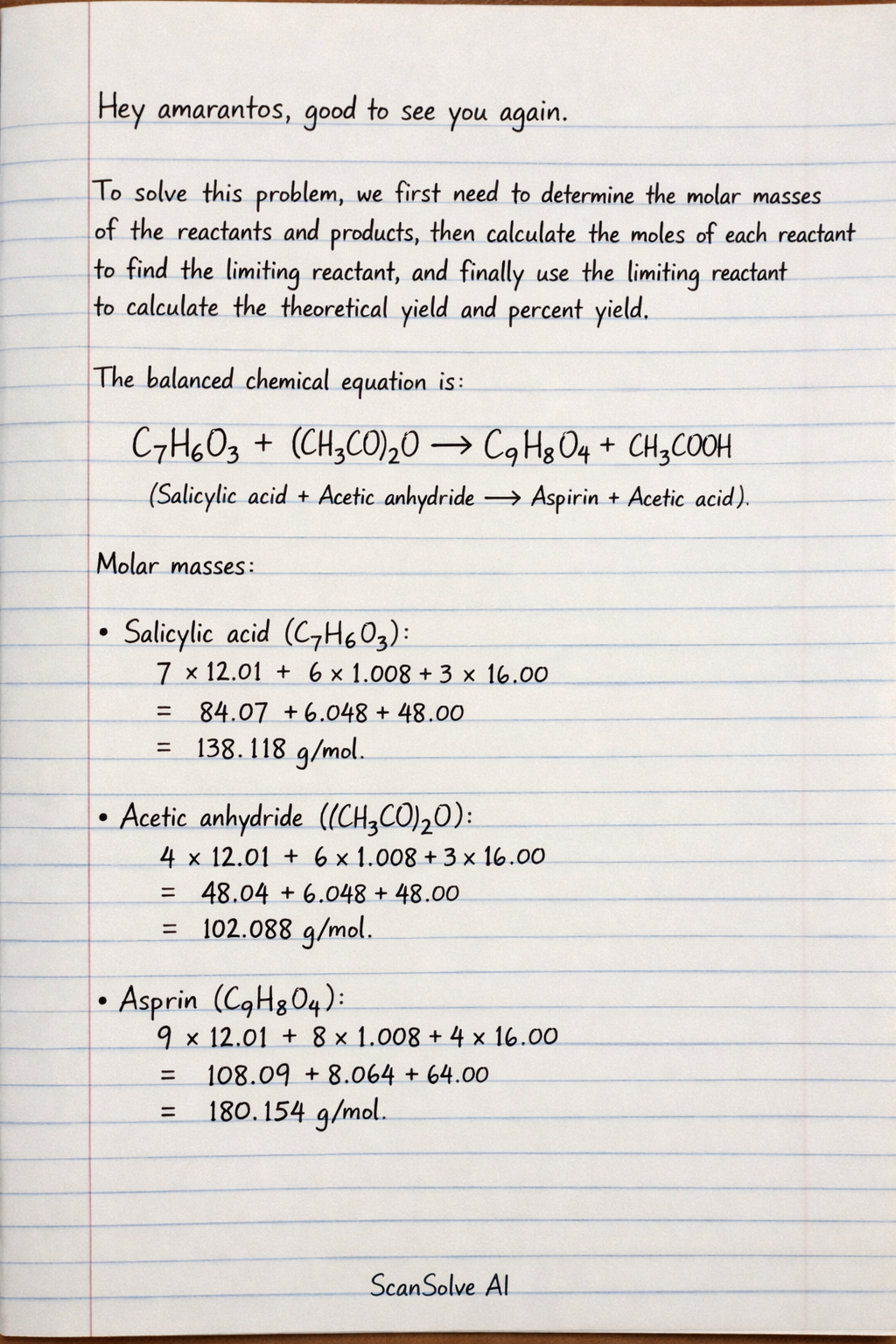
To solve this problem, we first need to determine the molar masses of the reactants and products, then calculate the moles of each reactant to find the limiting reactant, and finally use the limiting reactant to calculate the theoretical yield and percent yield.

The balanced chemical equation is: C7H6O3+(CH3CO)2OC9H8O4+CH3COOH\text{C}_7H_6O_3 + (CH_3CO)_2O \rightarrow C_9H_8O_4 + CH_3\text{COOH} (Salicylic acid) + (Acetic anhydride) \rightarrow (Aspirin) + (Acetic acid)

Molar masses: • Salicylic acid (C7H6O3\text{C}_7H_6O_3): (7×12.01)+(6×1.008)+(3×16.00)=84.07+6.048+48.00=138.118 g/mol(7 \times 12.01) + (6 \times 1.008) + (3 \times 16.00) = 84.07 + 6.048 + 48.00 = 138.118 \text{ g/mol} • Acetic anhydride ((CH3CO)2O\text{(CH}_3CO)_2\text{O} or C4H6O3\text{C}_4H_6O_3): (4×12.01)+(6×1.008)+(3×16.00)=48.04+6.048+48.00=102.088 g/mol(4 \times 12.01) + (6 \times 1.008) + (3 \times 16.00) = 48.04 + 6.048 + 48.00 = 102.088 \text{ g/mol} • Aspirin (C9H8O4\text{C}_9H_8O_4): (9×12.01)+(8×1.008)+(4×16.00)=108.09+8.064+64.00=180.154 g/mol(9 \times 12.01) + (8 \times 1.008) + (4 \times 16.00) = 108.09 + 8.064 + 64.00 = 180.154 \text{ g/mol}

a) Which is the limiting reactant?

Step 1: Calculate the moles of salicylic acid. Moles of salicylic acid=massmolarmass=3.0779g138.118g/mol=0.022284 mol\text{Moles of salicylic acid} = \frac{mass}{molar mass} = \frac{3.0779 g}{138.118 g/mol} = 0.022284 \text{ mol}

Step 2: Calculate the mass of acetic anhydride using its density and volume. Mass of acetic anhydride=density×volume=1.080g/mL×5.050mL=5.454 g\text{Mass of acetic anhydride} = density \times volume = 1.080 g/mL \times 5.050 mL = 5.454 \text{ g}

Step 3: Calculate the moles of acetic anhydride. Moles of acetic anhydride=massmolarmass=5.454g102.088g/mol=0.053426 mol\text{Moles of acetic anhydride} = \frac{mass}{molar mass} = \frac{5.454 g}{102.088 g/mol} = 0.053426 \text{ mol}

Step 4: Determine the limiting reactant. From the balanced equation, the stoichiometric ratio between salicylic acid and acetic anhydride is 1:1. Since 0.022284 mol0.022284 \text{ mol} (salicylic acid) is less than 0.053426 mol0.053426 \text{ mol} (acetic anhydride), salicylic acid is the limiting reactant.

The limiting reactant is salicylic acid. Salicylicacid\boxed{Salicylic acid}

b) What is the percent yield of this reaction?

Step 5: Calculate the theoretical yield of aspirin. Based on the balanced equation, 1 mole of salicylic acid produces 1 mole of aspirin. Moles of aspirin (theoretical)=molesoflimitingreactant=0.022284 mol\text{Moles of aspirin (theoretical)} = moles of limiting reactant = 0.022284 \text{ mol} Theoretical yield of aspirin=moles×molarmass=0.022284mol×180.154g/mol=4.0148 g\text{Theoretical yield of aspirin} = moles \times molar mass = 0.022284 mol \times 180.154 g/mol = 4.0148 \text{ g}

Step 6: Calculate the percent yield. Percent yield=actualyieldtheoreticalyield×100%\text{Percent yield} = \frac{actual yield}{theoretical yield} \times 100\% Percent yield=3.281g4.0148g×100%=81.72%\text{Percent yield} = \frac{3.281 g}{4.0148 g} \times 100\% = 81.72\%

The percent yield of this reaction is 81.72%. 81.72%\boxed{81.72\%}

Send me the next one 📸

Was this helpful?

Need help with your own homework?

Get instant step-by-step solutions to any question. Free to start.

Ask Your Question
Handwritten step-by-step solution preview

Handwritten Step-by-Step Solution

Get this as a handwritten image on WhatsApp — like a tutor wrote it for you.

Try on WhatsApp

Still have questions?

Quick Answer

The balanced chemical equation is: C_7H_6O_3 + (CH_3CO)_2O → C_9H_8O_4 + CH_3COOH (Salicylic acid) + (Acetic anhydride) → (Aspirin) + (Acetic acid) Molar masses: • Salicylic acid (C_7H_6O_3): (7 × 12.01) + (6 × 1.008) + (3 × 16.00) = 84.07 + 6.048 + 4…

a) Which is the limiting reactant? Given the density of acetic anhydride is 1.030 g/ml? b) What is the percent yield of this reaction?
Chemistry

This chemistry question involves key chemical concepts and calculations. The detailed solution below walks through each step, from identifying the reaction type to computing the final answer.

ScanSolve AI Answer
To solve this problem, we first need to determine the molar masses of the reactants and products, then calculate the moles of each reactant to find the limiting reactant, and finally use the limiting reactant to calculate the theoretical yield and percent yield. The balanced chemical equation is: C_7H_6O_3 + (CH_3CO)_2O → C_9H_8O_4 + CH_3COOH (Salicylic acid) + (Acetic anhydride) → (Aspirin) + (Acetic acid) Molar masses: • Salicylic acid (C_7H_6O_3): (7 × 12.01) + (6 × 1.008) + (3 × 16.00) = 84.07 + 6.048 + 48.00 = 138.118 g/mol • Acetic anhydride ((CH_3CO)_2O or C_4H_6O_3): (4 × 12.01) + (6 × 1.008) + (3 × 16.00) = 48.04 + 6.048 + 48.00 = 102.088 g/mol • Aspirin (C_9H_8O_4): (9 × 12.01) + (8 × 1.008) + (4 × 16.00) = 108.09 + 8.064 + 64.00 = 180.154 g/mol a) Which is the limiting reactant? Step 1: Calculate the moles of salicylic acid. Moles of salicylic acid = massmolar mass = 3.0779 g138.118 g/mol = 0.022284 mol Step 2: Calculate the mass of acetic anhydride using its density and volume. Mass of acetic anhydride = density × volume = 1.080 g/mL × 5.050 mL = 5.454 g Step 3: Calculate the moles of acetic anhydride. Moles of acetic anhydride = massmolar mass = 5.454 g102.088 g/mol = 0.053426 mol Step 4: Determine the limiting reactant. From the balanced equation, the stoichiometric ratio between salicylic acid and acetic anhydride is 1:1. Since 0.022284 mol (salicylic acid) is less than 0.053426 mol (acetic anhydride), salicylic acid is the limiting reactant. The limiting reactant is salicylic acid. Salicylic acid b) What is the percent yield of this reaction? Step 5: Calculate the theoretical yield of aspirin. Based on the balanced equation, 1 mole of salicylic acid produces 1 mole of aspirin. Moles of aspirin (theoretical) = moles of limiting reactant = 0.022284 mol Theoretical yield of aspirin = moles × molar mass = 0.022284 mol × 180.154 g/mol = 4.0148 g Step 6: Calculate the percent yield. Percent yield = actual yieldtheoretical yield × 100\% Percent yield = 3.281 g4.0148 g × 100\% = 81.72\% The percent yield of this reaction is 81.72%. 81.72\% Send me the next one 📸