
We read your photo as:
Analyze Element X (Period 3, Group VI) and its compound with Sodium. Also, differentiate density and relative density and apply Archimedes' principle.
ScanSolve AI Answer
Step-by-step solution
3 steps6.
a)
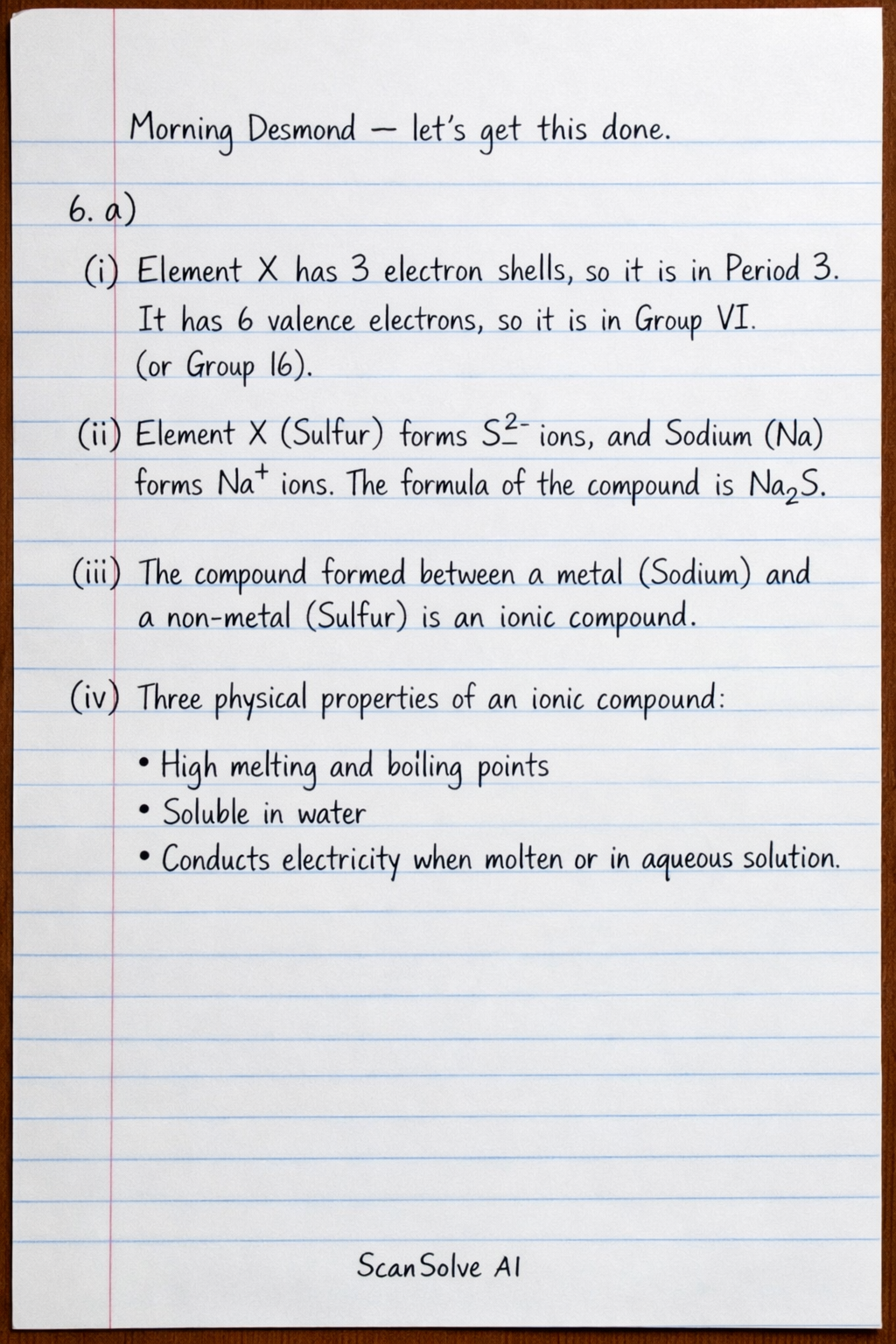
(i) Element X has 3 electron shells, so it is in Period 3. It has 6 valence electrons, so it is in Group VI (or Group 16).
(ii) Element X (Sulfur) forms S ions, and Sodium (Na) forms Na ions. The formula of the compound is NaS.
(iii) The compound formed between a metal (Sodium) and a non-metal (Sulfur) is an ionic compound.
(iv) Three physical properties of an ionic compound:
- High melting and boiling points
- Soluble in water
- Conducts electricity when molten or in aqueous solution
b)
(i) Density is the mass per unit volume of a substance and has units (e.g., kg/m³), while relative density is the ratio of the density of a substance to the density of a reference substance (usually water) and has no units.
(ii) Archimedes' principle states that when an object is wholly or partially immersed in a fluid, it experiences an upward buoyant force equal to the weight of the fluid displaced by the object.
(iii)
Calculate the loss in weight (buoyant force).
Calculate the relative density.
Simplify the result.
The relative density of the object is .
c)
(i) Two functions of the mammalian skeleton:
- Support for the body.
- Protection of vital internal organs.
(ii) Type of vertebrae found in each region:
I. neck region: Cervical vertebrae
II. tail region: Caudal vertebrae
III. abdominal region: Lumbar vertebraed)
(i) Biotechnology is the use of living organisms or their products to create or modify products or processes for specific uses.
(ii) Three applications of biotechnology:
- Production of vaccines and antibiotics
- Genetic engineering of crops for improved traits
- Gene therapy for treating genetic diseases
7.
a)
(i) A mixture is a substance containing two or more different substances that are physically combined and not chemically bonded. The components retain their individual properties.
(ii) Most appropriate method to separate:
I. water and palm oil: Decantation or using a separating funnel.
II. sodium chloride and water: Evaporation or distillation.b)
(i) One instrument used in detecting radioactive emissions: Geiger-Müller counter.
(ii) How each radiation is affected by a magnetic field:
I. -particles: Deflected (positively charged).
II. -particles: Deflected in the opposite direction to -particles (negatively charged).
III. -rays: Not deflected (no charge).c)
(i) Two structures found in plant cells only:
- Cell wall
- Chloroplasts
(ii) Two structures found in both animal and plant cells:
- Cell membrane
- Nucleus
d)
(i) Homeostasis is the maintenance of a stable internal environment in an organism despite changes in external conditions.
(ii) Three processes in the water cycle that take water into the atmosphere:
- Evaporation
- Transpiration
- Sublimation
Still stuck on this one?
Ask a follow-up, and the answer starts from this question.
More Chemistry Questions
Handwritten Step-by-Step Solution
Get this as a handwritten image on WhatsApp — like a tutor wrote it for you.
Try on WhatsApp