
We read your photo as:
Identify element Y with atomic number 17, determine element X's electronic configuration and position in the periodic table, explain Y's reactivity with Sodium, and recommend the better element for us
ScanSolve AI Answer
Here is the technical report for the chemical factory safety team, addressing all parts of your request:
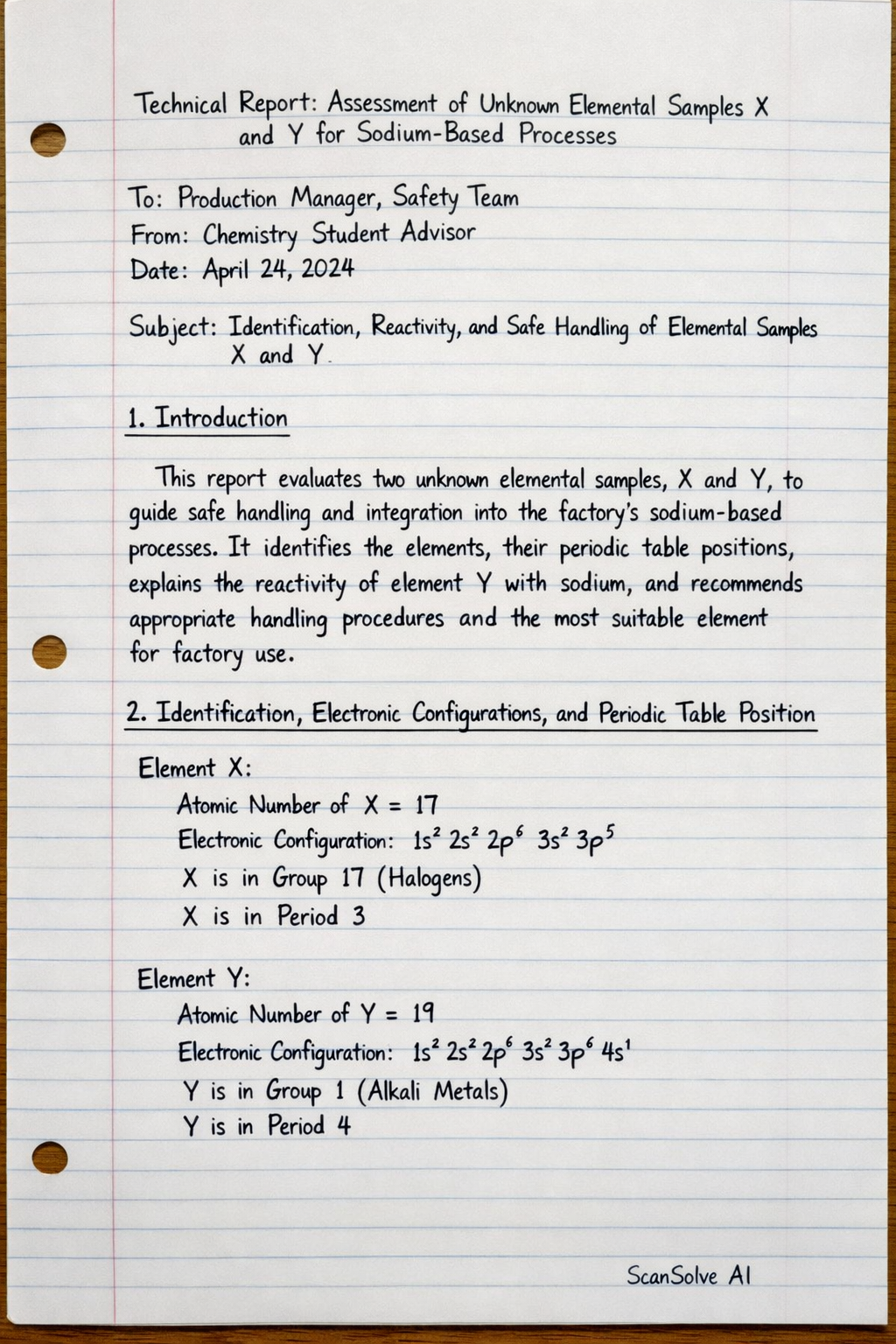
Technical Report: Assessment of Unknown Elemental Samples X and Y for Sodium-Based Processes
To: Production Manager, Safety Team
From: Chemistry Student Advisor
Date: [Current Date]
Subject: Identification, Reactivity, and Safe Handling of Elemental Samples X and Y
1. Introduction
This report evaluates two unknown elemental samples, X and Y, to guide safe handling and integration into the factory's sodium-based processes. It identifies the elements, their periodic table positions, explains the reactivity of element Y with sodium, and recommends appropriate handling procedures and the most suitable element for factory use.
2. Identification, Electronic Configurations, and Periodic Table Position
-
Element X:
- Given information: "its last electron entering the 4s orbital"
- Electronic Configuration: The Aufbau principle dictates filling orbitals in order. The 4s orbital is filled after 3p. Thus, the configuration is:
- Identification: This configuration corresponds to Potassium (K), which has 19 electrons.
- Periodic Table Position: Potassium is in Group 1 (Alkali Metals) and Period 4.
-
Element Y:
- Given information: "has an atomic number of 17"
- Electronic Configuration: An atomic number of 17 means it has 17 protons and 17 electrons. The electronic configuration is:
- Identification: This configuration corresponds to Chlorine (Cl). It has 7 valence electrons ().
- Periodic Table Position: Chlorine is in Group 17 (Halogens) and Period 3.
3. Reactivity of Element Y (Chlorine) with Sodium
Element Y, Chlorine (Cl), reacts vigorously with sodium (Na) due to their strong tendencies to achieve stable noble gas electronic configurations (an octet of valence electrons).
- Sodium (Na) has an electronic configuration of . It readily loses its single valence electron from the 3s orbital to form a stable ion (, like Neon).
- Chlorine (Cl) has an electronic configuration of . It readily gains one electron to complete its 3p orbital and achieve a stable ion (, like Argon).
This transfer of an electron from sodium to chlorine forms an ionic bond, resulting in the highly stable compound sodium chloride (). The process is highly exothermic, releasing a significant amount of energy, which manifests as a vigorous reaction.
4. Safe Handling Procedures for Element Y (Chlorine)
Chlorine is a highly toxic, corrosive gas that poses significant health and safety risks.
- Ventilation: Always handle chlorine in a well-ventilated area or under a certified fume hood to prevent inhalation.
- Personal Protective Equipment (PPE): Workers must wear appropriate PPE, including a full-face respirator with a suitable cartridge, chemical splash goggles, heavy-duty chemical-resistant gloves (e.g., butyl rubber), and protective clothing.
- Storage: Chlorine gas cylinders must be stored in a cool, dry, well-ventilated area, away from direct sunlight, heat sources, and incompatible materials (e.g., flammable substances, reducing agents, ammonia, other metals). Cylinders must be secured upright to prevent tipping.
- Emergency Preparedness: Implement robust emergency response plans, including leak detection systems, emergency showers, eyewash stations, and trained personnel for spill/leak containment.
5. Most Suitable Element for the Factory's Sodium-Based Processes
The factory's processes are "sodium-based," implying the use or interaction with elemental sodium.
- Element Y (Chlorine): As detailed above, chlorine reacts extremely vigorously and exothermically with sodium, forming sodium chloride. Introducing chlorine into a process involving elemental sodium would likely lead to uncontrolled, violent reactions or explosions, which is explicitly what the factory aims to avoid.
- Element X (Potassium): Potassium is an alkali metal, belonging to the same group as sodium. It shares similar chemical properties with sodium, such as being highly reactive metals that readily lose one electron. If the factory's processes involve the properties of alkali metals (e.g., as reducing agents), potassium could potentially be used as a substitute or complementary reactant to sodium, albeit with its own set of handling precautions due to its high reactivity.
Therefore, Element X (Potassium) is the most suitable element for the factory's sodium-based processes, as it is chemically similar to sodium and less likely to cause violent, uncontrolled reactions compared to the introduction of a highly reactive non-metal like chlorine.
Still stuck on this one?
Ask a follow-up, and the answer starts from this question.
More Chemistry Questions
Handwritten Step-by-Step Solution
Get this as a handwritten image on WhatsApp — like a tutor wrote it for you.
Try on WhatsApp