
We read your photo as:
Based on the provided image, identify the substances X and Y in the separating funnel, and order the given elements by reactivity.
ScanSolve AI Answer
Answers
3 partsHere are the solutions for questions 17, 18, and 19 based on the image provided.
Question 17:
The diagram shows a separating funnel, which is used to separate two immiscible liquids. Liquid X is on top, indicating it is less dense, and liquid Y is at the bottom, indicating it is more dense.
- A) Ethanol and petrol are miscible.
- B) Petrol and water are immiscible. Petrol is less dense than water, so petrol would be X and water would be Y. This matches the diagram.
- C) Petrol and kerosenes are miscible.
- D) Water and petrol is the same as B, but the order in the option implies X is water and Y is petrol, which is incorrect as water is denser.
The correct pair of substances that could be X and Y respectively is petrol and water.
The final answer is .
Question 18:
The separation technique shown is decantation using a separating funnel. This method is suitable for separating immiscible liquids that have different densities. The denser liquid settles at the bottom and can be drained off.
The final answer is .
Question 19:
To arrange the elements Calcium (Ca), Iron (Fe), Sodium (Na), and Zinc (Zn) in order of increasing reactivity (from least reactive to most reactive), we refer to the reactivity series of metals.
The reactivity series (from most reactive to least reactive) includes:
Sodium (Na) > Calcium (Ca) > Zinc (Zn) > Iron (Fe)
Therefore, arranging them from the least reactive to the most reactive gives:
Iron (Fe) < Zinc (Zn) < Calcium (Ca) < Sodium (Na)
The final answer is .
Try one yourself
A new problem that tests the same skill.
Still stuck on this one?
Ask a follow-up, and the answer starts from this question.
More Chemistry Questions
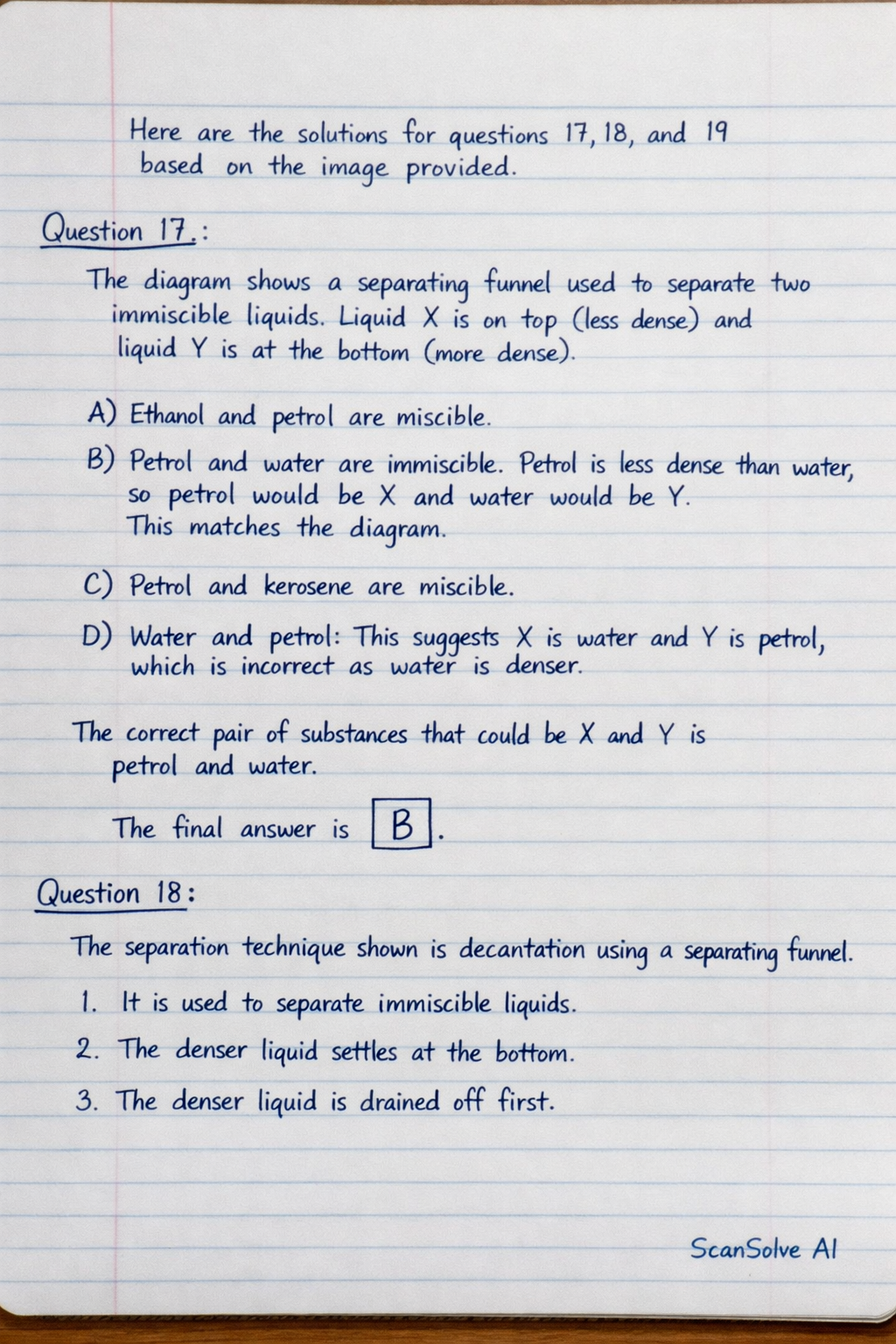
Handwritten Step-by-Step Solution
Get this as a handwritten image on WhatsApp — like a tutor wrote it for you.
Try on WhatsApp