

This chemistry question involves key chemical concepts and calculations. The detailed solution below walks through each step, from identifying the reaction type to computing the final answer.
ScanSolve AI Answer
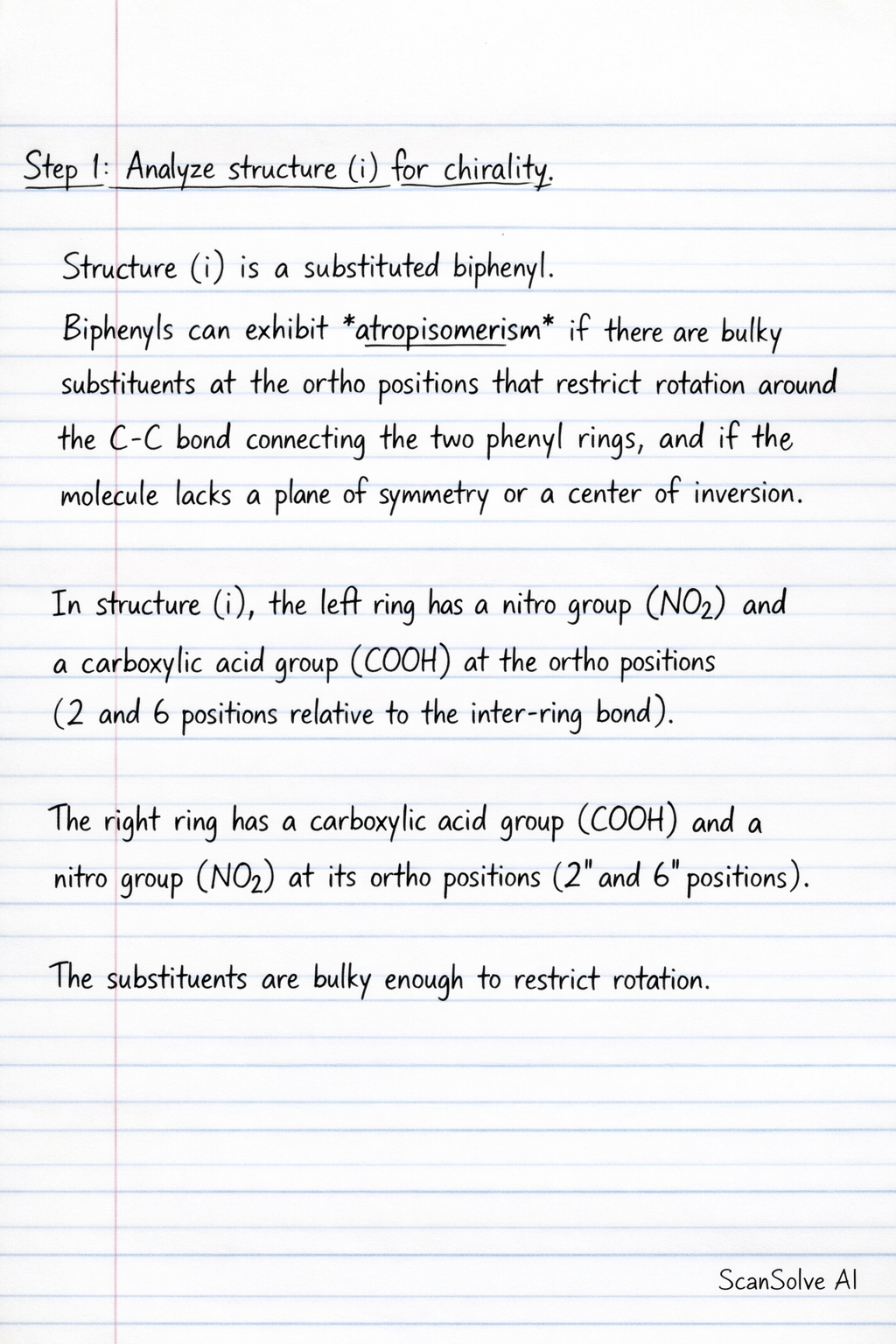
Step 1: Analyze structure (i) for chirality. Structure (i) is a substituted biphenyl. Biphenyls can exhibit atropisomerism if there are bulky substituents at the ortho positions that restrict rotation around the C-C bond connecting the two phenyl rings, and if the molecule lacks a plane of symmetry or a center of inversion. In structure (i), the left ring has a nitro group (NO_2) and a carboxylic acid group (COOH) at the ortho positions (2 and 6 positions relative to the inter-ring bond). The right ring has a carboxylic acid group (COOH) and a nitro group (NO_2) at its ortho positions (2' and 6' positions). The substituents are bulky enough to restrict rotation. If we try to find a plane of symmetry, we see that the substitution pattern is unsymmetrical. For example, a plane passing through the C-C bond connecting the rings would not work because the groups on one side (NO_2 on left, COOH on right) are different from the groups on the other side (COOH on left, NO_2 on right). There is no plane of symmetry or center of inversion. Therefore, structure (i) is chiral. Step 2: Analyze structure (ii) for chirality. Structure (ii) is a dispiro compound with two cyclobutane rings. It has two chiral centers, one on each cyclobutane ring. On the left chiral carbon, the COOH group is shown with a wedge bond (coming out of the plane) and the H atom is shown with a dashed bond (going into the plane). On the right chiral carbon, the COOH group is shown with a dashed bond (going into the plane) and the H atom is shown with a wedge bond (coming out of the plane). This arrangement indicates that the two chiral centers have opposite configurations relative to each other. If we consider a plane of symmetry that passes through the central spiro carbon and bisects the molecule, it would reflect one half onto the other. Specifically, a plane passing through the spiro carbon and the two carbons that are not chiral in each ring (the ones opposite to the chiral carbons) would reflect the left chiral center onto the right chiral center. The wedge COOH on the left would reflect to a dashed COOH on the right, and the dashed H on the left would reflect to a wedge H on the right. This matches the given structure. Since structure (ii) possesses an internal plane of symmetry, it is an achiral molecule, specifically a meso compound. a) Structure (i) is chiral. b) Structure (ii) is achiral.