
We read your photo as:
Answer question 10(b) and 11(a). Describe the structure of graphite and explain why it conducts electricity. Determine the empirical formula of a compound containing 71.12% O, 2.2% H, and 26.68% C.
ScanSolve AI Answer
Step-by-step solution
3 stepsAnswer question 10(b).
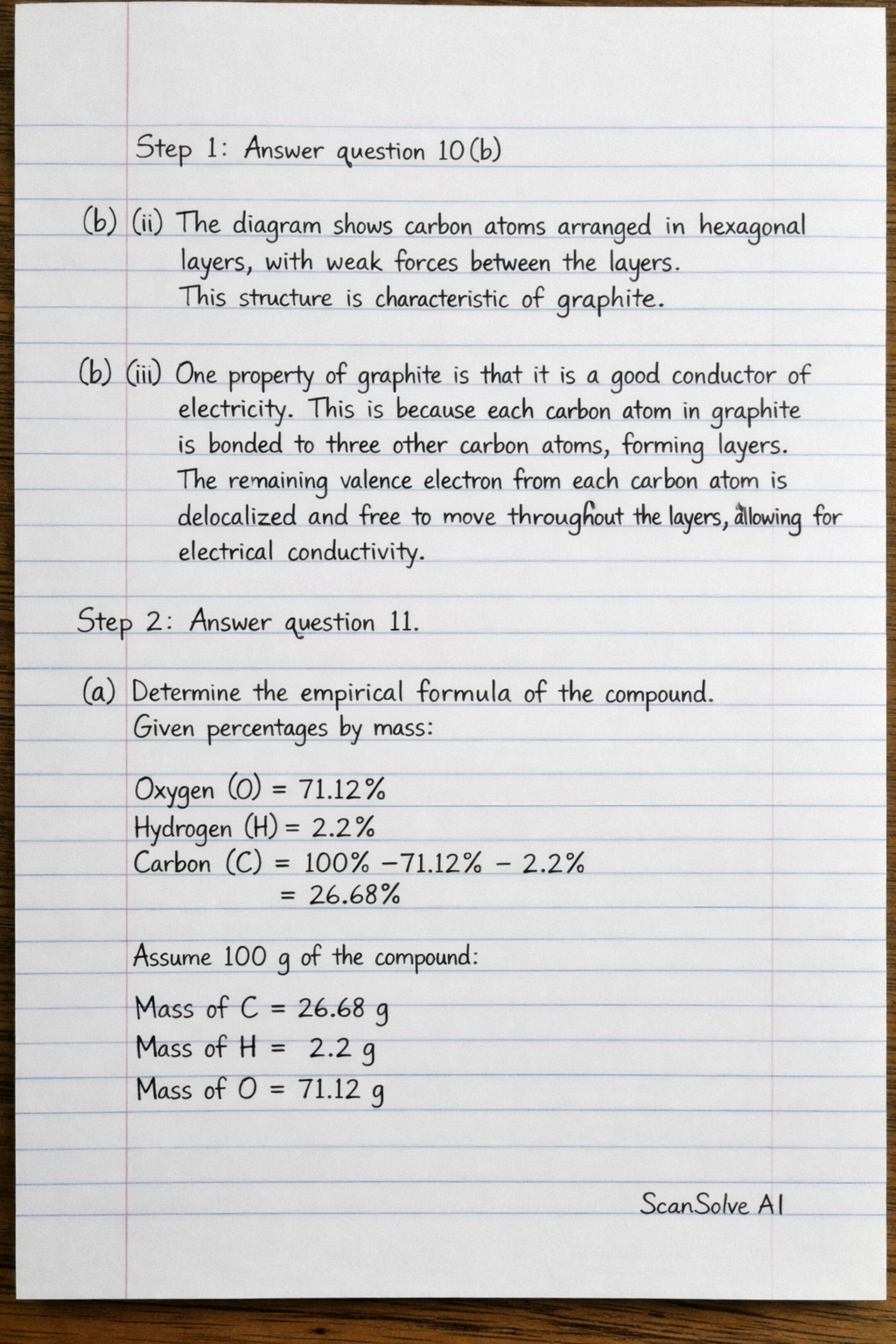
*b) (i) The diagram shows carbon atoms arranged in hexagonal layers, with weak forces between the layers. This structure is characteristic of graphite.
*b) (ii) One property of graphite is that it is a good conductor of electricity. This is because each carbon atom in graphite is bonded to three other carbon atoms, forming layers. The remaining valence electron from each carbon atom is delocalized and free to move throughout the layers, allowing for electrical conductivity.
Answer question 11.
*a) Determine the empirical formula of the compound.
Given percentages by mass:
Oxygen () =
Hydrogen () =
Carbon () =Assume 100 g of the compound:
Mass of C =
Mass of H =
Mass of O =Convert mass to moles (Atomic masses: C=12, H=1, O=16):
Moles of C
Moles of H
Moles of ODivide by the smallest number of moles to find the simplest ratio:
For C:
For H:
For O:The empirical formula is .
*b) Determine the molecular formula of the compound.
Relative molecular mass = 90.
Empirical formula mass of .Let the molecular formula be .
Multiply the subscripts in the empirical formula by :
Molecular formula .Answer question 12.
*a) (i) When hydrogen gas passes over hot lead(II) oxide, the reddish-brown solid lead(II) oxide turns into a grey solid (lead metal).
*a) (ii) The equation for the reaction which occurs in the combustion tube is:
*a) (iii) The property of hydrogen shown in the experiment above is its reducing property (or that it is a reducing agent).
Still stuck on this one?
Ask a follow-up, and the answer starts from this question.
More Chemistry Questions
Handwritten Step-by-Step Solution
Get this as a handwritten image on WhatsApp — like a tutor wrote it for you.
Try on WhatsApp