ScanSolve logoScanSolve
Toggle sidebar
  • Homework
  • Tutor
  • Humanizer
  • AI Detector
  • Questions
  • Blog
  • History
  • Mobile App

  • Homework
  • Tutor
  • Humanizer
  • AI Detector

  • Questions
  • Math homework helpMath
    Physics homework helpPhysics
    Chemistry homework helpChemistry
    Biology homework helpBiology
    Computer Science homework helpComputer Science
    History homework helpHistory
    More homework helpMore
  • Blog
  • History

  • Mobile App
ScanSolvePLUS
  • Unlimited answers
  • ScanSolve AI Pro
Start Free Trial →
Try on WhatsApp
Chemistry: Find the empirical formula of the compound, given the relative atomic mass of si... — Step-by-Step Solution | ScanSolve
Home > Chemistry Homework Help > Solution

Find the empirical formula of the compound, given the relative atomic mass of silicon (Si) = 28 and oxygen (O) = 16. A compound contains 46.7% of silicon (Si) and 53.3% oxygen (O) by mass.

Asked on March 26, 2026|Chemistry

This chemistry question involves key chemical concepts and calculations. The detailed solution below walks through each step, from identifying the reaction type to computing the final answer.

ScanSolve AI AnswerAnswered on March 26, 2026
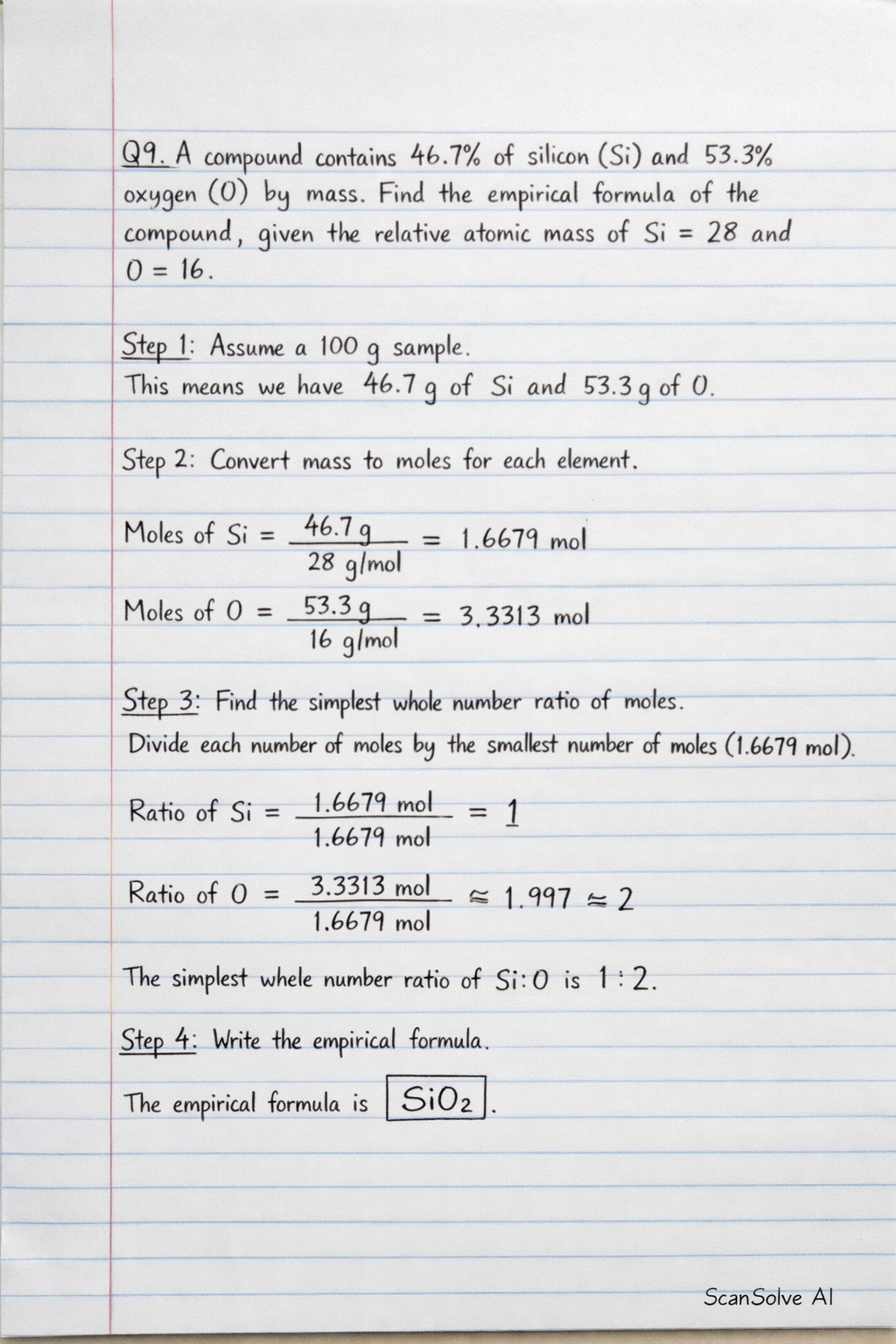
Q9. A compound contains 46.7% of silicon (Si) and 53.3% oxygen (O) by mass. Find the empirical formula of the compound, given the relative atomic mass of silicon (Si) = 28 and oxygen (O) = 16. Step 1: Assume a 100 g sample. This means we have 46.7 g of Si and 53.3 g of O. Step 2: Convert mass to moles for each element. $$ \text{Moles of Si} = \frac{\text{Mass of Si}}{\text{Relative atomic mass of Si}} = \frac{46.7 \text{ g}}{28 \text{ g/mol}} \approx 1.6679 \text{ mol} \\ \text{Moles of O} = \frac{\text{Mass of O}}{\text{Relative atomic mass of O}} = \frac{53.3 \text{ g}}{16 \text{ g/mol}} \approx 3.3313 \text{ mol} $$ Step 3: Find the simplest whole number ratio of moles. Divide each number of moles by the smallest number of moles (1.6679 mol). $$ \text{Ratio of Si} = \frac{1.6679 \text{ mol}}{1.6679 \text{ mol}} = 1 \\ \text{Ratio of O} = \frac{3.3313 \text{ mol}}{1.6679 \text{ mol}} \approx 1.997 \approx 2 $$ The simplest whole number ratio of Si:O is 1:2. Step 4: Write the empirical formula. The empirical formula is $\boxed{\text{SiO}_2}$. --- Q10. Caffeine is a compound found in coffee and tea. The percentage composition of caffeine is 49.1% carbon, 5.1% hydrogen, 16.5% oxygen and 28.9% nitrogen. The relative molecular mass of caffeine is 195. Find the molecular formula of caffeine, given the atomic mass of carbon (C) = 12, hydrogen (H) = 1, oxygen (O) = 16, and nitrogen (N) = 14. Step 1: Assume a 100 g sample and convert percentages to masses. Mass of C = 49.1 g Mass of H = 5.1 g Mass of O = 16.5 g Mass of N = 28.9 g Step 2: Convert mass to moles for each element. $$ \text{Moles of C} = \frac{49.1 \text{ g}}{12 \text{ g/mol}} \approx 4.0917 \text{ mol} \\ \text{Moles of H} = \frac{5.1 \text{ g}}{1 \text{ g/mol}} = 5.1 \text{ mol} \\ \text{Moles of O} = \frac{16.5 \text{ g}}{16 \text{ g/mol}} \approx 1.0313 \text{ mol} \\ \text{Moles of N} = \frac{28.9 \text{ g}}{14 \text{ g/mol}} \approx 2.0643 \text{ mol} $$ Step 3: Find the simplest whole number ratio of moles. Divide each number of moles by the smallest number of moles (1.0313 mol for O). $$ \text{Ratio of C} = \frac{4.0917 \text{ mol}}{1.0313 \text{ mol}} \approx 3.967 \approx 4 \\ \text{Ratio of H} = \frac{5.1 \text{ mol}}{1.0313 \text{ mol}} \approx 4.945 \approx 5 \\ \text{Ratio of O} = \frac{1.0313 \text{ mol}}{1.0313 \text{ mol}} = 1 \\ \text{Ratio of N} = \frac{2.0643 \text{ mol}}{1.0313 \text{ mol}} \approx 2.001 \approx 2 $$ The simplest whole number ratio of C:H:O:N is 4:5:1:2. Step 4: Write the empirical formula. The empirical formula is $\text{C}_4\text{H}_5\text{ON}_2$. Step 5: Calculate the empirical formula mass. $$ \text{Empirical formula mass} = (4 \times 12) + (5 \times 1) + (1 \times 16) + (2 \times 14) \\ = 48 + 5 + 16 + 28 \\ = 97 \text{ g/mol} $$ Step 6: Determine the factor 'n'. Given relative molecular mass = 195. $$ n = \frac{\text{Relative molecular mass}}{\text{Empirical formula mass}} = \frac{195}{97} \approx 2.01 \approx 2 $$ Step 7: Write the molecular formula. Multiply the subscripts in the empirical formula by n=2. $$ \text{Molecular formula} = (\text{C}_4\text{H}_5\text{ON}_2)_2 = \boxed{\text{C}_8\text{H}_{10}\text{O}_2\text{N}_4} $$

Related Chemistry Questions

  • Identify the base and exponents.
  • Identify the atomic number.
  • Acid, bases and salt
  • SECTION A: PHYSICAL CHEMISTRY
  • The image provided is the cover page of a chemistry examination paper. It contains general instructions and information...
  • I) Compound Words
See all Chemistry questions

This step-by-step solution was generated by ScanSolve AI. Need help with more chemistry problems? Browse Chemistry solutions or ask your own question.

Home›Chemistry Homework Help›Find the empirical formula of the compound, given the relati…
Q

Find the empirical formula of the compound, given the relative atomic mass of silicon (Si) = 28 and oxygen (O) = 16. A compound contains 46.7% of silicon (Si) and 53.3% oxygen (O) by mass.

March 26, 2026|Chemistry
Find the empirical formula of the compound, given the relative atomic mass of silicon (Si) = 28 and oxygen (O) = 16. A compound contains 46.7% of silicon (Si) and 53.3% oxygen (O) by mass.

Find the empirical formula of the compound, given the relative atomic mass of silicon (Si) = 28 and oxygen (O) = 16. A compound contains 46.7% of silicon (Si) and 53.3% oxygen (O) by mass.

ScanSolve AI

ScanSolve AI Answer

Answered on March 26, 2026

Q9. A compound contains 46.7% of silicon (Si) and 53.3% oxygen (O) by mass. Find the empirical formula of the compound, given the relative atomic mass of silicon (Si) = 28 and oxygen (O) = 16.

Step 1: Assume a 100 g sample. This means we have 46.7 g of Si and 53.3 g of O.

Step 2: Convert mass to moles for each element.

MolesofSi=MassofSiRelativeatomicmassofSi=46.7g28g/mol≈1.6679molMolesofO=MassofORelativeatomicmassofO=53.3g16g/mol≈3.3313molMoles of Si = \frac{Mass of Si}{Relative atomic mass of Si} = \frac{46.7 g}{28 g/mol} \approx 1.6679 mol \\ Moles of O = \frac{Mass of O}{Relative atomic mass of O} = \frac{53.3 g}{16 g/mol} \approx 3.3313 molMolesofSi=RelativeatomicmassofSiMassofSi​=28g/mol46.7g​≈1.6679molMolesofO=RelativeatomicmassofOMassofO​=16g/mol53.3g​≈3.3313mol

Step 3: Find the simplest whole number ratio of moles. Divide each number of moles by the smallest number of moles (1.6679 mol).

RatioofSi=1.6679mol1.6679mol=1RatioofO=3.3313mol1.6679mol≈1.997≈2Ratio of Si = \frac{1.6679 mol}{1.6679 mol} = 1 \\ Ratio of O = \frac{3.3313 mol}{1.6679 mol} \approx 1.997 \approx 2RatioofSi=1.6679mol1.6679mol​=1RatioofO=1.6679mol3.3313mol​≈1.997≈2

The simplest whole number ratio of Si:O is 1:2.

Step 4: Write the empirical formula. The empirical formula is SiO2\boxed{SiO_2}SiO2​​.


Q10. Caffeine is a compound found in coffee and tea. The percentage composition of caffeine is 49.1% carbon, 5.1% hydrogen, 16.5% oxygen and 28.9% nitrogen. The relative molecular mass of caffeine is 195. Find the molecular formula of caffeine, given the atomic mass of carbon (C) = 12, hydrogen (H) = 1, oxygen (O) = 16, and nitrogen (N) = 14.

Step 1: Assume a 100 g sample and convert percentages to masses.

  • Mass of C = 49.1 g
  • Mass of H = 5.1 g
  • Mass of O = 16.5 g
  • Mass of N = 28.9 g

Step 2: Convert mass to moles for each element.

MolesofC=49.1g12g/mol≈4.0917molMolesofH=5.1g1g/mol=5.1molMolesofO=16.5g16g/mol≈1.0313molMolesofN=28.9g14g/mol≈2.0643molMoles of C = \frac{49.1 g}{12 g/mol} \approx 4.0917 mol \\ Moles of H = \frac{5.1 g}{1 g/mol} = 5.1 mol \\ Moles of O = \frac{16.5 g}{16 g/mol} \approx 1.0313 mol \\ Moles of N = \frac{28.9 g}{14 g/mol} \approx 2.0643 molMolesofC=12g/mol49.1g​≈4.0917molMolesofH=1g/mol5.1g​=5.1molMolesofO=16g/mol16.5g​≈1.0313molMolesofN=14g/mol28.9g​≈2.0643mol

Step 3: Find the simplest whole number ratio of moles. Divide each number of moles by the smallest number of moles (1.0313 mol for O).

RatioofC=4.0917mol1.0313mol≈3.967≈4RatioofH=5.1mol1.0313mol≈4.945≈5RatioofO=1.0313mol1.0313mol=1RatioofN=2.0643mol1.0313mol≈2.001≈2Ratio of C = \frac{4.0917 mol}{1.0313 mol} \approx 3.967 \approx 4 \\ Ratio of H = \frac{5.1 mol}{1.0313 mol} \approx 4.945 \approx 5 \\ Ratio of O = \frac{1.0313 mol}{1.0313 mol} = 1 \\ Ratio of N = \frac{2.0643 mol}{1.0313 mol} \approx 2.001 \approx 2RatioofC=1.0313mol4.0917mol​≈3.967≈4RatioofH=1.0313mol5.1mol​≈4.945≈5RatioofO=1.0313mol1.0313mol​=1RatioofN=1.0313mol2.0643mol​≈2.001≈2

The simplest whole number ratio of C:H:O:N is 4:5:1:2.

Step 4: Write the empirical formula. The empirical formula is C4H5ON2\text{C}_4H_5ON_2C4​H5​ON2​.

Step 5: Calculate the empirical formula mass.

Empiricalformulamass=(4×12)+(5×1)+(1×16)+(2×14)=48+5+16+28=97g/molEmpirical formula mass = (4 \times 12) + (5 \times 1) + (1 \times 16) + (2 \times 14) \\ = 48 + 5 + 16 + 28 \\ = 97 g/molEmpiricalformulamass=(4×12)+(5×1)+(1×16)+(2×14)=48+5+16+28=97g/mol

Step 6: Determine the factor 'n'. Given relative molecular mass = 195.

n=RelativemolecularmassEmpiricalformulamass=19597≈2.01≈2n = \frac{Relative molecular mass}{Empirical formula mass} = \frac{195}{97} \approx 2.01 \approx 2n=EmpiricalformulamassRelativemolecularmass​=97195​≈2.01≈2

Step 7: Write the molecular formula. Multiply the subscripts in the empirical formula by n=2.

Molecular formula = (C_4H_5ON_2)_2 = \text{C_8H_{10}O_2N_4}

Need help with your own homework?

Get instant step-by-step solutions to any question. Free to start.

Ask Your Question
Handwritten step-by-step solution

Handwritten Step-by-Step Solution

Get this solution as a handwritten image on WhatsApp — just like a tutor wrote it for you.

Try on WhatsApp

More Chemistry Questions

Identify the base and exponents.Identify the atomic number.Acid, bases and saltSECTION A: PHYSICAL CHEMISTRYThe image provided is the cover page of a chemistry examination paper. It contains general instructi…I) Compound Words
See all Chemistryquestions →