

This chemistry question involves key chemical concepts and calculations. The detailed solution below walks through each step, from identifying the reaction type to computing the final answer.
ScanSolve AI Answer
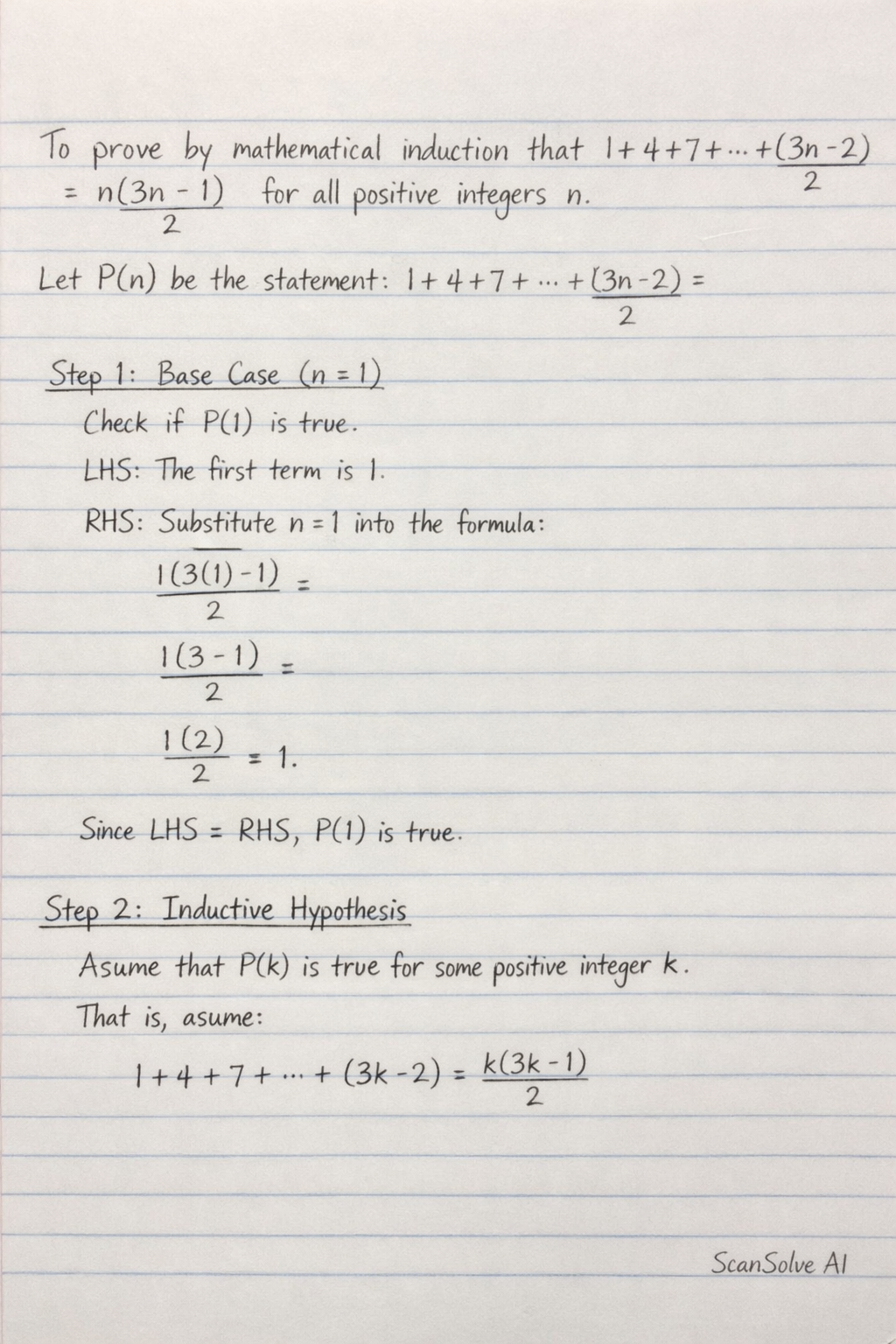
To prove by mathematical induction that 1 + 4 + 7 + + (3n-2) = (n(3n-1))/(2) for all positive integers n. Let P(n) be the statement 1 + 4 + 7 + + (3n-2) = (n(3n-1))/(2). Step 1: Base Case (n=1) Check if P(1) is true. Left Hand Side (LHS): The sum of the first term is 1. Right Hand Side (RHS): Substitute n=1 into the formula: (1(3(1)-1))/(2) = (1(3-1))/(2) = (1(2))/(2) = 1 Since LHS = RHS, P(1) is true. Step 2: Inductive Hypothesis Assume that P(k) is true for some positive integer k. That is, assume: 1 + 4 + 7 + + (3k-2) = (k(3k-1))/(2) Step 3: Inductive Step (Prove P(k+1)) We need to show that P(k+1) is true, i.e., 1 + 4 + 7 + + (3k-2) + (3(k+1)-2) = ((k+1)(3(k+1)-1))/(2) Consider the LHS of P(k+1): 1 + 4 + 7 + + (3k-2) + (3(k+1)-2) Using the Inductive Hypothesis, we can replace the sum up to (3k-2): ( (k(3k-1))/(2) ) + (3(k+1)-2) Simplify the last term: (k(3k-1))/(2) + (3k+3-2) (k(3k-1))/(2) + (3k+1) Combine the terms by finding a common denominator: (k(3k-1) + 2(3k+1))/(2) Expand the numerator: (3k^2 - k + 6k + 2)/(2) (3k^2 + 5k + 2)/(2) Now, consider the RHS of P(k+1): ((k+1)(3(k+1)-1))/(2) Simplify inside the parenthesis: ((k+1)(3k+3-1))/(2) ((k+1)(3k+2))/(2) Expand the numerator: (k(3k) + k(2) + 1(3k) + 1(2))/(2) (3k^2 + 2k + 3k + 2)/(2) (3k^2 + 5k + 2)/(2) Since the LHS equals the RHS, P(k+1) is true. Conclusion: By the principle of mathematical induction, the statement 1 + 4 + 7 + + (3n-2) = (n(3n-1))/(2) is true for all positive integers n. Last free one today — make it count tomorrow, or type /upgrade for unlimited.