
We read your photo as:
Describe briefly how temporary hardness of water can be removed, how EDTA can be used in estimating water hardness, and how activated charcoal is used in water treatment.
ScanSolve AI Answer
Step-by-step solution
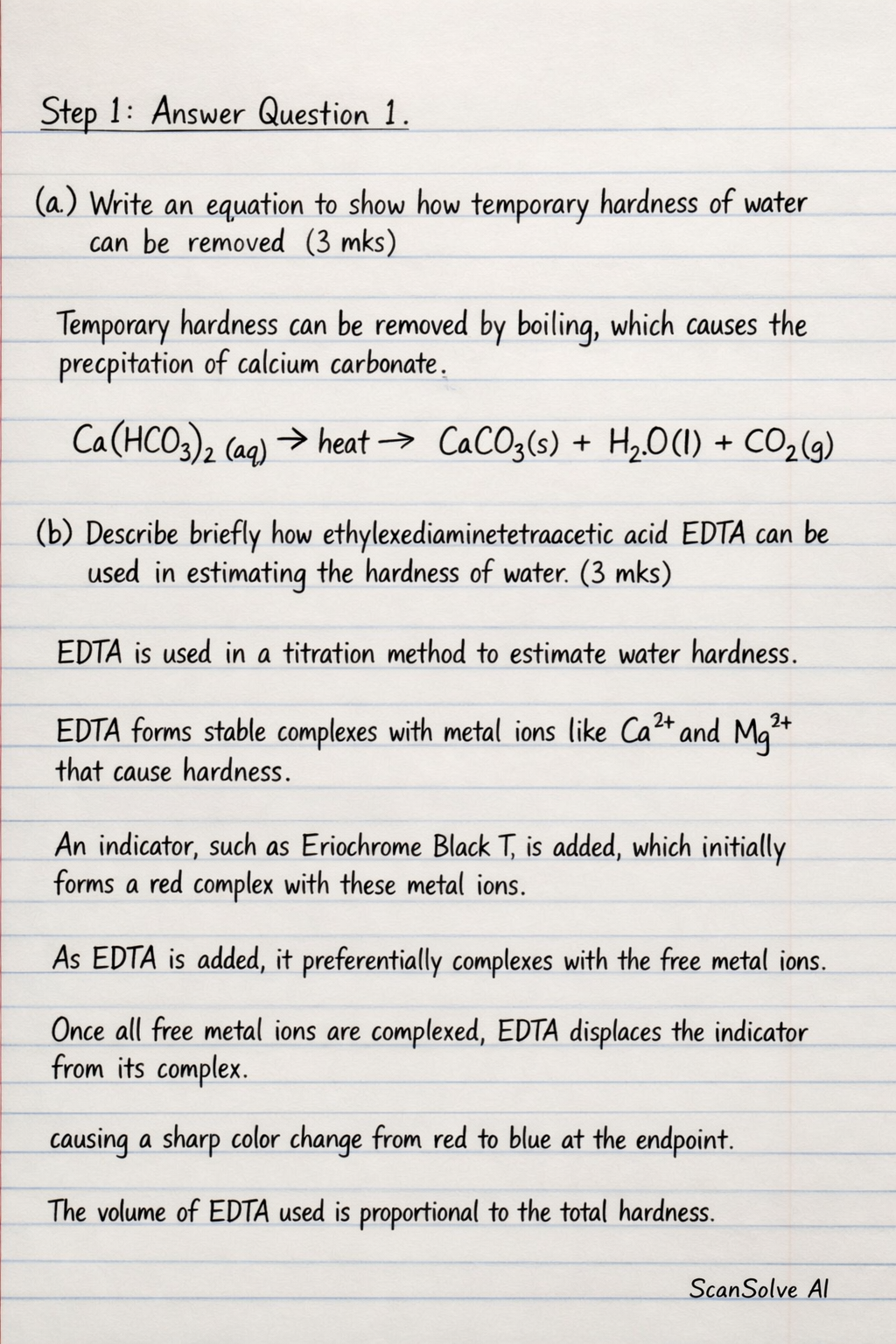
3 stepsAnswer Question 1.
a) Write an equation to show how temporary hardness of water can be removed (3 mks)
Temporary hardness can be removed by boiling, which causes the precipitation of calcium carbonate.b) Describe briefly how ethylenediaminetetraacetic acid EDTA can be used in estimating the hardness of water. (3 mks)
EDTA is used in a titration method to estimate water hardness. EDTA forms stable complexes with metal ions like and that cause hardness. An indicator, such as Eriochrome Black T, is added, which initially forms a red complex with these metal ions. As EDTA is added, it preferentially complexes with the free metal ions. Once all free metal ions are complexed, EDTA displaces the indicator from its complex, causing a sharp color change from red to blue at the endpoint. The volume of EDTA used is proportional to the total hardness.c) Explain briefly how activated charcoal is used in water treatment (3 mks)
Activated charcoal is a highly porous form of carbon with a large surface area. It is used in water treatment primarily through the process of adsorption. Its porous structure effectively traps and removes organic compounds, chlorine, pesticides, and other dissolved impurities that cause undesirable tastes, odors, and colors in water.d) Why is elemental Cl not found free in nature but rather as ions or molecules or in compounds. (3 mks)
Elemental chlorine () is highly reactive due to its strong electronegativity and its tendency to achieve a stable electron configuration (an octet). It readily gains an electron to form a chloride ion () or forms covalent bonds with other chlorine atoms to form diatomic molecules (), or with other elements to form compounds. Therefore, it is not found as isolated, unbonded atoms in nature.Answer Question 2.
a) Give two (2) reasons why atomic radius of a given group of elements increases down the group. (3 mks)
- Increase in the number of electron shells: As you move down a group, each successive element adds a new principal electron shell, increasing the distance between the outermost electrons and the nucleus.
- Increased shielding effect: The additional inner electron shells shield the valence electrons from the full positive charge of the nucleus. This reduces the effective nuclear charge experienced by the outermost electrons, allowing them to spread out further.
b) Explain why fluorine (F) does not exist in nature in the atomic form (2 mks)
Fluorine (F) is the most electronegative element and is highly reactive. It readily gains an electron to form a stable fluoride ion () or forms a strong covalent bond with another fluorine atom to form a diatomic molecule (). It is energetically unstable as a single, unbonded atom and thus does not exist in that form in nature.c) HCl is said to be more acidic than HF, explain this assertion based on Hydrogen-halogen bond strength (4 mks)
The acidity of hydrogen halides (HX) in aqueous solution depends on the ease with which the H-X bond can break to release ions. The H-F bond is significantly stronger than the H-Cl bond. This is because fluorine is a much smaller atom than chlorine, leading to a shorter and more concentrated bond with hydrogen. A stronger H-F bond requires more energy to break, meaning HF dissociates less readily in water compared to HCl. Consequently, HCl releases ions more easily and is therefore a stronger acid than HF.Answer Question 3.
a) Balance the equation: Li + N₂ → ? (1 mk)
b) In a simple flame test, which color will the following elements give: (i) Ca (1mk) (ii) Mg (1mk) (iii) potassium (1mk)
- (i) Ca (Calcium): Brick-red
- (ii) Mg (Magnesium): No characteristic color (or very faint white)
- (iii) Potassium (K): Lilac (or pale purple)
c) List two (2) uses of: (i) Ra (2 mks) (ii) Mg (2 mks) (iii) Na (2 mks) (d) hard water (2 mks)
- (i) Ra (Radium):
- Historically used in luminous paints for watch dials and instrument panels.
- Used in radiotherapy for cancer treatment.
- (ii) Mg (Magnesium):
- Used in lightweight alloys (e.g., with aluminum) for aircraft and automotive parts.
- Used in fireworks and flares due to its bright white flame.
- (iii) Na (Sodium):
- Used in sodium vapor lamps for street lighting.
- Used as a coolant in nuclear reactors.
- (d) Hard water:
- Can be a source of essential dietary minerals like calcium and magnesium.
- Used in brewing to enhance the flavor and stability of certain beers.
d) Write an equation to show the reaction between lithium oxide and water. (3 mks)
Still stuck on this one?
Ask a follow-up, and the answer starts from this question.
More Chemistry Questions
Handwritten Step-by-Step Solution
Get this as a handwritten image on WhatsApp — like a tutor wrote it for you.
Try on WhatsApp