
We read your photo as:
When bromine reacts with potassium chloride and potassium iodide, what happens? Write balanced equations for chlorine reacting with calcium bromide and sodium iodide.
ScanSolve AI Answer
Here are the answers to Question 3:
i) What happens when bromine reacts with:
a) Potassium chloride?
Bromine is less reactive than chlorine. Therefore, bromine cannot displace chlorine from potassium chloride.
No reaction occurs.
b) Potassium iodide?
Bromine is more reactive than iodine. Therefore, bromine will displace iodine from potassium iodide, forming potassium bromide and iodine.
Bromine displaces iodine to form potassium bromide and iodine.
ii) Write a complete balanced equation when chlorine reacts with:
a) Calcium bromide
Chlorine is more reactive than bromine, so it will displace bromine from calcium bromide.
b) Sodium iodide
Chlorine is more reactive than iodine, so it will displace iodine from sodium iodide.
Still stuck on this one?
Ask a follow-up, and the answer starts from this question.
More Chemistry Questions
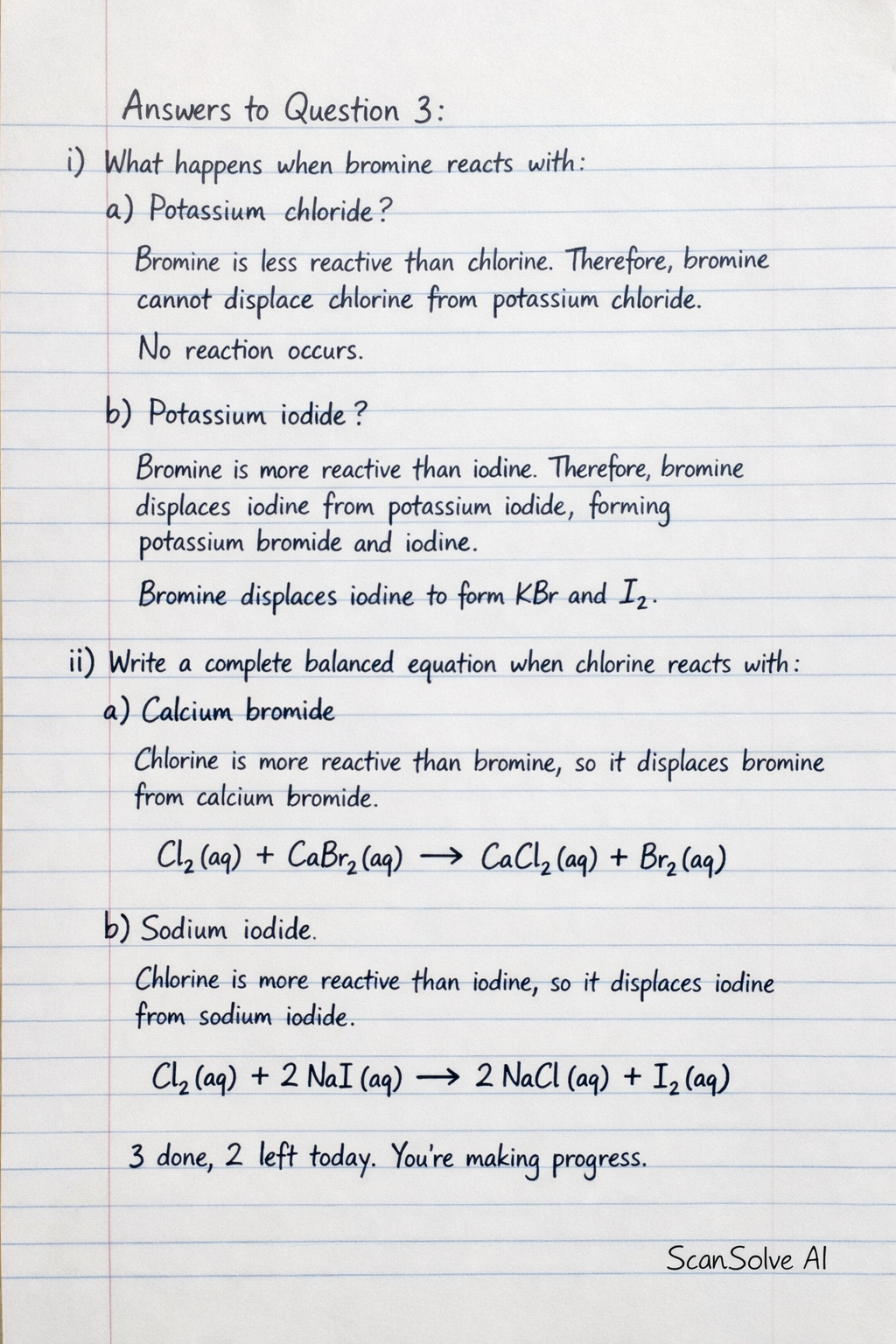
Handwritten Step-by-Step Solution
Get this as a handwritten image on WhatsApp — like a tutor wrote it for you.
Try on WhatsApp