
We read your photo as:
Explain the changes made to the equilibrium mixture and their effects on the yield of ammonia.
ScanSolve AI Answer
Answer
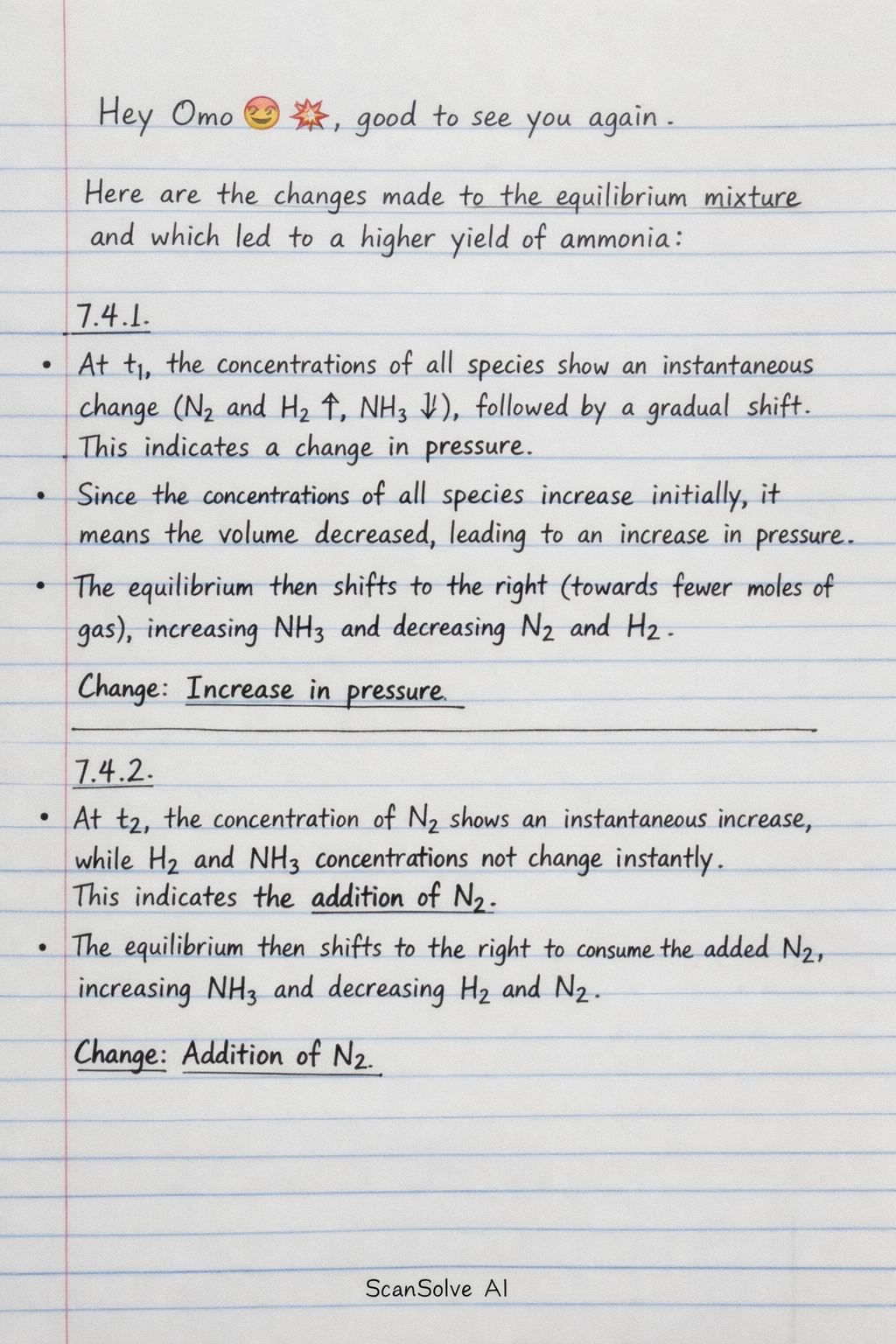
Here are the changes made to the equilibrium mixture and which led to a higher yield of ammonia:
7.4.1
At t, the concentrations of all species show an instantaneous change (N and H increase, NH decreases), followed by a gradual shift. This indicates a change in pressure. Since the concentrations of all species increase initially, it means the volume decreased, leading to an increase in pressure.
The equilibrium then shifts to the right (towards fewer moles of gas), increasing NH and decreasing N and H.
Change: Increase in pressure
7.4.2
At t, the concentration of N shows an instantaneous increase, while H and NH concentrations do not change instantly. This indicates the addition of N.
The equilibrium then shifts to the right to consume the added N, increasing NH and decreasing H and N.
Change: Addition of N
7.4.3
At t, all concentrations change gradually without any instantaneous jumps. The concentration of NH decreases, while N and H increase. This indicates a shift to the left. Since the forward reaction is exothermic (), an increase in temperature favors the endothermic reverse reaction.
Change: Increase in temperature
7.5
A higher yield of ammonia means the equilibrium shifts to the right, increasing the concentration of NH.
- At t, increasing pressure shifts the equilibrium to the right (fewer moles of gas), leading to a higher yield of NH.
- At t, adding N (a reactant) shifts the equilibrium to the right, leading to a higher yield of NH.
- At t, increasing temperature shifts the equilibrium to the left (endothermic reverse reaction), leading to a lower yield of NH.
Therefore, the changes made at t and t led to a higher yield of ammonia.
Answer:
Try one yourself
A new problem that tests the same skill.
Still stuck on this one?
Ask a follow-up, and the answer starts from this question.
More Chemistry Questions
Handwritten Step-by-Step Solution
Get this as a handwritten image on WhatsApp — like a tutor wrote it for you.
Try on WhatsApp