
We read your photo as:
For the reaction N2(g) + 3H2(g) <=> 2NH3(g) with ΔH = -92 kJ/mol, state the equilibrium law and the effect of changes in concentration, temperature, and pressure on the equilibrium position.
ScanSolve AI Answer
Answers
3 partsStep-by-step solution
10 stepsParts (A) and (B) of the question require experimental data (e.g., initial rates at different concentrations) to determine the order of reaction and calculate the rate constant. This data is not provided in the image. Therefore, these parts cannot be solved.
Part c(i)
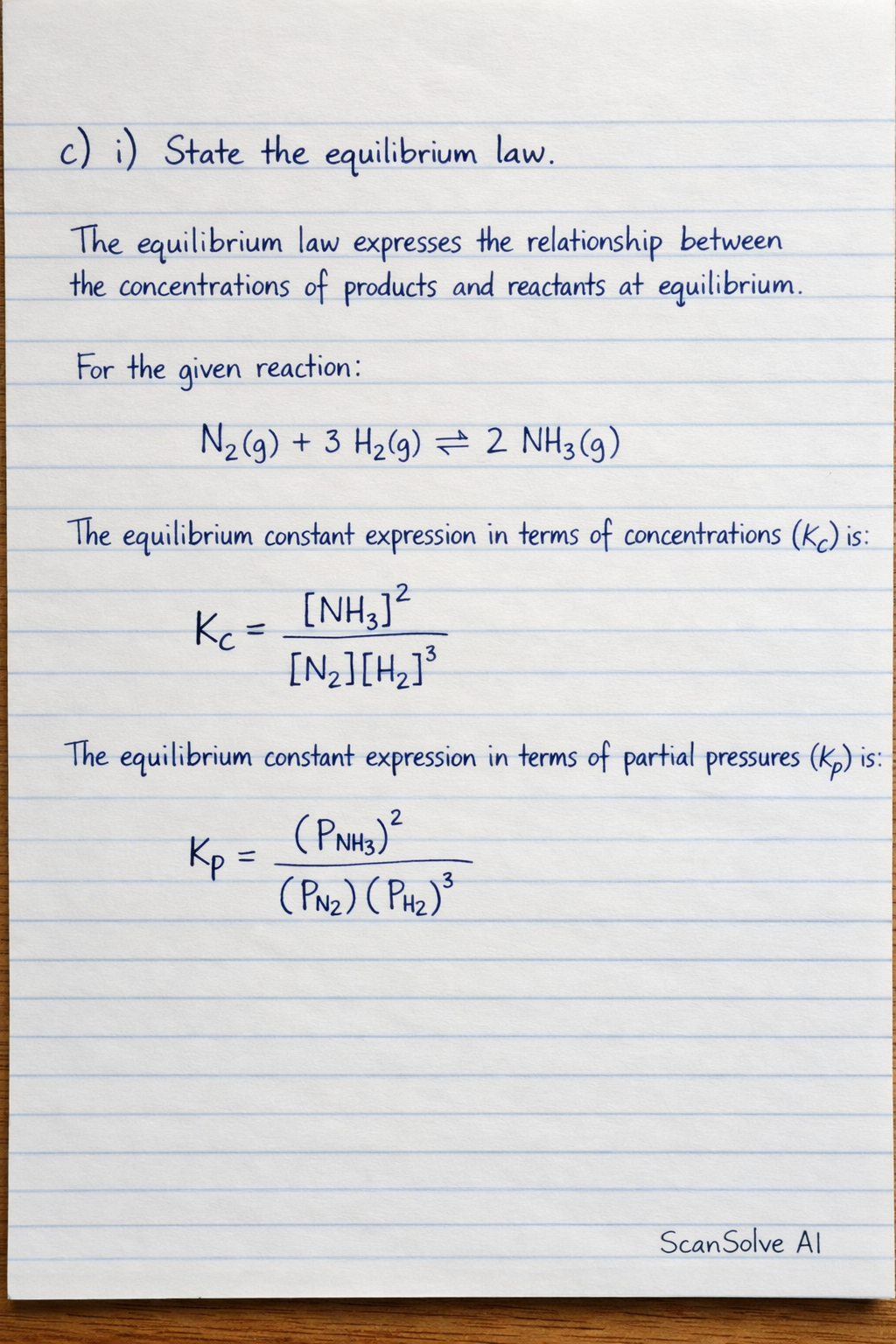
State the equilibrium law.
The equilibrium law expresses the relationship between the concentrations (or partial pressures) of products and reactants at equilibrium. For the given reaction:
The equilibrium constant expression in terms of concentrations () is:
The equilibrium constant expression in terms of partial pressures () is:
The equilibrium law states that at a given temperature, the ratio of the product of the concentrations (or partial pressures) of the products raised to their stoichiometric coefficients to the product of the concentrations (or partial pressures) of the reactants raised to their stoichiometric coefficients is a constant.
Part c(ii)· 4 steps
State the effect of the following on the equilibrium position for the reaction above
The reaction is with . This indicates the forward reaction is exothermic.
(A) Increase in temperature:
Identify the nature of the reaction's enthalpy change.
The forward reaction is exothermic ().
Apply Le Chatelier's principle.
An increase in temperature will shift the equilibrium in the endothermic direction to absorb the added heat. The reverse reaction (decomposition of ) is endothermic.
The equilibrium position will shift to the left, favoring the formation of reactants ( and ).(B) Decrease in pressure:
Determine the number of moles of gaseous reactants and products.
Reactant side:
Product side:Apply Le Chatelier's principle.
A decrease in pressure will shift the equilibrium to the side with a greater number of moles of gas to counteract the pressure change.
The equilibrium position will shift to the left, favoring the formation of reactants ( and ).
Part d(i)0.4894
Calculate the mole fraction of each component in the solution.
Given:
Vapor pressure of pure ethanol () = 44 mmHg
Vapor pressure of pure methanol () = 94 mmHg
Mass of methanol () = 30g
Mass of ethanol () = 45g
RAM: C=12, O=16, H=1
Calculate the molar mass of each component.
Molar mass of
Molar mass ofCalculate the moles of each component.
Moles of methanol ():
Moles of ethanol ():
Calculate the total moles in the solution.
Calculate the mole fraction of each component.
Mole fraction of methanol ():
Mole fraction of ethanol ():
Part d(ii)
Calculate the partial vapor pressure of each component in the solution at 20°C.
Apply Raoult's Law ().
Partial vapor pressure of methanol ():
Partial vapor pressure of ethanol ():
Part d(iii)
Calculate the total vapor pressure of the mixture.
Apply Dalton's Law of Partial Pressures ().
2. (a) (i) Define the term standard enthalpy of formation.
The *standard enthalpy
Try one yourself
A new problem that tests the same skill.
Still stuck on this one?
Ask a follow-up, and the answer starts from this question.
More Chemistry Questions
Handwritten Step-by-Step Solution
Get this as a handwritten image on WhatsApp — like a tutor wrote it for you.
Try on WhatsApp