
Chemical equilibria: Reversible reactions and factors governing the equilibrium position Dynamic equilibrium Le chatelier's principle and equilibrium constant Simple examples to include action of steam on iron
ScanSolve AI Answer
-
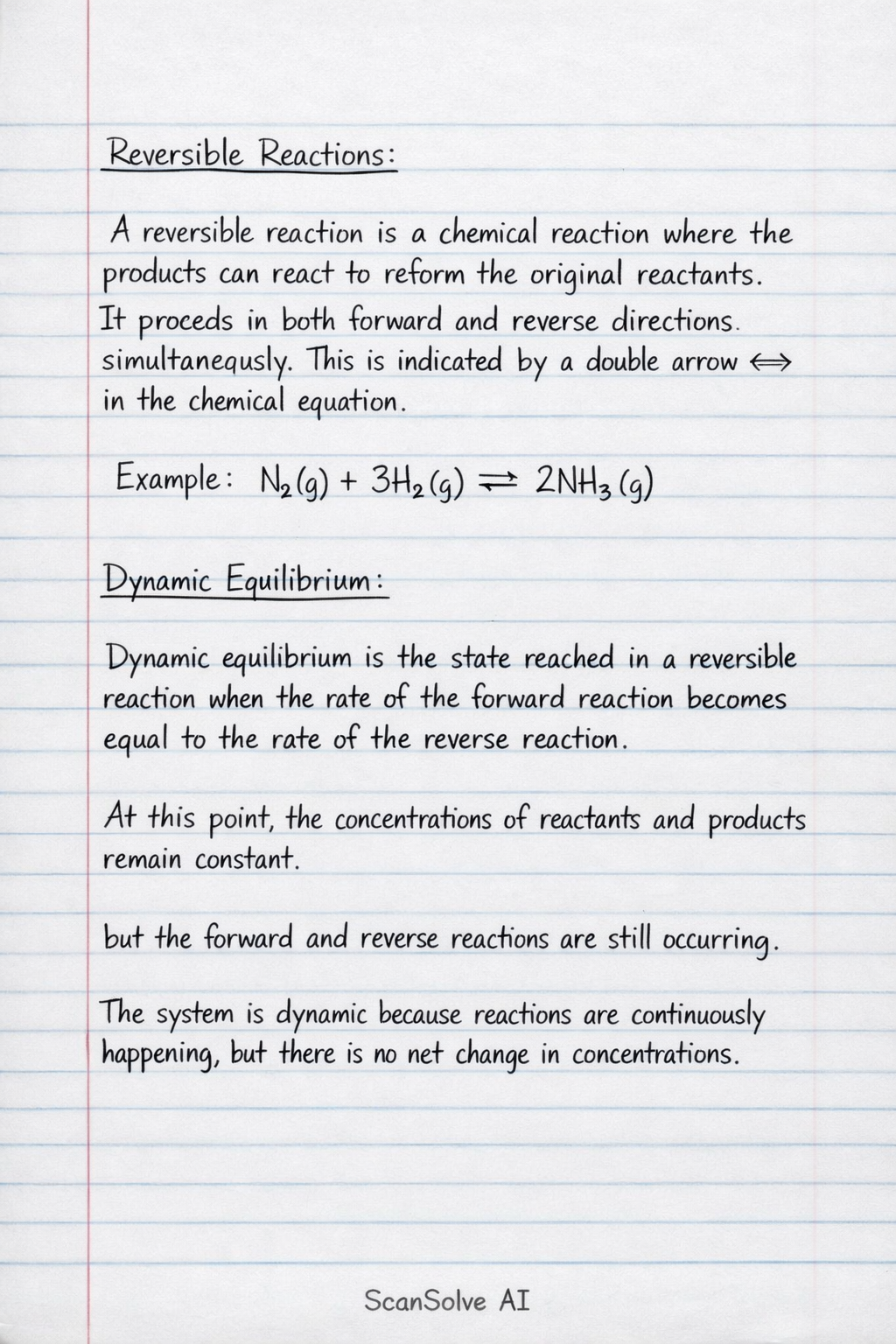
Reversible Reactions: A reversible reaction is a chemical reaction where the products can react to reform the original reactants. It proceeds in both forward and reverse directions simultaneously. This is indicated by a double arrow () in the chemical equation. Example:
-
Dynamic Equilibrium: Dynamic equilibrium is the state reached in a reversible reaction when the rate of the forward reaction becomes equal to the rate of the reverse reaction. At this point, the concentrations of reactants and products remain constant, but the forward and reverse reactions are still occurring. The system is dynamic because reactions are continuously happening, but there is no net change in concentrations.
-
Factors Governing the Equilibrium Position: The position of equilibrium refers to the relative amounts of reactants and products at equilibrium. It can be shifted by changes in:
- Concentration of reactants or products.
- Pressure (for reactions involving gases).
- Temperature.
- A catalyst does not affect the equilibrium position but speeds up the attainment of equilibrium.
-
Le Chatelier's Principle: Le Chatelier's Principle states that if a change of condition (e.g., temperature, pressure, or concentration) is applied to a system in equilibrium, the system will shift in a direction that relieves the stress.
-
Effect of Concentration Change:
- Increasing the concentration of a reactant shifts the equilibrium to the right (towards products).
- Increasing the concentration of a product shifts the equilibrium to the left (towards reactants).
- Decreasing the concentration of a reactant shifts the equilibrium to the left.
- Decreasing the concentration of a product shifts the equilibrium to the right.
-
Effect of Pressure Change (for gaseous reactions):
- Increasing pressure shifts the equilibrium towards the side with fewer moles of gas.
- Decreasing pressure shifts the equilibrium towards the side with more moles of gas.
- If the number of moles of gas is equal on both sides, pressure change has no effect on the equilibrium position.
-
Effect of Temperature Change:
- Increasing temperature shifts the equilibrium in the endothermic direction (to absorb the added heat).
- Decreasing temperature shifts the equilibrium in the exothermic direction (to release heat).
-
Effect of Catalyst: A catalyst increases the rates of both the forward and reverse reactions equally. Therefore, it helps the system reach equilibrium faster but does not change the position of the equilibrium or the equilibrium constant.
-
-
Equilibrium Constant ( and ): The equilibrium constant is a value that expresses the ratio of product concentrations to reactant concentrations at equilibrium, each raised to the power of their stoichiometric coefficients. It indicates the extent to which a reaction proceeds to completion.
-
(in terms of concentrations): For a general reversible reaction:
The equilibrium constant is given by:
where , , , and are the molar concentrations of the species at equilibrium. Pure solids and liquids are not included in the expression.
-
(in terms of partial pressures): For reactions involving gases, the equilibrium constant is expressed using partial pressures:
where , , , and are the partial pressures of the gaseous species at equilibrium.
-
Significance of values:
- If (large value), the equilibrium lies far to the right, favoring products.
- If (small value), the equilibrium lies far to the left, favoring reactants.
- If , significant amounts of both reactants and products are present at equilibrium.
-
-
Simple Example: Action of Steam on Iron: The reaction between iron and steam is a reversible reaction:
-
Equilibrium Constant Expression (): Since and are pure solids, they are not included in the expression.
-
Applying Le Chatelier's Principle:
-
Effect of Concentration/Partial Pressure:
- Increasing (adding steam): Equilibrium shifts to the right, favoring the formation of and .
- Increasing (adding hydrogen): Equilibrium shifts to the left, favoring the formation of and .
- Removing : Equilibrium shifts to the right to produce more .
-
Effect of Pressure (Total Pressure):
- Reactant side has 4 moles of gaseous .
- Product side has 4 moles of gaseous .
- Since the number of moles of gas is equal on both sides (4 moles on each side), a change in total pressure will have no effect on the equilibrium position.
-
Effect of Temperature:
- The forward reaction is endothermic ().
- Increasing temperature: Equilibrium shifts to the right (endothermic direction) to absorb the added heat, favoring the formation of and .
- Decreasing temperature: Equilibrium shifts to the left (exothermic direction) to release heat, favoring the formation of and .
-
-
Still stuck on this one?
Ask a follow-up, and the answer starts from this question.
More Chemistry Questions
Handwritten Step-by-Step Solution
Get this as a handwritten image on WhatsApp — like a tutor wrote it for you.
Try on WhatsApp