

This chemistry question involves key chemical concepts and calculations. The detailed solution below walks through each step, from identifying the reaction type to computing the final answer.
ScanSolve AI Answer
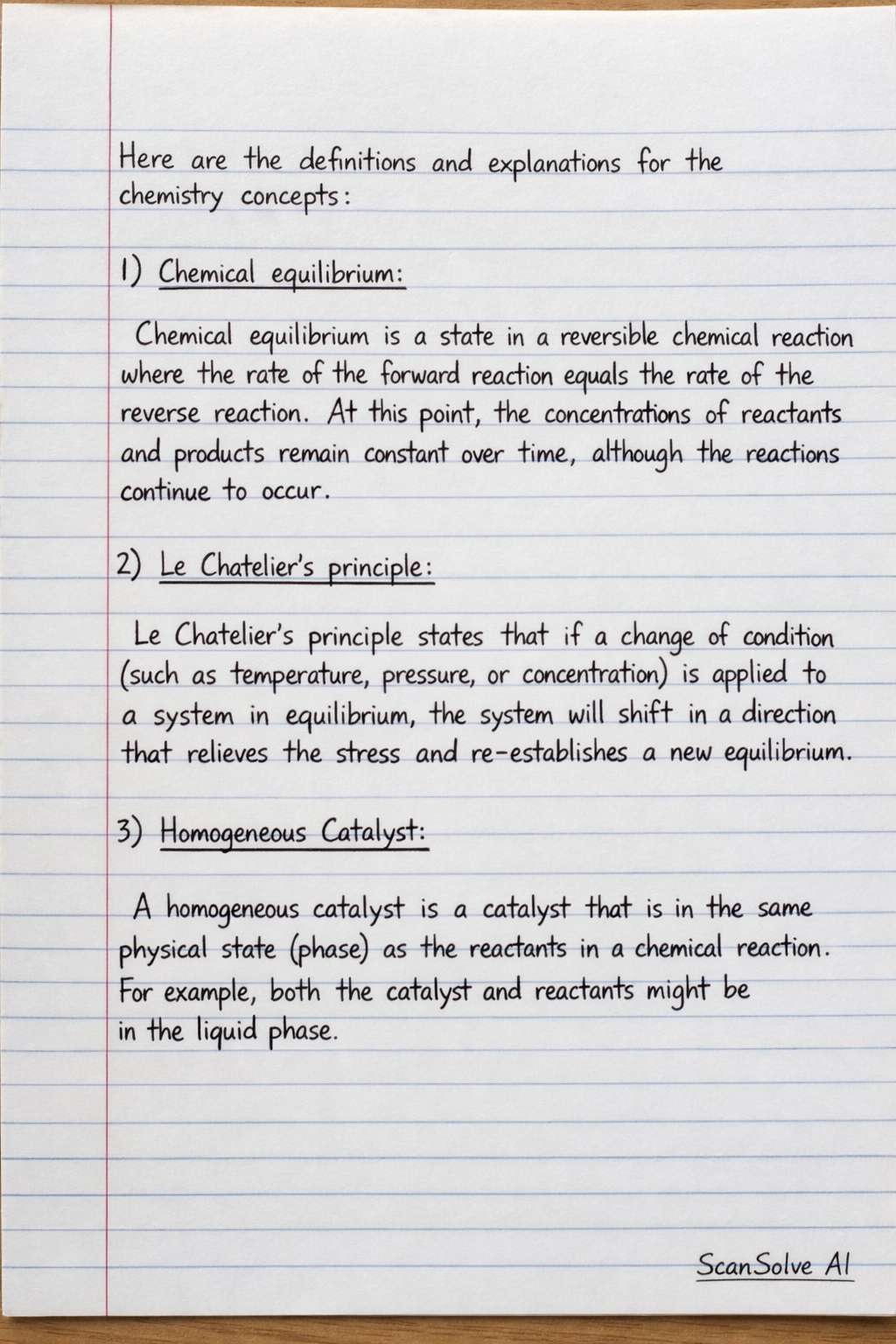
Here are the definitions and explanations for the chemistry concepts: 1) Chemical equilibrium: Chemical equilibrium is a state in a reversible chemical reaction where the rate of the forward reaction equals the rate of the reverse reaction. At this point, the concentrations of reactants and products remain constant over time, although the reactions continue to occur. 2) Le Chatelier's principle: Le Chatelier's principle states that if a change of condition (such as temperature, pressure, or concentration) is applied to a system in equilibrium, the system will shift in a direction that relieves the stress and re-establishes a new equilibrium. 3) Homogeneous Catalyst: A homogeneous catalyst is a catalyst that is in the same physical state (phase) as the reactants in a chemical reaction. For example, both the catalyst and reactants might be in the liquid phase. 4) Heterogeneous Catalyst: A heterogeneous catalyst is a catalyst that is in a different physical state (phase) from the reactants in a chemical reaction. For example, a solid catalyst used with gaseous or liquid reactants. What's next?