
We read your photo as:
Choose from the options below an oxide of a group 14 (IV) element that exhibits amphipoteric character.
ScanSolve AI Answer
This answer stops before the end.
It was cut off when it was first written. Ask ScanSolve this question again for the full working.
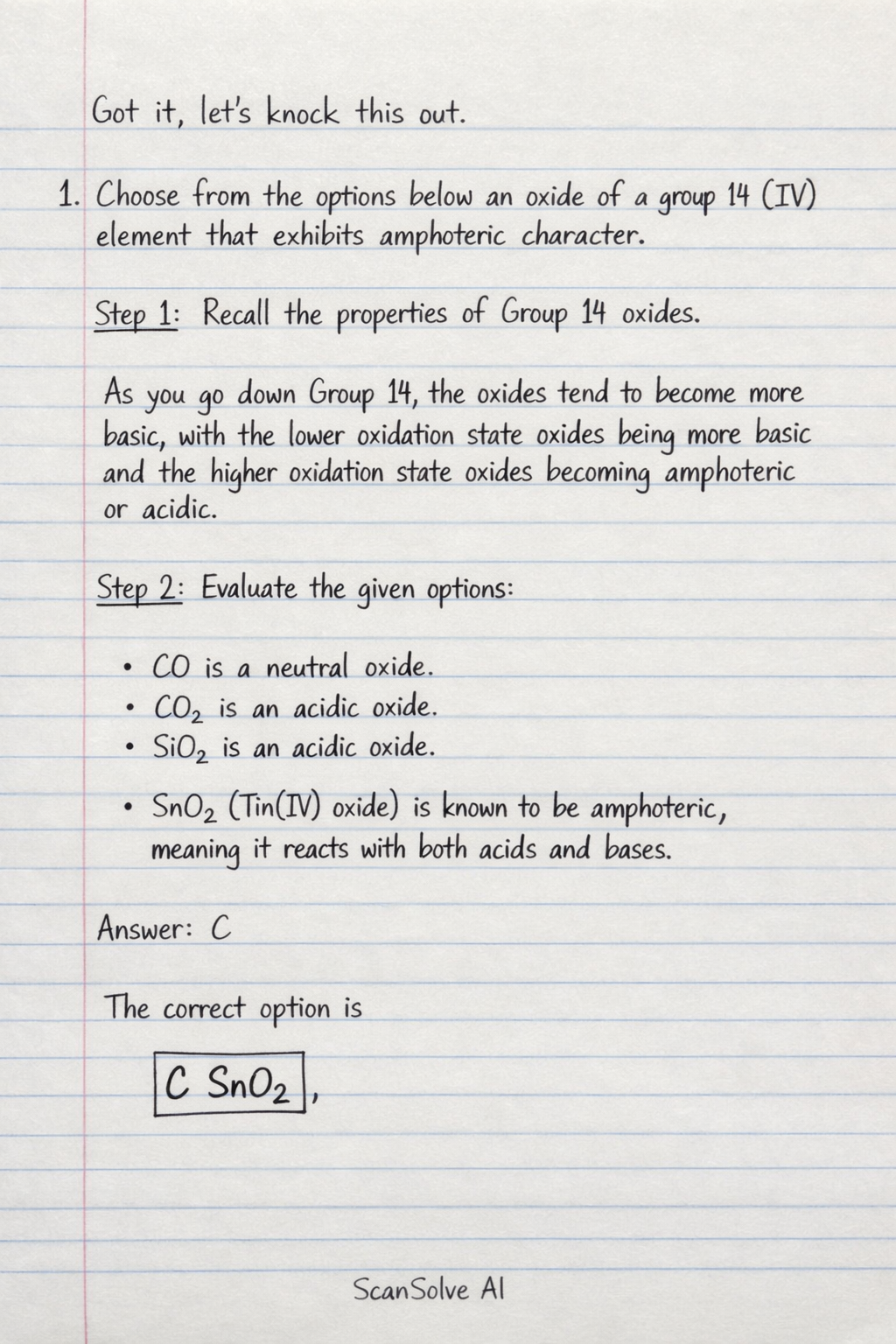
1. Choose from the options below an oxide of a group 14 (IV) element that exhibits amphoteric character.
- Step 1: Recall the properties of Group 14 oxides. As you go down Group 14, the oxides tend to become more basic, with the lower oxidation state oxides being more basic and the higher oxidation state oxides becoming amphoteric or acidic.
- Step 2: Evaluate the given options:
- CO is a neutral oxide.
- is an acidic oxide.
- is an acidic oxide.
- (Tin(IV) oxide) is known to be amphoteric, meaning it reacts with both acids and bases.
- Answer: C The correct option is .
2. Which of the following can be used as a primary standard in volumetric analysis?
- Step 1: A primary standard is a substance of high purity, stability, high molar mass, and does not absorb moisture or carbon dioxide from the air.
- Step 2: Evaluate the options:
- KOH, HCl, and are either hygroscopic (absorb water) or volatile, making their concentrations difficult to maintain precisely. They are secondary standards.
- (sodium carbonate) is a stable, non-hygroscopic solid with a relatively high molar mass, making it suitable as a primary standard for acid-base titrations.
- Answer: D The correct option is .
3. Identify the compound which on warming with aqueous sodium hydroxide will produce an alcohol.
- Step 1: Warming with aqueous sodium hydroxide () suggests a nucleophilic substitution reaction (hydrolysis) for haloalkanes.
- Step 2: Evaluate the options:
- (ethanoic acid) is an acid and would form a salt.
- (methanol) is already an alcohol.
- (propene) is an alkene and would not form an alcohol under these conditions.
- (bromoethane) is a haloalkane. It undergoes hydrolysis with aqueous to produce an alcohol ().
- Answer: D The correct option is .
4. The mole fraction of methanol in a mixture containing 2.0 moles of methanol and 3.0 moles of ethanol is:
- Step 1: Calculate the total number of moles in the mixture. Total moles = moles of methanol + moles of ethanol Total moles =
- Step 2: Calculate the mole fraction of methanol. Mole fraction of methanol () =
- Answer: B The correct option is .
5. Indicate the type of isomerism that exists between propanal () and propanone ().
- Step 1: Identify the functional groups of each compound.
- Propanal () is an aldehyde.
- Propanone () is a ketone.
- Step 2: Determine their molecular formulas. Both have the molecular formula .
- Step 3: Since they have the same molecular formula but different functional groups, they are functional group isomers.
- Answer: D The correct option is .
6. What is the number of moles of carbonate ions () in 21.2 g of ? (RMM )
- Step 1: Calculate the number of moles of . Moles of Moles of
- Step 2: Determine the moles of carbonate ions. From the chemical formula , 1 mole of contains 1 mole of ions. Therefore, moles of ions = .
- Answer: B The correct option is .
7. Identify the particle X in the following nuclear reaction: .
- Step 1: Apply the conservation of mass number (superscript) and atomic number (subscript). For mass number: . For atomic number: .
- Step 2: Identify the particle with a mass number of 4 and an atomic number of 2. This corresponds to an alpha particle ($_{2}^{4}
Still stuck on this one?
Ask a follow-up, and the answer starts from this question.
More Chemistry Questions
Handwritten Step-by-Step Solution
Get this as a handwritten image on WhatsApp — like a tutor wrote it for you.
Try on WhatsApp