
Chronological reduction of a map 🗺 using short steps
ScanSolve AI Answer
Step-by-step solution
4 stepsHere are the steps for reducing a map:
Identify the original scale of the map.
This is typically given as a representative fraction (e.g., 1:50,000) or a graphic scale bar.
Determine the desired new scale for the reduced map.
For a reduction, the new scale's denominator will be larger than the original scale's denominator (e.g., reducing from 1:50,000 to 1:100,000).
Calculate the reduction factor.
This is the ratio of the original scale's denominator to the new scale's denominator.
For example, if reducing from 1:50,000 to 1:100,000, the reduction factor is:Apply the reduction factor to all linear measurements on the map.
Multiply every distance on the original map by this factor to get the corresponding distance on the reduced map. For instance, a 4 cm line on the original map would become on the reduced map.
Still stuck on this one?
Ask a follow-up, and the answer starts from this question.
More Chemistry Questions
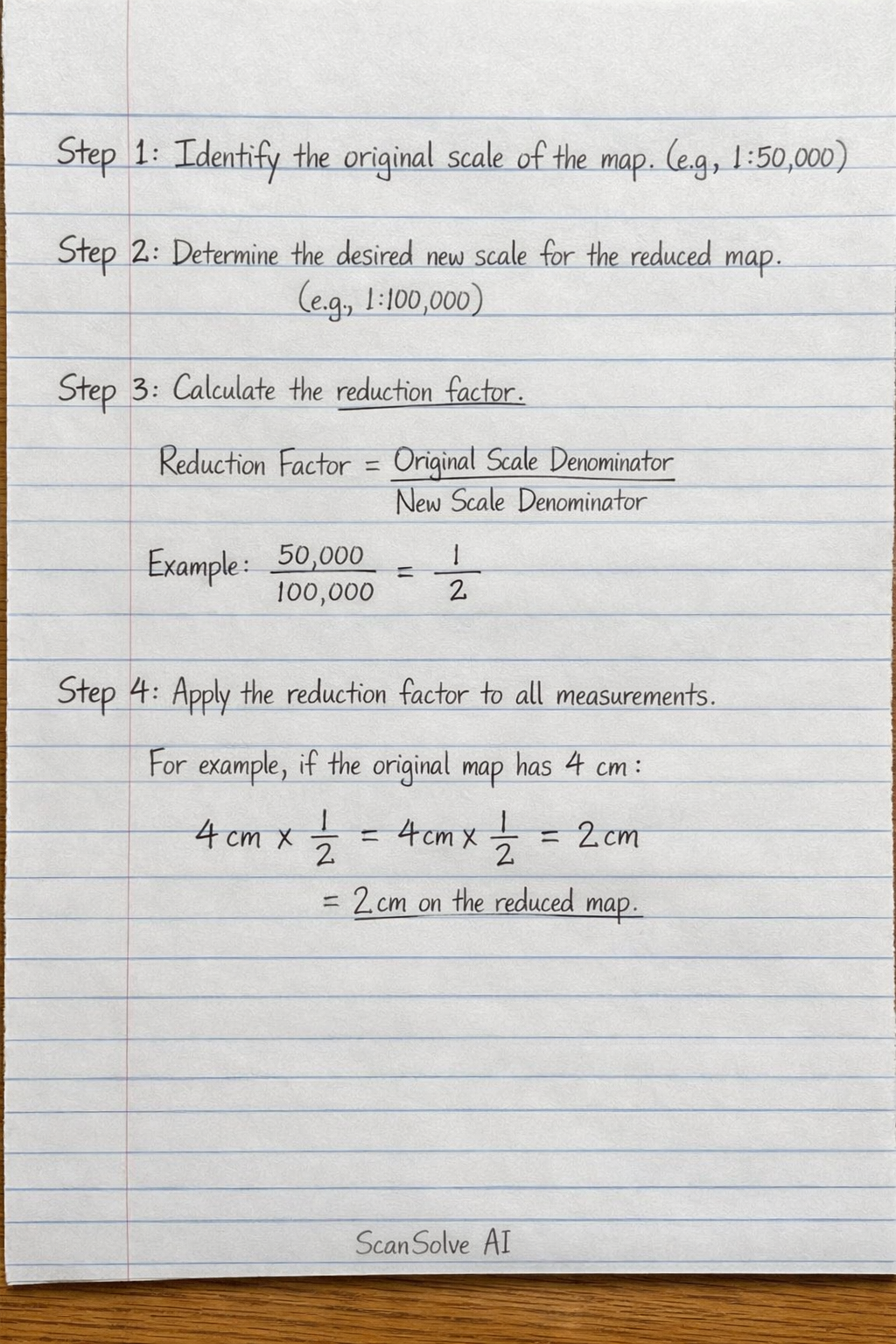
Handwritten Step-by-Step Solution
Get this as a handwritten image on WhatsApp — like a tutor wrote it for you.
Try on WhatsApp