
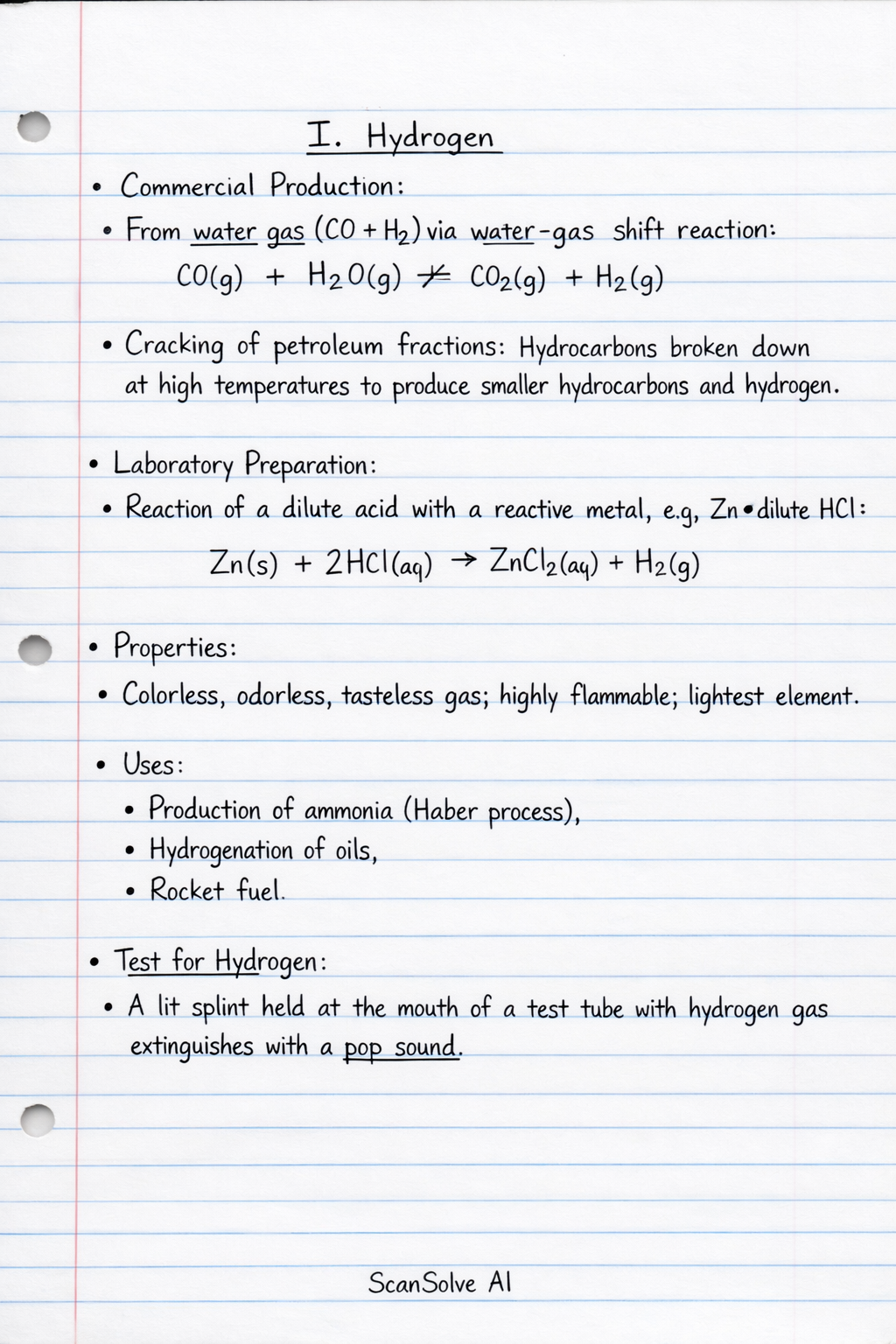
We read your photo as:
Explain the commercial and laboratory preparation, properties, uses, and tests for hydrogen. Also, explain the preparation of chlorine.
Chemistry
ScanSolve AI Answer
Here is an explanation of the topics outlined in your image:
I. Hydrogen
- Commercial Production:
- From water gas (a mixture of and ) via the water-gas shift reaction: .
- Cracking of petroleum fractions: Hydrocarbons are broken down at high temperatures to produce smaller hydrocarbons and hydrogen.
- Laboratory Preparation: Reaction of a dilute acid with a reactive metal, e.g., zinc with dilute hydrochloric acid:
- Properties: Colorless, odorless, tasteless gas; highly flammable; lightest element.
- Uses: Production of ammonia (Haber process), hydrogenation of oils, rocket fuel.
- Test for Hydrogen: A lit splint held at the mouth of a test tube containing hydrogen gas extinguishes with a pop sound.
II. Halogens (Chlorine as a representative element)
- Laboratory Preparation of Chlorine: Oxidation of concentrated hydrochloric acid with manganese(IV) oxide:
- Industrial Preparation of Chlorine: Electrolysis of brine (concentrated sodium chloride solution):
- Properties: Greenish-yellow gas, pungent odor, toxic, strong oxidizing agent.
- Uses: Water sterilization, bleaching agent, manufacture of hydrochloric acid (), plastics (e.g., PVC), and insecticides.
- Hydrogen Chloride and HCl Acid:
- Preparation: Direct combination of hydrogen and chlorine: .
- Properties: Hydrogen chloride is a colorless gas with a pungent odor, highly soluble in water forming hydrochloric acid (a strong acid).
- Test for Chlorides: Add silver nitrate solution to a solution containing chloride ions, followed by dilute nitric acid. A white precipitate of silver chloride () forms, which is soluble in ammonium hydroxide.
III. Oxygen and Sulfur
- i) Oxygen
- Lab Preparation: Decomposition of hydrogen peroxide using manganese(IV) oxide as a catalyst:
- Properties: Colorless, odorless, tasteless gas; sparingly soluble in water; supports combustion but does not burn itself.
- Uses: Respiration, combustion, welding, steel production.
- Oxides:
- Acidic oxides: Non-metal oxides that react with water to form acids or react with bases (e.g., , ).
- Basic oxides: Metal oxides that react with water to form bases or react with acids (e.g., , ).
- Amphoteric oxides: React with both acids and bases (e.g., , ).
- Neutral oxides: Do not react with acids or bases (e.g., , , ).
- Trioxygen (Ozone): An allotrope of oxygen ().
- Importance in the atmosphere: Forms the ozone layer in the stratosphere, which absorbs harmful ultraviolet (UV) radiation from the sun, protecting life on Earth.
- ii) Sulfur
- Uses: Production of sulfuric acid, vulcanization of rubber, fungicides, gunpowder.
- Allotropes: Sulfur exists in several allotropic forms, primarily rhombic sulfur (alpha-sulfur, stable at room temperature) and monoclinic sulfur (beta-sulfur, stable above ). Plastic sulfur is an amorphous form obtained by pouring molten sulfur into cold water.
- Preparation of Allotropes: Rhombic sulfur is prepared by slow evaporation of carbon disulfide solution of sulfur. Monoclinic sulfur is prepared by cooling molten sulfur slowly. Plastic sulfur is prepared by rapidly cooling molten sulfur.
- Properties and Uses of Allotropes: Different allotropes have distinct crystal structures, densities, and melting points. Their uses are generally for the element sulfur itself, as listed above.
IV. Nitrogen
- Lab Preparation: Heating an aqueous solution of ammonium nitrite:
- Production from Liquid Air: Fractional distillation of liquid air. Nitrogen (boiling point ) distills off first, leaving liquid oxygen (boiling point ).
V. Ammonia
- Lab Preparation: Heating an ammonium salt with a strong base, e.g., ammonium chloride with calcium hydroxide:
- Industrial Preparation (Haber Process): Direct combination of nitrogen and hydrogen under high temperature (), high pressure ( atm), and with an iron catalyst:
Was this helpful?
Still stuck on this one?
Ask a follow-up, and the answer starts from this question.
Got a different question?Ask your own question
More Chemistry Questions
QDescribe the preparation, collection, and properties of hydrogen chloride gas.QWrite the balanced chemical equations and explain the preparation, properties, and uses of hydrogen…QComplete the table below by indicating the colour and physical state at room temperature. Also…QIdentify the gas prepared and explain its preparation with a balanced chemical equation…QName three uses of hydrogen gas. Write the equation for the reaction of hydrogen with: (I) sodium…
Handwritten Step-by-Step Solution
Get this as a handwritten image on WhatsApp — like a tutor wrote it for you.
Try on WhatsApp