
We read your photo as:
Compound X has less than 4 carbon atoms. Using the given test results, identify compound X and give its systematic name. Then, give the systematic name for CH3CH(CH3)CH2NH2.
ScanSolve AI Answer
Answers
3 partsStep-by-step solution
10 stepsPart a
The information required to determine the molecular formula of W and suggest its structures is unreadable in the provided image.
Part b
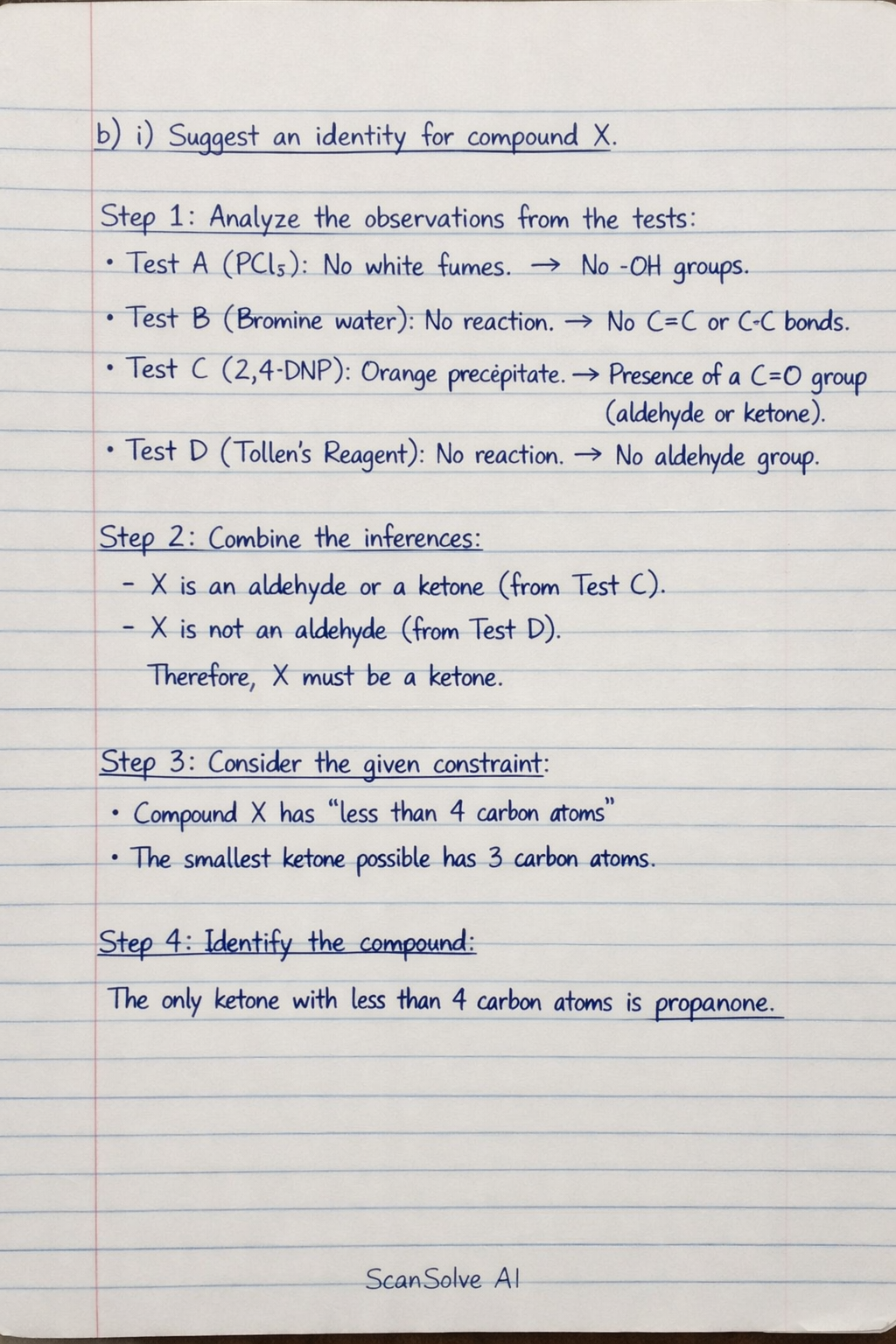
i) Suggest an identity for compound X.
Analyze the observations from the tests.
- Test A (PCl₅): No white fumes. This indicates the absence of -OH groups (alcohols or carboxylic acids).
- Test B (Bromine water): No reaction. This indicates the absence of C=C or C≡C double/triple bonds and phenols.
- Test C (2,4-dinitrophenyl hydrazine): Orange precipitate. This indicates the presence of a carbonyl group (), meaning X is either an aldehyde or a ketone.
- Test D (Tollen's Reagent): No reaction. This indicates the absence of an aldehyde group.
Combine the inferences.
From Test C, X is an aldehyde or a ketone. From Test D, X is not an aldehyde. Therefore, X must be a ketone.
Consider the given constraint.
Compound X has "less than 4 carbon atoms". The smallest ketone possible has 3 carbon atoms.
Identify the compound.
The only ketone with less than 4 carbon atoms is propanone.
The identity of compound X is .
Part c(i)
Give the systematic name for each of the following compounds.
Identify the longest carbon chain containing the amine group.
This is a 3-carbon chain (propane).
Number the chain to give the amine group the lowest possible number.
The amine group is on carbon 1.
Identify substituents.
There is a methyl group on carbon 2.
The systematic name is .
Part c(ii)
Identify the functional group, which is an acyl chloride ().
Identify the longest carbon chain containing the acyl chloride group.
This is a 3-carbon chain.
The parent carboxylic acid would be propanoic acid.
For acyl chlorides, the suffix -oic acid is replaced by -oyl chloride.
The systematic name is .
Part d
State the reagents and reaction conditions for the conversions in the table below.
| Reaction | Reagent
Try one yourself
A new problem that tests the same skill.
Still stuck on this one?
Ask a follow-up, and the answer starts from this question.
More Chemistry Questions
Handwritten Step-by-Step Solution
Get this as a handwritten image on WhatsApp — like a tutor wrote it for you.
Try on WhatsApp