
We read your photo as:
Copper forms the hydrated complex, [ extCu( extH2 extO)6]2+. (i) Give the name of the complex ion and draw its shape. (ii) Give the formula of the complex ion formed when a solution of EDTA is added t
ScanSolve AI Answer
Here are the solutions to the questions:
4. (b) Copper forms the hydrated complex,
-
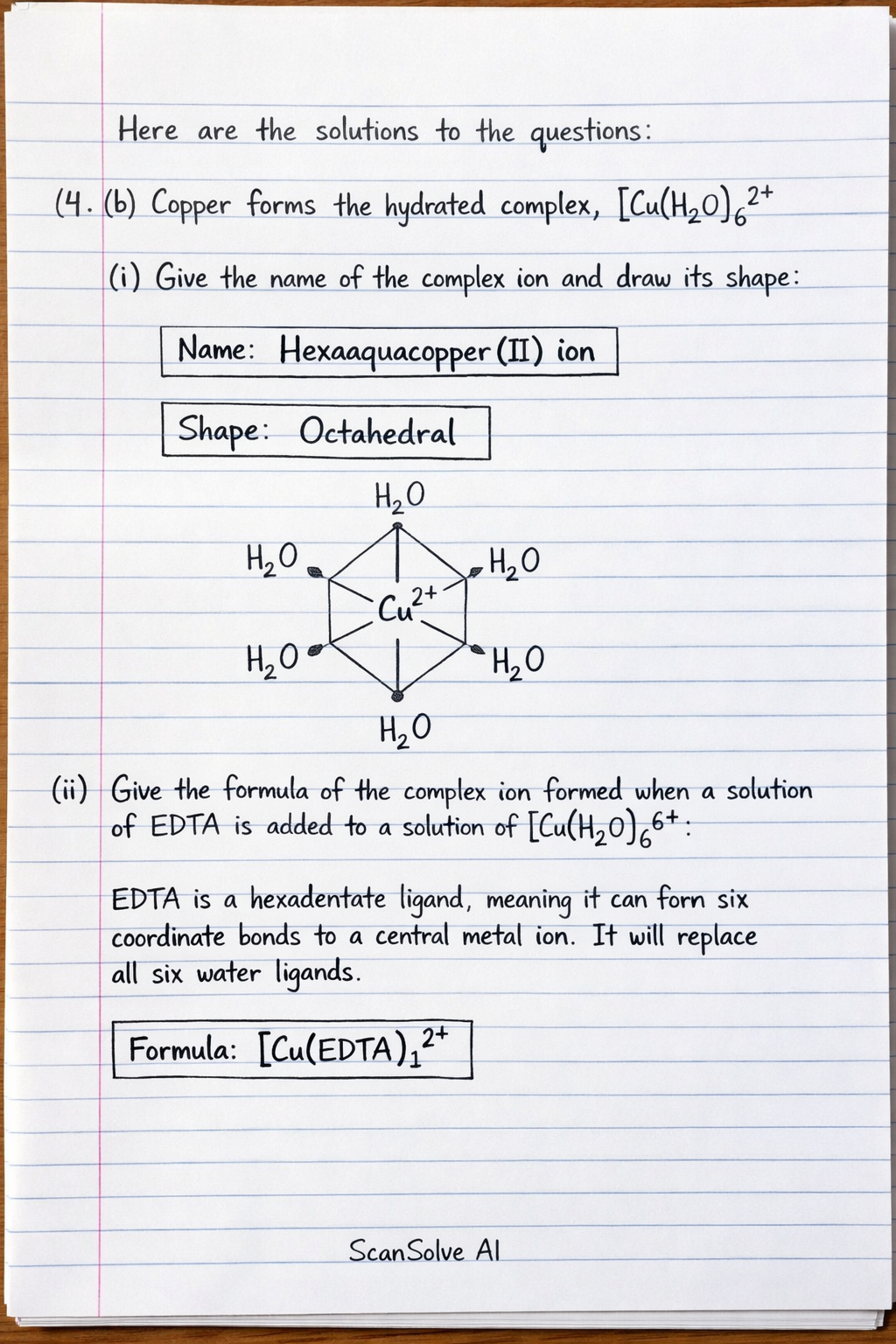
(i) Give the name of the complex ion and draw its shape:
- Name:
- Shape: (A drawing would show a central Cu atom with six ligands arranged at the vertices of an octahedron, with the overall charge outside square brackets.)
-
(ii) Give the formula of the complex ion formed when a solution of EDTA is added to a solution of EDTA is a hexadentate ligand, meaning it can form six coordinate bonds to a central metal ion. It will replace all six water ligands.
- Formula:
-
(iii) Using the s p d notation, write the electronic configuration of copper in the complex ion. In the complex ion , copper is in the +2 oxidation state ().
- Atomic number of Copper (Cu) is 29.
- Electronic configuration of neutral Cu: .
- To form , two electrons are removed: first from the orbital, then from the orbital.
- Electronic configuration of :
4. (c) Carbon, silicon, germanium, tin and lead are elements of Group IV (14) of the Periodic Table.
-
(i) State the variation in structure of the elements carbon to lead. The elements of Group IV show a transition from giant covalent structures to giant metallic structures down the group. Carbon (diamond/graphite), silicon, and germanium have giant covalent structures. Tin and lead have giant metallic structures.
-
(ii) Give the name or formula of a chloride of Group IV element that is
-
A: covalent and decomposes readily at room temperature and pressure (r.t.p.).
- Name:
- Formula: (Lead(IV) chloride is covalent but thermally unstable and decomposes readily at room temperature to and .)
-
B: strongly reducing.
-
Still stuck on this one?
Ask a follow-up, and the answer starts from this question.
More Chemistry Questions
Handwritten Step-by-Step Solution
Get this as a handwritten image on WhatsApp — like a tutor wrote it for you.
Try on WhatsApp