
We read your photo as:
Name the complex ion [Co(NH3)6]3+ and determine the oxidation and coordination numbers of cobalt.
ScanSolve AI Answer
Step-by-step solution
5 stepsa) (i)
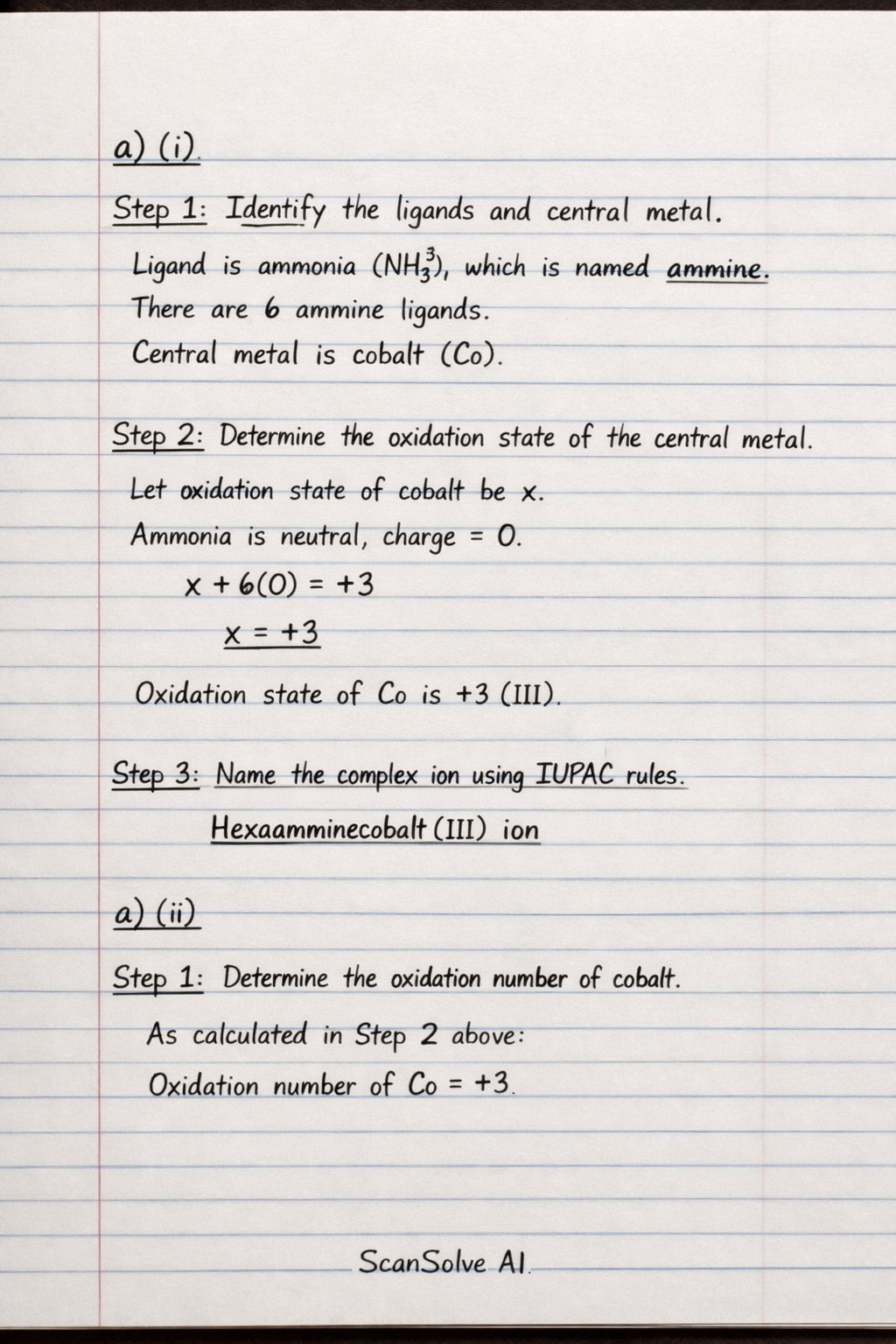
Identify the ligands and central metal.
The ligand is ammonia (), which is named ammine in coordination compounds. There are 6 ammine ligands. The central metal is cobalt (Co).
Determine the oxidation state of the central metal.
Let the oxidation state of cobalt be . The ammonia ligand is neutral, so its charge is 0. The overall charge of the complex ion is .
The oxidation state of cobalt is +3, denoted as (III).
Name the complex ion using IUPAC rules.
The name starts with the number and name of the ligand, followed by the metal name and its oxidation state in Roman numerals, and finally "ion" because it's a charged species.
The name is hexaamminecobalt(III) ion.a) (ii)
Determine the oxidation number of cobalt.
As calculated in Step 2 above, the oxidation number of cobalt is +3.
Determine the coordination number of cobalt.
The coordination number is the number of ligand atoms directly bonded to the central metal ion. In , there are 6 ligands, and each is a monodentate ligand.
Therefore, the coordination number is 6.a) (i) Name the complex ion:
a) (ii)
Oxidation number:
Coordination number:
Still stuck on this one?
Ask a follow-up, and the answer starts from this question.
More Chemistry Questions
Handwritten Step-by-Step Solution
Get this as a handwritten image on WhatsApp — like a tutor wrote it for you.
Try on WhatsApp