
We read your photo as:
Explain the concepts of complex ions and isomerism. Illustrate the geometric isomerism of the complex [Co(NH3)4(H2O)2]3+ and determine the electron configurations of Sc3+ and Mn2+.
ScanSolve AI Answer
Answers
2 partsStep-by-step solution
4 stepsHere are the solutions to the chemistry questions:
Part b(i)
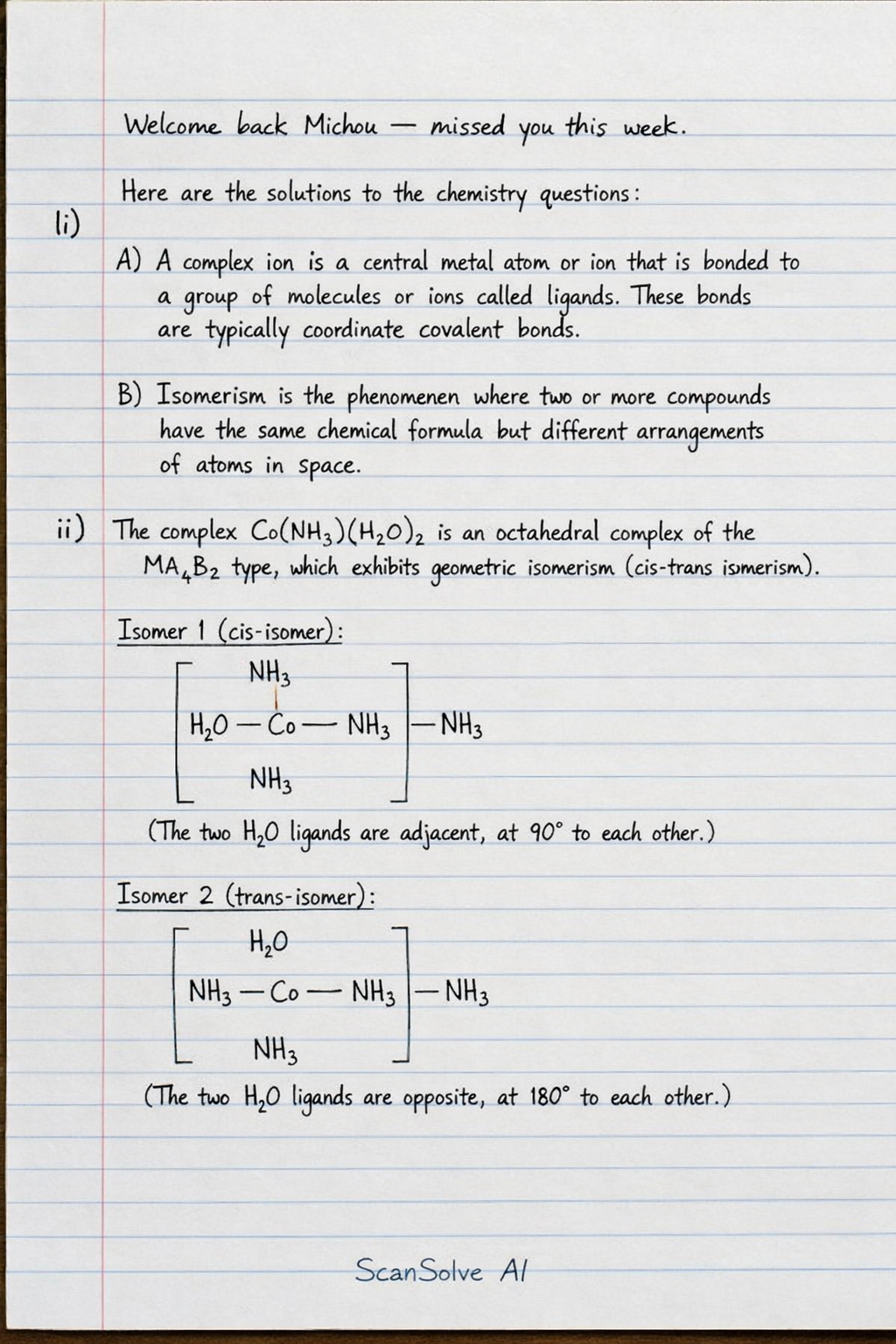
A) A complex ion is a central metal atom or ion that is bonded to a group of molecules or ions called ligands. These bonds are typically coordinate covalent bonds.
B) Isomerism is the phenomenon where two or more compounds have the same chemical formula but different arrangements of atoms in space.
Part b(ii)
The complex is an octahedral complex of the type, which exhibits geometric isomerism (cis-trans isomerism).
(The two ligands are adjacent, at 90° to each other.)
(The two ligands are opposite, at 180° to each other.)
Part b(iii)
Determine the atomic number and ground state electron configuration for each element.
- (atomic number 21):
- (atomic number 25):
Write the electron configuration for the given ions by removing electrons from the highest energy level first.
- For : Three electrons are removed (two from and one from ). The electronic configuration is .
- For : Two electrons are removed from the orbital. The electronic configuration is .
Part b(iv)
Identify the d-electron configuration for each ion.
- has a configuration.
- has a configuration.
Explain the relationship between d-electrons and colour.
Ions of transition metals are coloured if they have partially filled d-orbitals, allowing for d-d electronic transitions when visible light is absorbed.
has no d-electrons (), so no d-d transitions are possible. Therefore, is not coloured. has a partially filled d-orbital (), so it is coloured.
Part e
The Contact Process for the production of sulfuric acid
Stage 1: Production of sulfur dioxide.
Stage 2: Oxidation of sulfur dioxide to sulfur trioxide.
Stage 3: Absorption of sulfur trioxide and formation of sulfuric acid.
Try one yourself
A new problem that tests the same skill.
Still stuck on this one?
Ask a follow-up, and the answer starts from this question.
More Chemistry Questions
Handwritten Step-by-Step Solution
Get this as a handwritten image on WhatsApp — like a tutor wrote it for you.
Try on WhatsApp