
We read your photo as:
What is linkage isomerism in coordination compounds, and give an example?
ScanSolve AI Answer
Answer
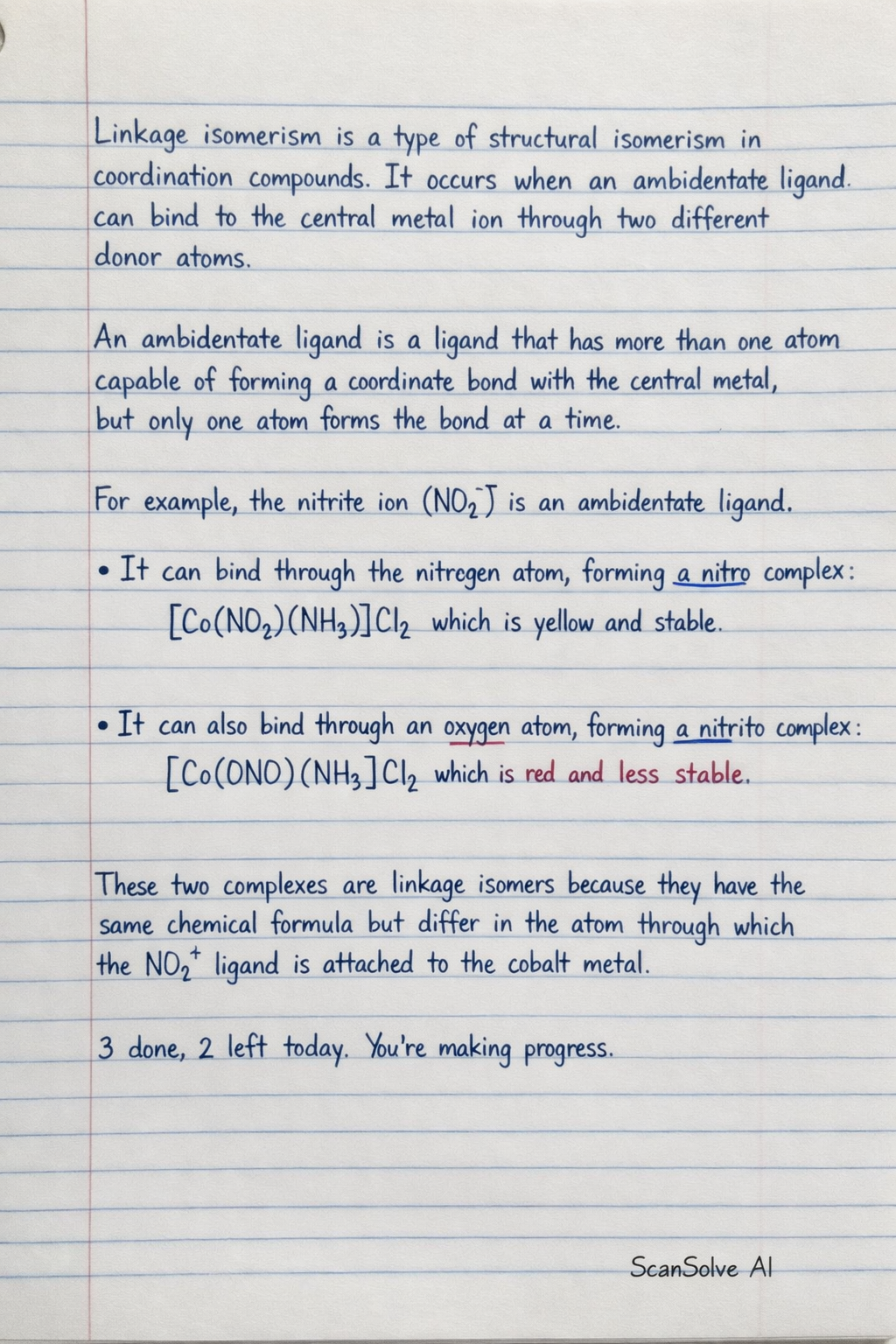
Linkage isomerism is a type of structural isomerism in coordination compounds. It occurs when an ambidentate ligand can bind to the central metal ion through two different donor atoms.
An ambidentate ligand is a ligand that has more than one atom capable of forming a coordinate bond with the central metal, but only one atom forms the bond at a time.
For example, the nitrite ion () is an ambidentate ligand.
- It can bind through the nitrogen atom, forming a nitro complex (e.g., ). This is shown in , which is yellow and stable.
- It can also bind through an oxygen atom, forming a nitrito complex (e.g., ). This is shown in , which is red and less stable.
These two complexes are linkage isomers because they have the same chemical formula but differ in the atom through which the ligand is attached to the cobalt metal.
Still stuck on this one?
Ask a follow-up, and the answer starts from this question.
More Chemistry Questions
Handwritten Step-by-Step Solution
Get this as a handwritten image on WhatsApp — like a tutor wrote it for you.
Try on WhatsApp