
We read your photo as:
What is the IUPAC name for the complex ion [Co(NH3)6]3+ and what are its oxidation and coordination numbers?
ScanSolve AI Answer
Step-by-step solution
9 stepsDany, let's break down the explanation for the complex ion .
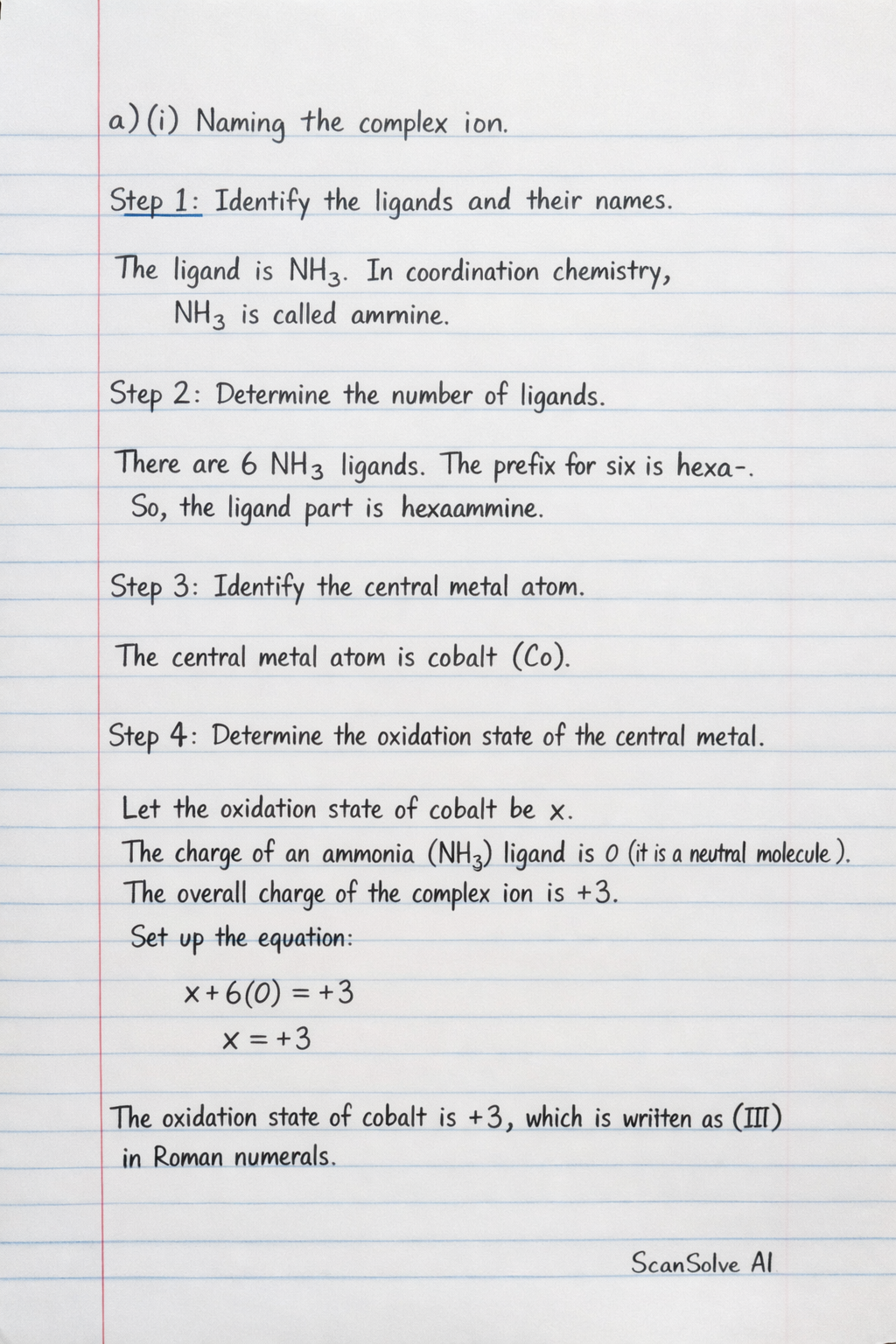
a) (i) Naming the complex ion
Identify the ligands and their names.
The ligand is . In coordination chemistry, is called ammine.
Determine the number of ligands.
There are 6 ligands. The prefix for six is hexa-. So, the ligand part is hexaammine.
Identify the central metal atom.
The central metal atom is cobalt (Co).
Determine the oxidation state of the central metal.
Let the oxidation state of cobalt be .
The charge of an ammonia () ligand is 0 (it is a neutral molecule).
The overall charge of the complex ion is .
Set up the equation:The oxidation state of cobalt is +3, which is written as (III) in Roman numerals.
Combine the parts according to IUPAC rules.
For a cationic complex (positively charged), the name of the ligand(s) comes first, followed by the name of the central metal, and then its oxidation state in Roman numerals in parentheses. Since it's an ion, "ion" is added at the end.
Ligand name + Metal name(Oxidation state) + ion
hexaammine + cobalt + (III) + ionThe name of the complex ion is:
a) (ii) Determining the oxidation number and coordination number
Oxidation Number:
The oxidation number (or oxidation state) of the central metal ion represents the charge it would have if all ligands were removed along with their electron pairs.Assign known charges to ligands and the overall complex.
The ligand is neutral, so its charge is 0.
The overall charge of the complex ion is .Calculate the oxidation number of the central metal (Co).
Let the oxidation number of Co be .
The sum of the oxidation numbers of the central metal and all ligands must equal the overall charge of the complex ion.The oxidation number of cobalt is +3.
Coordination Number:
The coordination number is the total number of donor atoms from the ligands that are directly bonded to the central metal ion.Identify the ligands and their denticity.
The ligand is . Ammonia is a monodentate ligand, meaning it forms one coordinate bond to the central metal ion through its nitrogen atom.
Count the number of ligands and multiply by their denticity.
There are 6 ligands.
Since each ligand is monodentate (denticity = 1), the coordination number is:The coordination number of cobalt is 6.
Oxidation number:
Coordination number:
Still stuck on this one?
Ask a follow-up, and the answer starts from this question.
More Chemistry Questions
Handwritten Step-by-Step Solution
Get this as a handwritten image on WhatsApp — like a tutor wrote it for you.
Try on WhatsApp