
We read your photo as:
What is the coordination number of [Fe(CN)6]4-?
ScanSolve AI Answer
Answer
6
Step-by-step solution
10 stepsHere are the answers to your questions:
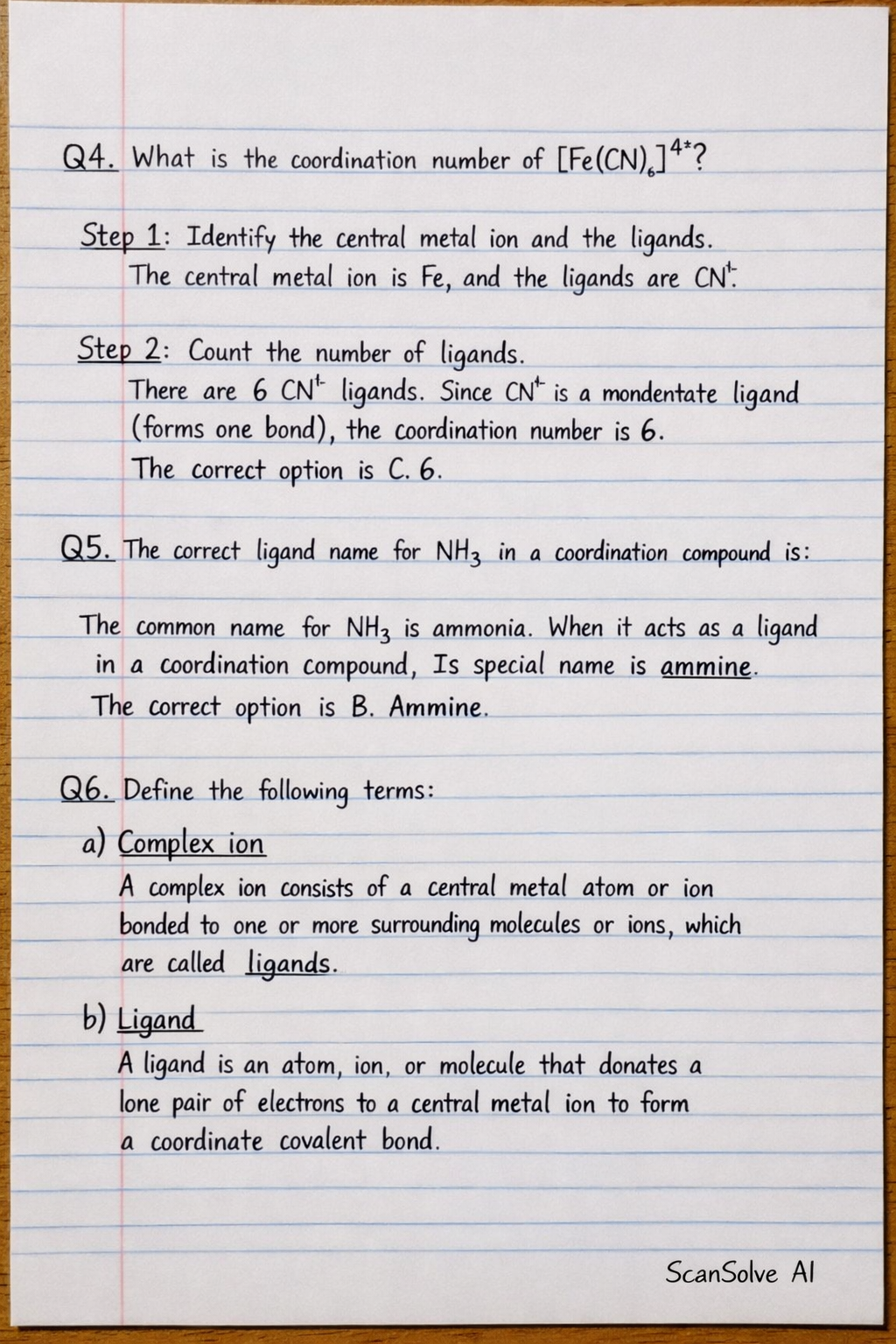
Q4. What is the coordination number of [Fe(CN)]?
Identify the central metal ion and the ligands.
The central metal ion is Fe, and the ligands are CN.
Count the number of ligands.
There are 6 CN ligands. Since CN is a monodentate ligand (forms one bond), the coordination number is 6.
The correct option is C. 6.Q5. The correct ligand name for NH in a coordination compound is:
The common name for NH is ammonia. When it acts as a ligand in a coordination compound, its special name is ammine.
The correct option is B. Ammine.Q6. Define the following terms:
a) Complex ion
A complex ion consists of a central metal atom or ion bonded to one or more surrounding molecules or ions, which are called ligands.b) Ligand
A ligand is an atom, ion, or molecule that donates a lone pair of electrons to a central metal ion to form a coordinate covalent bond.c) Coordination number
The coordination number is the total number of coordinate bonds formed between the central metal ion and its ligands.Q7. Study the formula of the complex ion, [Co(NH)Cl]
a) Draw the structure of the complex ion given above.
Identify the central metal and ligands.
The central metal is Co. There are four ammine () ligands and two chloro () ligands.
Determine the coordination number and geometry.
The coordination number is . A coordination number of 6 corresponds to an octahedral geometry.
Draw the octahedral structure.
The structure can exist as cis or trans isomers. Below is an example of the trans isomer.
(Note: This is a simplified representation. In a full 3D drawing, the bonds would be shown with wedges and dashes to indicate spatial arrangement.)
b) Name the complex ion using correct coordination nomenclature.
Determine the oxidation state of the central metal.
Let the oxidation state of Co be . is neutral (0 charge), and has a -1 charge. The overall charge is -1.
So, the central metal is Cobalt(I).
Name the ligands alphabetically and the central metal.
Ligands: tetraammine (for 4 ) and dichloro (for 2 ). Ammine comes before chloro alphabetically.
Since the complex ion has a negative charge, the suffix "-ate" is added to the metal name: cobaltate.Combine the parts.
The name is tetraamminedichlorocobaltate(I) ion.
Q8. Study the coordination compound below.
The compound is .a) Identify the counter ion.
Identify the complex ion and its charge.
The complex ion is , which has a charge of -4.
Identify the ion outside the brackets that balances this charge.
To balance the -4 charge of the complex ion, there must be 4 positive charges. These come from potassium ions.
The counter ion is K.
Try one yourself
A new problem that tests the same skill.
Still stuck on this one?
Ask a follow-up, and the answer starts from this question.
More Chemistry Questions
Handwritten Step-by-Step Solution
Get this as a handwritten image on WhatsApp — like a tutor wrote it for you.
Try on WhatsApp