
We read your photo as:
Copper (II) Sulphate reacts with Barium Chloride. Given the reaction details, calculate the temperature change of the solution.
ScanSolve AI Answer
Answer
Step-by-step solution
5 stepsHere's how to calculate the temperature change:
Question 7:
Copper (II) Sulphate reacts with Barium Chloride according to the equation:
Volume of
Volume of
Heat capacity of solution
Density of solution
Calculate the moles of each reactant.
Convert volumes from to :
Moles of :
Moles of :
Determine the limiting reactant.
From the balanced equation, and react in a molar ratio.
Since of is less than of , is the limiting reactant.
Therefore, of reaction occurs.Calculate the total heat released ().
The enthalpy change for the reaction is .
Convert to Joules:
Calculate the total mass of the solution.
Total volume of solution:
Mass of solution:
Calculate the temperature change ().
Use the formula :
Rounding to three significant figures:
The temperature change is .
Try one yourself
A new problem that tests the same skill.
Still stuck on this one?
Ask a follow-up, and the answer starts from this question.
More Chemistry Questions
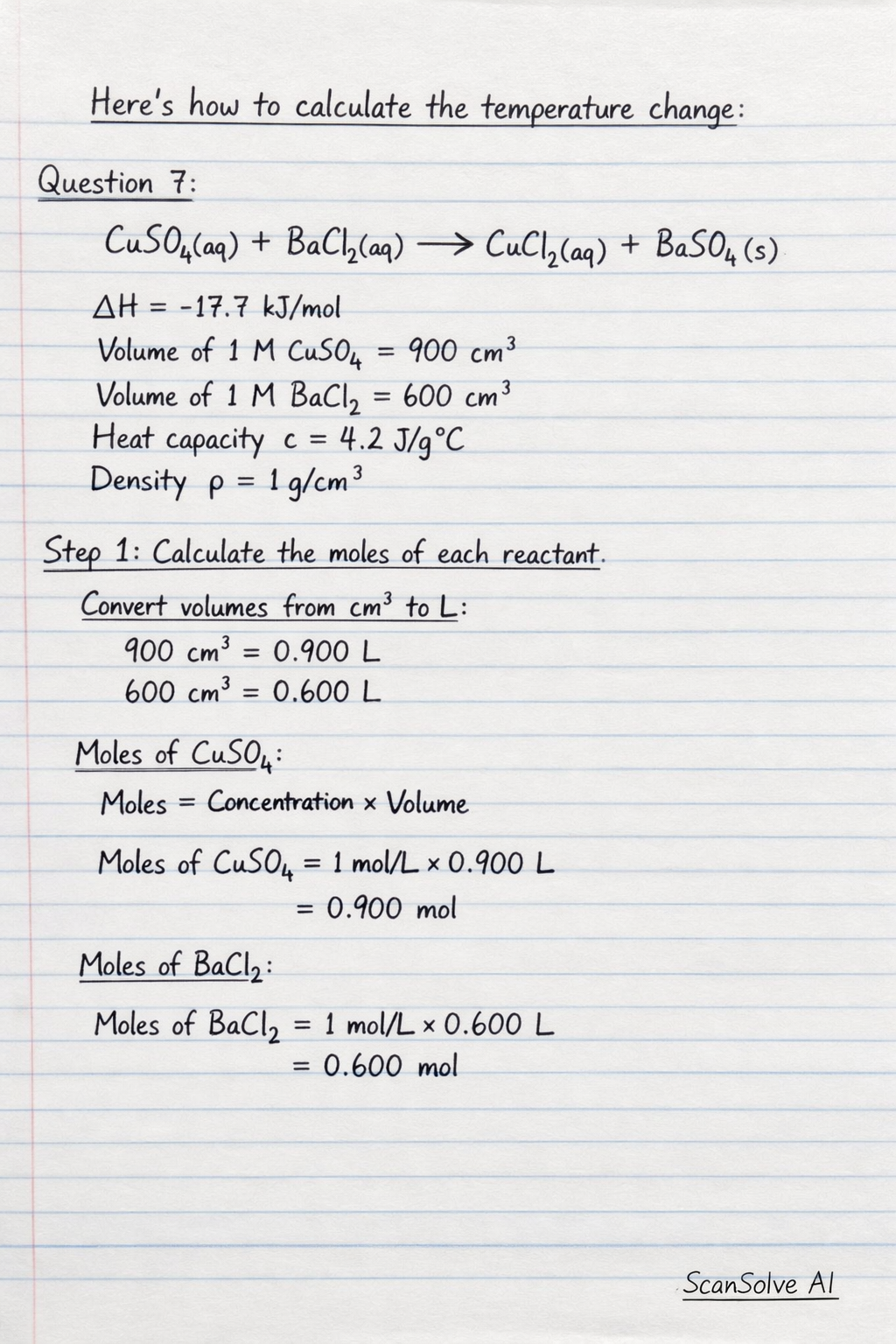
Handwritten Step-by-Step Solution
Get this as a handwritten image on WhatsApp — like a tutor wrote it for you.
Try on WhatsApp