
We read your photo as:
Write the observations and the equation of the reactions which occur when concentrated sulphuric (VI) acid reacts with each of the following: b) Copper (II) sulphate crystals c) Copper metal followed
ScanSolve AI Answer
Step-by-step solution
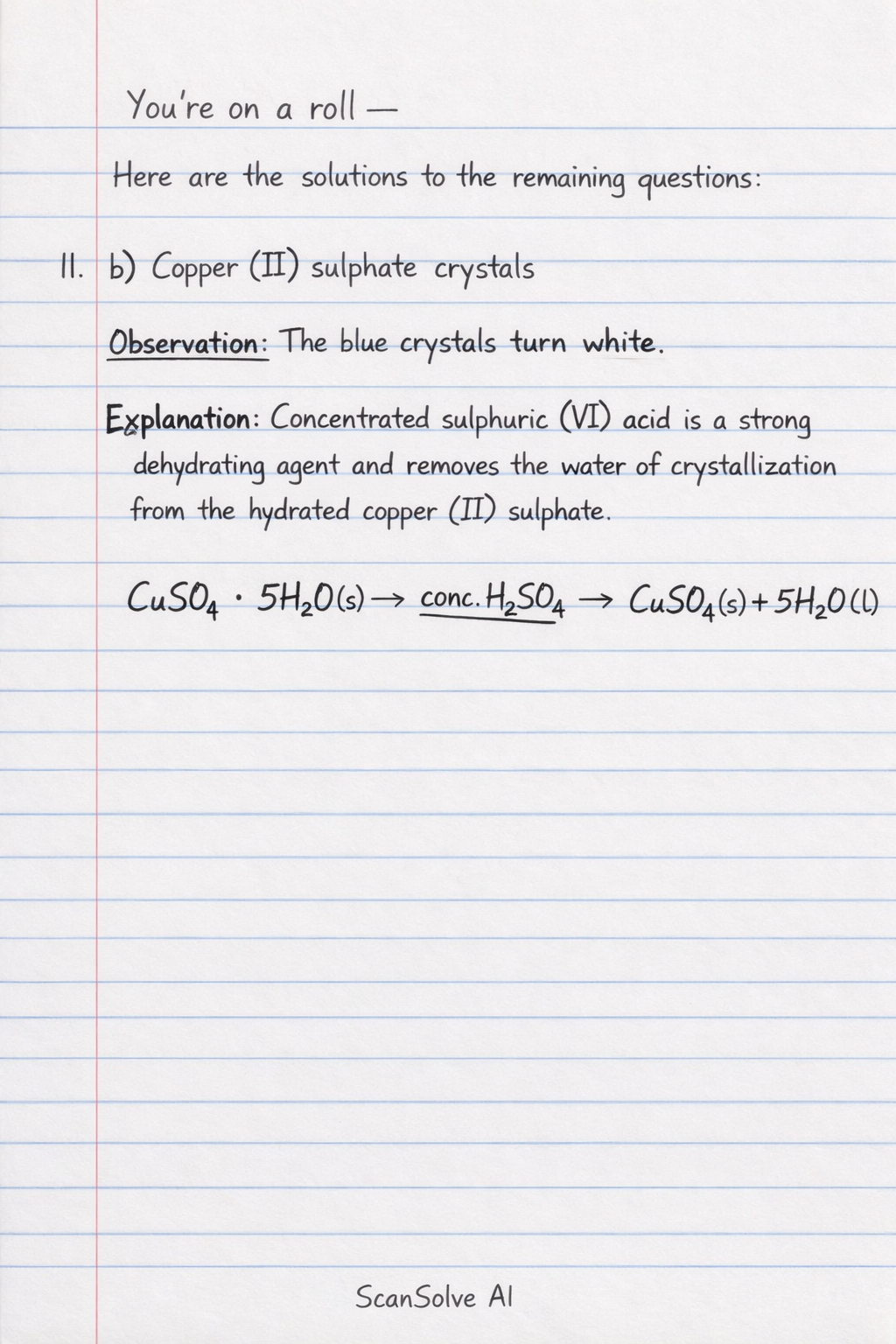
9 stepsHere are the solutions to the remaining questions:
-
Write the observations and the equation of the reactions which occur when concentrated sulphuric (VI) acid reacts with each of the following: b) Copper (II) sulphate crystals Observation: The blue crystals turn white. Explanation: Concentrated sulphuric (VI) acid is a strong dehydrating agent and removes the water of crystallization from the hydrated copper (II) sulphate. Equation:
c) Copper metal followed by Potassium Manganate (VII) solution
- Reaction with Copper metal: Observation: The copper metal dissolves, forming a blue solution. A colorless gas with a pungent smell is evolved. Equation:
- Reaction of the gas with Potassium Manganate (VII) solution: Observation: The purple potassium manganate (VII) solution is decolorized (turns colorless). Equation:
d) Potassium Nitrate
Observation: Colorless fumes (of nitric acid) are produced.
Equation: -
a) State Charles' Law. Charles' Law states that for a fixed mass of gas at a constant pressure, the volume is directly proportional to its absolute temperature.
b) A gas occupies at . What volume would the gas occupy at , if its pressure remains constant?
Convert temperatures to Kelvin.
$$ T_1 = 27^\circ\text{C} + 273 = 300\text{ K} $$ $$ T_2 = 177^\circ\text{C} + 273 = 450\text{ K} $$Apply Charles' Law, .
$$ V_2 = \frac{V_1 T_2}{T_1} $$ $$ V_2 = \frac{450\text{ cm}^3 \times 450\text{ K}}{300\text{ K}} $$ $$ V_2 = \frac{202500}{300}\text{ cm}^3 $$ $$ V_2 = 675\text{ cm}^3 $$ The new volume would be $\boxed{\text{675 cm}^3}$. c) At a temperature of $57^\circ\text{C}$, Nitrogen gas occupies a volume of $750\text{cm}^3$. At what temperature, in degrees Celsius, will the gas occupy $100\text{ cm}^3$?Convert initial temperature to Kelvin.
$$ T_1 = 57^\circ\text{C} + 273 = 330\text{ K} $$Apply Charles' Law, .
$$ T_2 = \frac{V_2 T_1}{V_1} $$ $$ T_2 = \frac{100\text{ cm}^3 \times 330\text{ K}}{750\text{ cm}^3} $$ $$ T_2 = \frac{33000}{750}\text{ K} $$ $$ T_2 = 44\text{ K} $$Convert the final temperature back to degrees Celsius.
$$ T_2(\text{in }^\circ\text{C}) = 44\text{ K} - 273 = -229^\circ\text{C} $$ The gas will occupy $100\text{ cm}^3$ at $\boxed{\text{-229}^\circ\text{C}}$.13. a) State Graham's Law of Diffusion. Graham's Law of Diffusion states that the rate of diffusion of a gas is inversely proportional to the square root of its molar mass (or density) at constant temperature and pressure.
b) It takes 20 seconds for $200\text{cm}^3$ of Oxygen gas to diffuse across a porous plug. How long will it take an equal volume of Sulphur (IV) oxide to diffuse across the same plug? (S = 32.0, O = 16.0)Calculate the molar masses of Oxygen () and Sulphur (IV) oxide ().
$$ M_{\text{O}_2} = 2 \times 16.0 = 32.0\text{ g/mol} $$ $$ M_{\text{SO}_2} = 32.0 + (2 \times 16.0) = 32.0 + 32.0 = 64.0\text{ g/mol} $$Apply Graham's Law of Diffusion.
For equal volumes, the ratio of times is directly proportional to the square root of the ratio of molar masses.
Substitute the given values.
$$ \frac{20\text{ s}}{\text{Time}_{\text{SO}_2}} = \sqrt{\frac{32.0\text{ g/mol}}{64.0\text{ g/mol}}} $$ $$ \frac{20\text{ s}}{\text{Time}_{\text{SO}_2}} = \sqrt{0.5} $$ $$ \frac{20\text{ s}}{\text{Time}_{\text{SO}_2}} \approx 0.7071 $$Solve for .
$$
\text{Time}_{\text{SO}_2} = \frac{20\text{ s}}{0.7071}
$$
$$
\text{Time}_{\text{SO}_2} \approx 28.28\text{ s}
$$
It will take approximately $\boxed{\text{28.28 s}}$ for Sulphur (IV) oxide to diffuse.
Still stuck on this one?
Ask a follow-up, and the answer starts from this question.
More Chemistry Questions
Handwritten Step-by-Step Solution
Get this as a handwritten image on WhatsApp — like a tutor wrote it for you.
Try on WhatsApp